
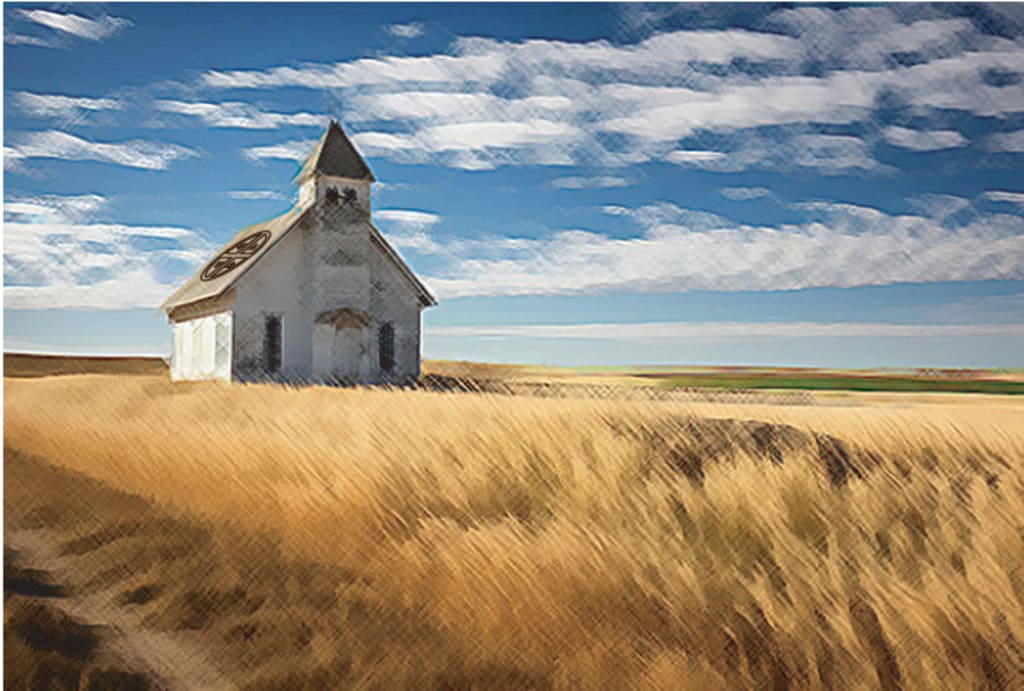
In the middle of a barren, dirt field surrounded by dying weeds sits an old, wooden church. It had a name once but it's been long since forgotten. The sign blew away during the great dust storms of ’38, and no one saw fit to replace it. Nowadays people around town just refer to it as God’s House. Its exterior is as dry and weathered as the surrounding flatlands. No cross hangs over the battered front door. No stained glass, or glass of any kind for that matter, glistens in its slender windows. They are heavily shuttered against the Kansas winds. The bell tower has no spire. It is merely a squat chimney perched ominously over the entrance. The bell within it is small and rusty and only rings when a twister comes knocking. Its sole occupant is only slightly younger than that church itself and he tends to it as well as any man of ninety-four years can manage. He is the Right Reverend Hyram Pinker and he is the oldest man in town.
God’s House was the first structure built in these parts and sits atop a very low rise overlooking the entire plain. Eventually, the settlers built their farmhouses, but only after God had a place to call home. These were followed by a grocer, a hardware store, and a dry goods establishment and thus the town of Pritchard, Kansas came to be. It grew from a small commune of about twenty families to a proper town of about thirty-five hundred people in its heyday. Wheat and corn grew in abundance and farms were profitable. So profitable that a gas station was eventually built to supply the new-fangled, motorized machinery that had become a necessity of such large scale farms. As the population peaked, a couple of diners were erected but only one sold liquor. The one distinct difference it had from just about anywhere else in the country was that no government building or town hall had been built. The local leadership consisted of the most prosperous residents and they found God’s House plenty large enough to administer to the community’s needs. Thus, Pritchard managed to stay off of the country’s radar for a very long time, at least until the drought and dust storms of the Great Depression decimated the Plains States and Pritchard along with them.
The Depression eventually ended, the dust storms resumed their normal, seasonal patterns, and Pritchard began to heal. A new school was built, along with a drug store and a movie theater. The town even managed to lure both a veterinarian and a doctor to take up residence. Federal subsidies had pulled the farmers out of destitution, but they also forced the government to officially recognize the existence of Pritchard. Hence the only official Federal building ever built in the town; a post office, came to be.
Time passed, wars came and went, and new Presidents were elected. The dust storms took no heed of events in the outside world, but such was life on the Kansas Plains. Plainsmen are hardy people, used to roughing it through tough times. The town had faith that the Lord would provide and Hyram Pinker kept that faith well-tended. Unfortunately, time is also a relentless, lumbering thing. That which does not keep up with it is easily forgotten. Pritchard was no exception. The only progress the town ever made happened because it simply had no choice. It existed in a state of progressive apathy disturbed only by time’s relentless march. Electricity was brought in only because there was no longer an available supply of gas lamps and fuel, having become obsolete a decade earlier. Color T.V.s and flat screens only appeared when black and white tubes ceased to be manufactured. And like all other progress, the internet only grazed them once the Department of Agriculture stopped accepting subsidy requests and reports unless they were filed online. Time marched on dragging Pritchard behind it like a blind, legless cripple perched on a dolly, sulking and insolent.
For all its stagnancy, Pritchard wasn’t considered a pariah. Its people were kind and generous and its family values secure and consistent. There were no murders to speak of in the town’s history, and crime never went above the petty theft level. The Sheriff was a farmer in his own right, and law enforcement was more of a hobby. Children were born, grew up, got married, had kids of their own, and family farms were handed down through generations.
Despite this wholesome image of Americana, Pritchard still generated its share of gossip amongst its distant neighbors. The most common subject was the fact that the entire population of thirty-five hundred had inter-married over the last hundred years, which was largely true. Enough people lived there for this not to present any sort of breeding issue but folks talked about it anyway since the only people who lived in Pritchard were born in Pritchard. The second most common subject was the women of Pritchard. After the dust storms and drought returned in 2008 and stayed put for a couple of years, the young folk started leaving. Endless crop failures led to continuing boredom and their young men migrated to other places to find work. They all swore to come home when things changed but those who got out never did. That left a very minuscule population of men to tend to a very robust population of bored, young women. As such, the neighboring towns took delight in warning travelers about those “Pritchard Girls.” Once you let ‘em in, they stuck like a burr on a saddle blanket and nothing short of dynamite would get ‘em off ya! Again, this was largely true as any unsuspecting, unaccompanied male traveler of any age, be he a one-armed, wall-eyed, paraplegic, was fair game if his destination was anywhere near Pritchard.
By the time 2010 rolled in, poor Reverend Pinker had his hands full between shotgun weddings to out-of-towners and marathon confessionals. It was no surprise that he suffered a small stroke one afternoon as Hattie Wheaton detailed her Saturday night transgressions in the bathroom of the filler-up. But old Hyram wasn’t ready to leave his flock just yet. A week later, he was back at the pulpit of his washed-out church turning out three sermons a day and preaching on the evils of sin. That summer also saw half the country searching for some missing, drugged-out heiress and her friends which Hyram used with great flair to educate his younger parishioners on the wages of sin. The first rains in a year also came to Pritchard that summer. They were hard and fast and cleared the sky of dust and debris. But two years of drought had left the land hardscrabble and unyielding. By the time the flooding had ceased, Pritchard sat in a mudflow and the first signs of decay appeared. During the worst of it, Reverend Pinker had been trapped in his clapboard church and the bell tower gave way. The townspeople rescued him, and he spent the following month recuperating in a facility in nearby Holcomb. He had his second mild stroke two days after his admittance. In the week that followed, he dreamed of faces he’d never seen. He heard a language he’d never heard before and all around him, the dead would speak.
A month later, Hyram Pinker returned to Pritchard. The flooding had subsided and the mud generated some minuscule signs of rebirth in the soil. The church tower had been rebuilt, the rusty, old bell was once again hanging from its headstock, and Hyram gave a tearful thanks to the town for saving God’s House. With the church back in business and the land growing once again, things looked bright for the people of Pritchard. The town proper was restored and farms were producing in record numbers but beneath the façade of renewal, an errant thread of decay had come loose. When 2017 rolled in, Pritchard was once again solvent and stable but the thread continued to unravel. Like its pious patriarch, an old man dressed in his Sunday best to distract from the odor of rot that his body now emitted. Pritchard suffered down deep inside.
It was seven years to the day since the old church collapsed that the Right Reverend Hyram Pinker gave his final sermon. He led the congregation in a round of hymns and thanks for the bountiful harvest of the previous spring when he suddenly froze. Standing at the podium clutching its sides, he looked out over his flock and bellowed “The war of souls is coming. Beware the stealer of souls. Follow not the angel’s face because it lies. Fear the one lost in time for he shall destroy God!” And then he collapsed. Hyram Pinker died of a massive heart attack at the age of ninety-four in a clapboard church with no name in a flyspeck town so insignificant that no road map ever bothered to mention it.
About the Creator
Rage
Content Warning: Domestic Violence, Assault Rage D. A. Ratliff “Who did this?” My voice echoed through the house. All I wanted was a cup of tea, but one of the twins, running through the house like maniacs, knocked it over. My nerves tingled, and every muscle in my body felt coiled like a spring. Survival seemed out of reach.
By D. A. Ratliff6 days ago in Fiction




Comments
There are no comments for this story
Be the first to respond and start the conversation.