
The Postman Who Delivered to Heaven
a solemn connection

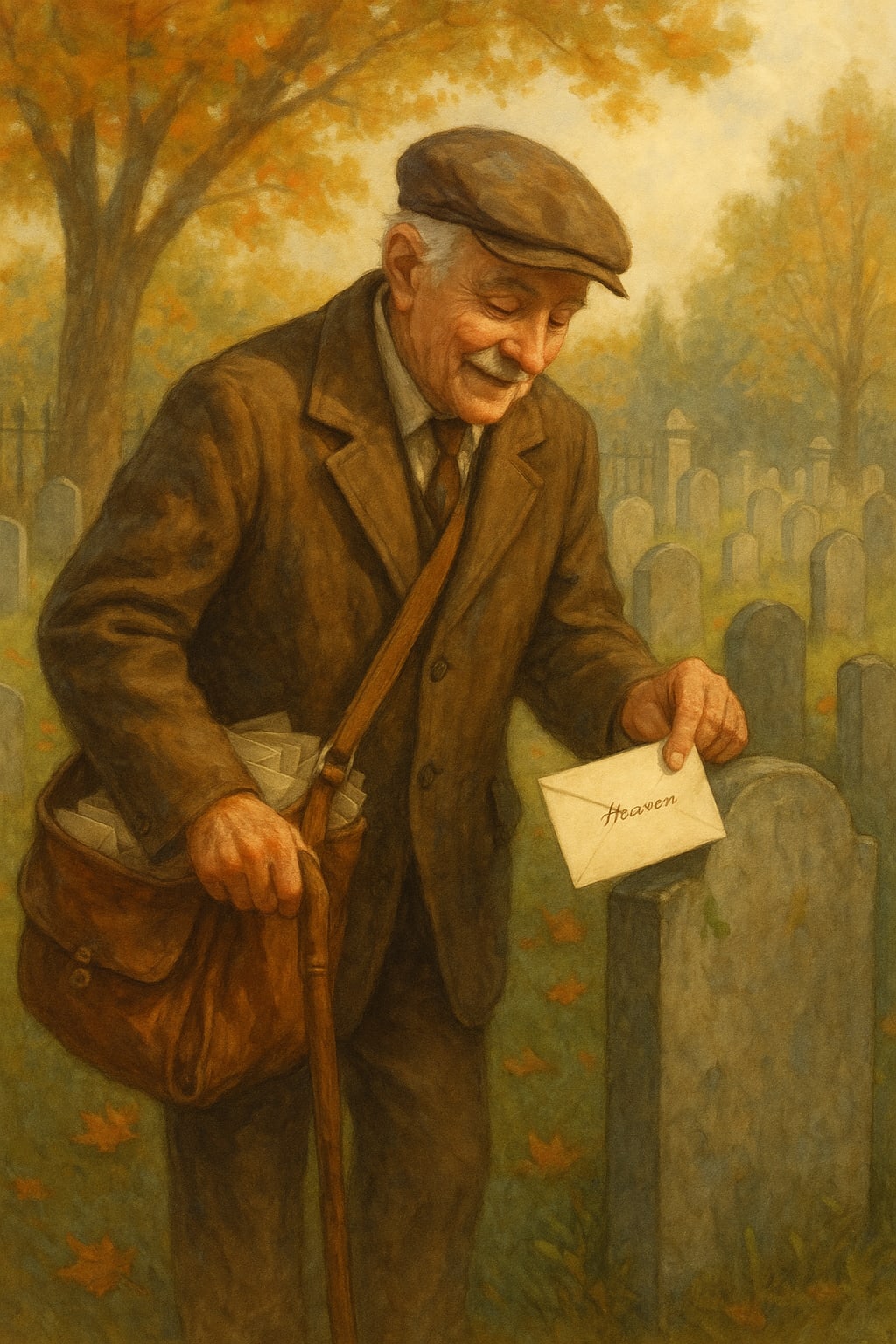
In the little town of Windmere, nestled between golden hills and roads no GPS could find, lived a postman named Eliot Finch.
Eliot was 84, walked with a wooden cane and the kind of slow grace that made you believe time was just being polite around him. He had been delivering mail for 63 years — never missed a day, never lost a letter. His bag was patched, his route unchanged.
People said Eliot knew the town better than anyone alive — which wasn’t entirely true.
Because Eliot delivered letters to people who weren’t alive.
He’d make his last round around sunset. Up the cobblestone hill. Past the old chapel. And then he’d stop by the cemetery gates.
He’d open his mailbag.
And gently place each envelope on a gravestone.
No one knew where the letters came from. The stamps weren’t real. The ink smelled of lavender and old paper. But the handwriting was always different.
Some were addressed to “My Dear Mama.” Others to “Charlie, who died before I could say I was sorry.” One was simply labeled: “To the one I still love.”
And Eliot — kind Eliot — never read a single one.
He just delivered.
---
Every child in Windmere grew up hearing stories of “The Postman to Heaven.” Some believed it. Some laughed. But all watched in silence when Eliot walked by — eyes bright, back straight, heart full of invisible weight.
One spring morning, Eliot didn’t show up for work.
His tiny cottage was quiet. The mailbag sat by the door. The kettle was cold.
The town grew hushed.
By afternoon, the mayor and the doctor went to check on him. Eliot was sitting in his chair by the window, smiling. He had passed peacefully in his sleep.
But there was one strange thing.
On the table beside him was a single envelope.
Addressed to:
Mr. Eliot Finch
Wherever You Go Next
There was no stamp. No return address.
Inside was a letter, written in the handwriting of every person who had ever sent him one — as if a thousand voices had signed it at once.
It read:
You delivered our love when no one else could.
You carried the words we were too late to say.
And now — it’s time we return the favor.
We’ll be waiting at the gates.
Come home.
---
Now here’s where things get strange.
At Eliot’s funeral, the whole town came. Children sang. Elders wept. The sky, they swore, turned the color of rose-petals just as they lowered him into the ground.
But that night — the mail resumed.
Fresh envelopes appeared on the graves again. New messages. New names.
Only now, there was no postman to deliver them.
Or so they thought.
Because just before dawn, Mrs. Linwood — who opened her bakery at 4 a.m. sharp — swore she saw a figure on the hill. An old man in a brown coat. Walking with a cane. Mailbag slung across his back.
He tipped his hat to her.
And vanished behind the chapel.
---
Soon after, children began reporting something even stranger.
The children would leave letters of their own— addressed to lost pets, beloved grandparents, even stars that had fallen — and by morning, the letters were gone. But in their place was always something small, something gentle.
A feather. A pressed flower. A candy wrapper that smelled like their favorite memory.
“I think he read them,” one little girl said. “And he left me something back.”
---
A new postman took Eliot’s route. But he always left the last stop blank. “That hill belongs to someone else,” he’d say, with a wink.
People still left letters at the cemetery gates. Not every night. Not always seriously.
But once, during a particularly snowy winter, a widowed man left a note that read: “I don’t know who you are. But if she gets this, please tell her I’m learning to live again.”
The next day, he found a pressed daisy on his windshield.
His wife’s favorite flower.
many years have passed......
The roads are now mapped. The bakery sells espresso. But the legend has only grown.
Visitors come with folded letters in their pockets. They ask, nervously, “Where do we leave them?”
Locals just smile and point toward the hill.
And once in a while — just once — someone sees him.
A man walking softly between tombstones.
Worn coat. Crooked cane. A gentle smile.
They try to follow, but always lose him behind a breeze, or a rustle of trees that seems to whisper, thank you.
The twist?
Someone discovered Eliot's childhood diary in an old trunk. Inside, tucked on the last page, was a scribbled note from when he was just ten:
“If people can send letters anywhere… why can’t they send them to heaven?”
“When I grow up, I’ll be the postman who makes sure they get there.”
He never told anyone.
He just became it.
And in doing so — gave a thousand broken hearts a place to heal.
About the Creator
E. hasan
An aspiring engineer who once wanted to be a writer .
Becca
"Everything is so... flat." Denille said stupidly as she looked around her new neighborhood. She looked around at the muted desert where even the smallest sign of life seemed to have given up. The plant life was shrubs that were half cooked by the heat and where there should have been a lawn, a mess of white rocks laid glistening in the sun. Even the sky looked stretched thin, like the sun had ironed it smooth. She’d moved from Riverside, where at least there were hills, but here in Barstow, everything felt baked and brittle.
By Sara Wilson7 days ago in Fiction
Mirror Dance
Tables. Lots of them. People. Cheerful and noisy chatter and the rustle of colorful taffeta dresses and suits, the scent of cloying perfumes carrying the atmosphere from day into night; as the amount of consumed alcohol rises, ties loosen, collar buttons come undone, inhibitions and formalities slowly evaporate into sweet submission.
By Gabriella Reti3 days ago in Fiction


Comments
There are no comments for this story
Be the first to respond and start the conversation.