
The Philosophical Room
The Materialistic nature of Humanity. A forgotten kind of simple room.


Not so long ago, mankind made tremendous technological advances from steam to electricity. Many assumed that these inventions would automatically bring people closer, making society better. Instead, Bergson warned, without a matching effort toward moral and spiritual growth...technology would deepen divisions rather than bridge them.
His message still resonates today. Our machines may connect us, but only our humanity can unite us.
World Philosophy day is celebrated every 3rd Thursday in November.
How right was he back then?
Henri Bergson was a pioneering French philosopher known for his radical ideas on time, consciousness, and creativity. He challenged mechanistic views of reality and deeply influenced 20th-century thought.
🧠 Born in 1859 in Paris, France , he received his Ph.D. from the University of Paris - taught at Collège de France, among his other many achievements.
This quote reflects his belief that while material advancements can enhance human life, they must be balanced with spiritual growth to avoid potential dangers.
"An increase in the material means at the disposal of humanity may even present dangers, unless it is accompanied by a corresponding spiritual effort".
📚 His Major Works include:
- Time and Free Will (1889): Which Introduced his concept of duration (la durée), a qualitative, lived experience of time.
- Matter and Memory (1896): Explored the relationship between body and consciousness, arguing for a dualistic view of mind and matter.
- Creative Evolution (1907): Proposed élan vital, a vital force driving evolution beyond mechanistic or Darwinian explanations.
Darwin describes how species evolve through natural selection - where individuals with traits better suited to their environment are more likely to survive and reproduce.
Mechanistic theory views systems as being created from individual parts that interact like a machine.
🔍 Bergson's Core Philosophical Ideas
- Duration (la durée): Bergson argued that real time is not a series of discrete moments (as in clocks or physics), but a continuous flow experienced subjectively.
- Intuition vs. Intellect: He championed intuition as a deeper mode of knowing than analytical reasoning, especially for grasping life and consciousness.
- Élan Vital: A creative life force that propels evolution and novelty, opposing deterministic or reductionist models.
- Critique of Mechanism: Bergson challenged the dominance of scientific rationalism, suggesting that life and consciousness cannot be fully explained by physical laws.
🌍 Influence and Legacy
- Nobel Prize in Literature (1927): Awarded for the vitality and brilliance of his philosophical writing. "In recognition of his rich and vitalizing ideas and the brilliant skill with which they have been presented".
- Impact on Art and Literature: Influenced writers like Marcel Proust (French novelist) and philosophers such as Gilles Deleuze.
- Debates with Einstein: Famously clashed with Einstein over the nature of time - Bergson’s subjective time vs. Einstein’s objective, measurable time.
~ Subjective Time: is the way individuals perceive and experience time, which can vary based on emotions, attention, and context.
~ Objective Time: is measured by clocks and calendars.
🌀🌀🌀🌀
Let’s step into the forgotten room - a surreal space where Henri Bergson’s philosophy pulses beneath the dust and clutter of modern distraction.
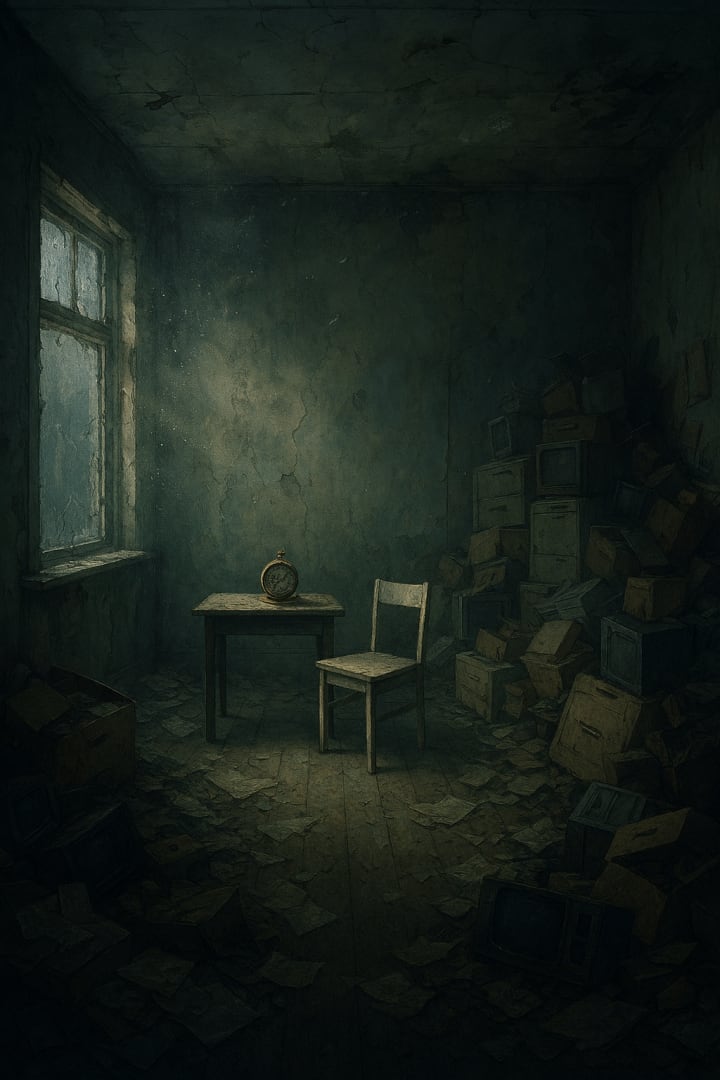
We find ourselves in a dim, timeless chamber tucked behind a digital firewall, beneath layers of algorithmic sediment. No one remembers how to enter it. The door is not locked - it’s simply ignored.
The Architecture of the room is not measured in square feet but in la durée - Bergson’s lived time. Its walls ripple with events that never happened, dreams that outlived their dreamers. Clocks here melt into puddles of need versus want. Time flows like insatiable beasts, not like ticks.
Objects of Minimalism have become completely Overgrown.
- A single chair awaiting a friendly visitor
- A mirror that once reflected gentle kindness
- A candle that burns with the flame of forgotten longing
- A drawer labeled “Élan Vital,” , or driven evolution, filled with sketches of unborn ideas
These objects once anchored a people who lived by intuition, not intellect. A people who knew how to appreciate the simple gifts of nature - knowing when they had enough - not needing excess to blind their eyes to the beauty of nature and a simple way of existing.
But now, the room is cluttered with:
- Notifications fossilized into amber
- Echoes of productivity apps
- A shrine to the god of optimization, fast paced and flickering,
🧠 Philosophy in Motion
Élan Vital (the vital driving force) appears as a Wandering Spirit:
In this room, Bergson’s vital force is a barefoot child drawing spirals on the floor with chalk. She’s not trying to explain anything - she’s trying to become something. She moves not forward, but inward.
Intuition vs. Intellect:
Visitors who stumble in try to analyze the room. They measure the dust, catalog the silence. But the room resists. It can only be known through feeling, through surrender. The intellect sees clutter; intuition sees a sanctuary where simplicity breeds calm.
Creative Evolution:
The room evolves not by design but by accidental joy, by play, by the act of forgetting, changing and a return to a practical and stressless existence. Each time someone remembers it, it changes shape. It’s a living metaphor for Bergson’s idea that life is not a machine but a poem in motion.
🎭 The People Who Forgot within the room.
They are sleek, efficient, and haunted. They’ve traded the minimalism of being for the maximalism of doing. They no longer dream in symbols - they dream in spreadsheets. But sometimes, in sleep, they hear the room calling.
And when they return, even briefly, they remember:
- That time is not a line but a wave
- That memory is not storage but transformation
- That existence is not accumulation but a continuous reawakening.
And so, to live is not to hoard moments like coins in a jar, nor to stack achievements like bricks in a wall. It is to awaken - again and again - to the pulse of unfolding, to the quiet revolution of presence. In Bergson’s forgotten room, time does not pass; it deepens. Memory does not archive; it transforms. Existence, stripped of its clutter, reveals itself as a spiral -each turn a return, each breath a beginning. To reawaken is not to start over, but to remember that we will never be finished.
We, like the room, must simply... evolve.

About the Creator
Novel Allen
You can only become truly accomplished at something you love. (Maya Angelou). Genuine accomplishment is not about financial gain, but about dedicating oneself to activities that bring joy and fulfillment.
Keep reading
More stories from Novel Allen and writers in Fiction and other communities.


Comments (3)
A poetic and insightful reflection on time, memory and the need to reawaken our humanity. Wonderful work.
Bergson was a smart man, time is subjective, but its also a bit objective. Both are a bit of each other I think. But his ideas ring true today. Too much stuff is our downfall, and we have stopped using our brains.
Whoaaaa, this was soooo fascinating. Loved your take on the challenge!