

There weren't always dragons in the Valley. But after they came, there was always the fear of them.
Whenever the dragons appeared, this fear served its purpose. These were not the dragons of legend–they didn't arrive on wings, breathing fire, and working magic. They were actual, terrifyingly dangerous, reptilian predators. They were real–just as real as the fear they inspired. This fear informed the People how to wait, how to watch. It taught them patience and endurance–to maintain their fortifications and to keep their steel bright. The People knew quite well the benefits of fear. Fear was, in fact, their most potent ally.
Once there was a time before the People learned to fear, however brief it may have been; a time when the valley was young and untouched by any hand or foot, and the People had come with hope and steadfast courage. Exiled from the Guo Empire, wandering, the People knew their future well. They knew the peace and prosperity of a new land, a land isolated, unknown, and unwanted by the Guo–a land as unwanted as the People themselves. The People knew this, but what the People did not know was where it would be found, and how it would change them.
The People had not always been a people. First, they were individuals and citizens of Guo: a child born months early speaking from the womb, an old woman suddenly gifted in every known tongue, a boy whose sight was taken and whose mind was given extraordinary, impossible knowledge. For a time, these strange, unexplainable events were common among the Guo, so common that those to whom they happened were given a name: Discemit.
All throughout the Empire, the Discemit were lauded with praise, said to be blessed of the gods, and even worshipped as gods by some. But the ripening sweetness of their gifts soon gave way to rancor and decay. This was when the Discemit were first acquainted with fear–but with a fear that was not their own. The fear they encountered was that of others for themselves, a fear cultivated carefully by the Magistrates of the Great Ruler.
Fear grew like a weed in the Empire, but it was cared for like a flower. Its gardeners were expert at their craft, planting seeds of rumors in the fertile soil of the unknown and watering daily with misinformation. Those who grew this fear were themselves afraid, but differently so. The thing they feared was loss of power and position.
In the beginning, the Discemit were scattered and separate, but every town had a few. Initially, they were celebrated by the Magistrates. Each Discemit, by order of the Great Ruler, was to become a ward of the state. They were to be taken in by nobles and rulers, given honorary seats in every Council, and appear before the Guo whenever occasion permitted, always with the Magistrates behind them and a hand on each shoulder. The people of Guo loved the Discemit and the Magistrates knew it. They also knew the benefits of being beloved by the people. But what the Magistrates did not know was the liability the Discemit would soon become.
Never before had the people of Guo been witness to such miracles as those the Discemit were blessed with. The Magistrates were cunning and quick to use the people's wonder for their own gain, but in retrospect their haste was less than profitable. The Discemit, as it turned out, were not always friendly towards the Magistrates' priorities; what's more, they could not be controlled quite as easily as the Magistrates had anticipated.
Throughout the Empire, the Discemit began to talk, and the people of Guo listened. The Magistrates listened as well. Some spoke of the greed they witnessed behind closed doors in the houses of the powerful. Some made mention of the unrighteous inequalities they saw on the streets. Some wondered aloud why the Discemit themselves should not rule in place of the Magistrates. The people of Guo began to murmur in agreement across the Empire, and the Magistrates understood their mistake and acquired their fear. And just as the People in the Valley years later, they would not allow their fear to go to waste.
The Discemit voices were loud, but the Magistrates’ were louder. They said: “We know of your great love for the Discemit and we share it! We have taken them up into our homes and have witnessed the splendor of their gifts, but we have also witnessed other things: dark things, strange things.” The people of Guo heard and wondered. The first seeds of fear had been successfully sown.
Years passed, tensions rose, and the Discemit appeared less and less before the people of Guo. All throughout the Empire, golden fields of fear were fully grown and ready to harvest. But not everyone possessed this fear. The Discemit had their friends, families, and supporters. They had discovered that fear’s potency could be neutralized by proximity. This was why, they knew, the Magistrates had kept them isolated.
“We are but the vessels of the voice of Guo!” the Magistrates intoned. “We, like you, are wary of the danger the Discemit pose. We know them, and like you, we know to fear them. What is it you would have us do?”
"Be gone with them!" cried Guo. "We cannot bear to live beside them." Guo did not cry as one, however. Some demanded more: "Kill them! Kill the vile beasts!" Others raised their voices in protest: "What have they done to us? They are but people of the Guo Empire, just as you and I. They are our friends, our families, and our neighbors!" The people had spoken and the Magistrates, pleased, considered their words.
After brief deliberation, the Magistrates acted by the voice of the majority. The Discemit and their followers were to be sent away in full support of the Great Ruler to find a home of their own. What better way to rid Guo of dissent without the shedding of much blood and the wasting of many resources? Additionally, the Magistrates knew that the Discemit might someday prove to be of use. But for now, their utility had run dry, and they began to journey forth from Guo.
The Discemit were not alone, however. They went not only with their followers, but with the outcasts, the pariahs, the vagrants, and the unwanted. Never before had such an exile from Guo been so available to such a large number of people. Everything was carried out according to the majority's wishes, and the Empire of Guo again reverted to a state of comfortable, monolithic support for the Great Ruler and His Magistrates, just as they had planned.
For months, the Discemit and their company journeyed. The Guo Empire was as vast as the riches of its rulers, but not as vast as the unexplored land beyond its borders. The exiles caravanned beyond the Western Desert, explored the borders of the Lakes of Prosper, and even searched among the Mountains of the North. During these months they began to call themselves anew. Brought together in unity, away from the Guo, they were no longer Discemit, nor outcast, nor pariah. They were simply People. And finally, in joy and jubilation, the People found their Valley.
The Valley was everything they wanted, and more importantly, everything they needed. Lush with vegetation and forests, abounding in springs of water, and replete with ore of every kind, the Valley could easily accommodate the wandering exiles. The People rejoiced and sent word to Guo that they had found their home. The Empire looked on in satisfaction and applauded the offshoot group's great fortune. Perhaps the Discemit were blessed by the gods after all, they thought. The Magistrates were more than satisfied. They were not, however, surprised. The Discemit and their followers were exactly where the Magistrates wanted them.
It wasn't long after the People had settled in the Valley that they first learned to fear. And it wasn’t long after that when they learned of fear’s advantages. In the Empire, fear’s tutor had been the Magistrates, but in the Valley it was the dragons, and oh, how different their methods were.
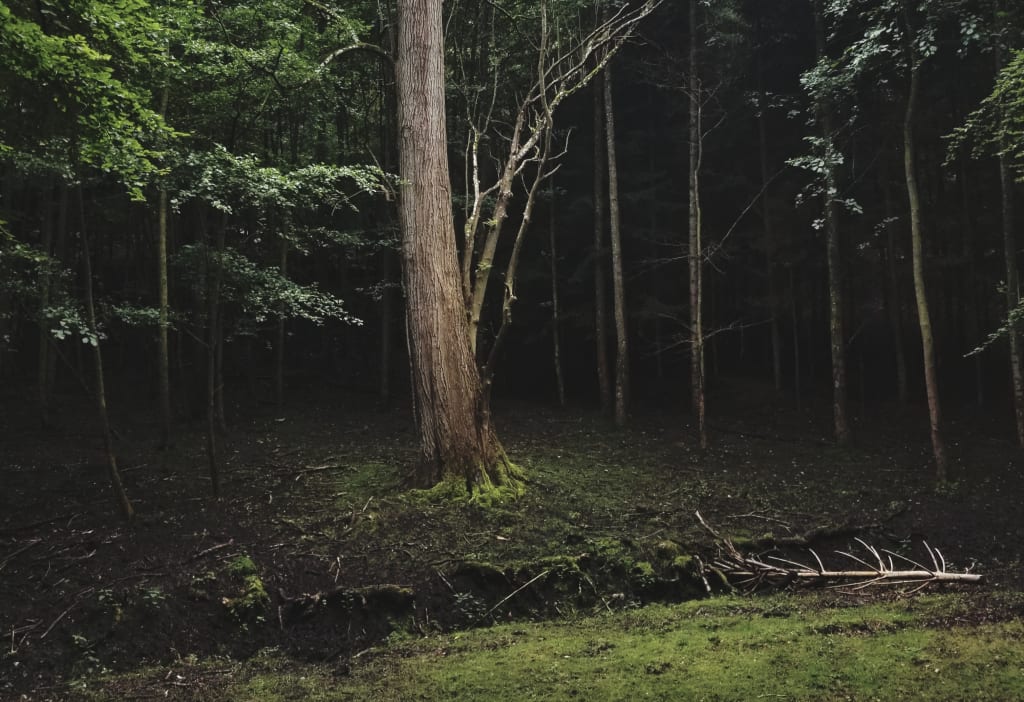
The dragons were quicker and more cunning than the Magistrates could ever be. From the forests they came without warning or mercy, taking men, women, and children alike. These beasts, as it was said by disconsolate witnesses, were serpents larger than a full grown man and faster than a horse. Their bodies were not much different than a common lizard’s–but they were hundreds of times larger, their four legs long and strong, and their mouths frighteningly filled with pristine rows of dagger-like teeth. Stealthily, they stalked their prey from behind the bushes and hidden high on the branches of trees. Their attacks could come from any direction upon anyone who dared to wander in the woods.
When the attacks first began, the People had no indication of their source. The unfortunate victims would simply disappear without a trace. The People turned to the gifted among them for guidance, but even they were in the dark. They could only guess at what awful occurrences were befalling them in their otherwise precious new home. Curfews were set up, rules were established, and fear descended upon the Valley. This fear was aimless, unrefined, and of little value, however, until the People learned what to direct it towards.
The dragons, for a time, were only seen from afar, blurry shapes careening through the night as victims’ screams faded into quietude. Eventually, Litha, a young girl prone to visions with wisdom beyond her years, was the first to witness their awful form in full. One night as she slept, she dreamt of her brother, Merrick, walking alone. Suddenly, the dragon came, and the girl could only watch in horror as Merrick was taken by the nightmarish creature before her eyes. She awoke gasping, drenched in cold sweat, frantically calling for her parents. Her brother was nowhere to be found, and the family knew that Litha’s vision was reality. Her visions always were. And now, the bereaved could do nothing more than grieve and make known the terrible truth of the disappearances. The dragons' reign of terror was upon the Valley.
And so began the People’s use of fear, but unlike the Magistrates in Guo, they had no need to nurture its growth; the dragons did this well enough alone. The fear inspired action, and the People took it swiftly. Fortifications were thrown up around their villages and fields, watches were kept throughout the night, and the forests were avoided at all costs. The attacks’ frequency diminished, and the People again began to have a delicate peace.
For years, this peace continued, and the dragons were almost forgotten. The attacks had nearly ceased completely, and the bewildered Valley settlement could only guess as to why. The People prospered and grew in strength and love for their Valley. The fear of dragons waned, but it never left completely, and oh, how grateful the People soon would be for its stubborn persistence.
Out of nowhere, the dragons struck again. Whereas before they had only attacked alone, this time they advanced in groups of three or four, trampling the People's defenses underfoot and massacring their guards. After every raid each dragon left with a human corpse, but one day, for the first time ever, they also left behind a carcass of their own.
A man gifted with unusual strength, Barthamy, was keeping watch on the night of the attack. His fellow guards were taken by surprise and nearly died before they even had the chance to act, but one, a woman gifted with a keener sense than most, managed to land a blow with her sword before the dragon’s jaws snapped shut around her throat. The beast was stunned just long enough for Barthamy to swing his axe with all his strength upon the creature’s neck. Even Barthamy’s powerful arms and sharp axe were barely able to pierce the dragon’s thick scaly hide, and it was just enough to knock the dragon wounded to the ground.
Barthamy swiftly bounded forward and swung again, incredibly able to land his axe precisely where it had already struck before. This time, the axe cleaved through the dragon’s soft inner flesh and almost severed the vertebrae of its iron-hard spine. The dragon was dead, and Barthamy became the first Dragonslayer.
The People mourned their losses, buried their dead, and studied the dragon’s body. It was unlike that of any creature they had ever seen. Its interlocking scales were more impregnable than their finest armor, its teeth were sharper than their keenest knives, and its bones were stronger than their toughest steel. Aghast, the People marveled at how such a creature could exist, but with this newfound knowledge their fear became more efficacious than ever before. Now, at long last, they knew exactly what it was they feared.
But what would the People do with their fear? Would they return to Guo and suffer the consequences? Would they abandon their Valley? Or would they stay and learn to face the rising threat before them? The People had grown to love their community, and dreaded the Magistrates’ displeasure upon their potential return. They certainly feared the Empire’s wrath, but did this fear outweigh that of the dragons? No, it did not, but what did carry more weight was the People's love of their Valley; they would rather face the beasts than abandon their home.
The People had never expected to become the victims of such draconic foes, but despite the inevitable trials ahead of them, they looked steadfastly forward to their future in the Valley. As they continued resolute, they would soon learn the benefits of a thing more powerful than fear: hope.
With Barthamy’s strength, the other varied gifts of the former Discemit, and the scales, teeth, and bones of the fallen dragon, the People carried on in their beloved Valley. Nurturing a healthy fear and a newfound hope, they prepared anew to face a peril the likes of which had never been faced before. The Valley belonged to the People, not the dragons! For this truth the People would fight, and for this fight the Valley would support them, sustain them, and even change them. Soon enough, they would become much more than the People of the Valley. Soon enough, they would become Dragonslayers.
Just as the Magistrates had planned.
About the Creator
Soren Peterson
I'm a 24 year old from Utah with an interest in philosophy, theology, history, music, and languages.
Thanks for reading!
Keep reading
More stories from writers in Fiction and other communities.
TUS NUA - ch 49
TUS NUA – ch 49 New Beginnings – Mia and Midnight (*)(*)(*) As Mia spoke on the phone to Ali’s sister, Ellen, Finola slipped quietly away and walked to the stream behind Tus Nua. Carefully, she put a block on her family so no one could know what she was about to do.
By Margaret Brennan2 days ago in Fiction
One Hard Thing
Stop me if you’ve heard this one before: You have the number, you know your schedule- you’ve even picked out the perfect day and time to make this appointment. Shoot, you’ve even picked out alternative days and times just in case their schedules can’t accommodate you!
By Taylor Rigsbya day ago in Motivation



Comments (1)
I enjoyed your story and found it well written and easy to comprehend. Great twist at the end! I didn't see that coming at all. I know you were constrained by the given opening and format of the contest, so this is just thoughts for if you were to write a full novel from this. I'd probably write it more in 'present tense' rather than as past history. It suffers from being an abbreviated history of sorts. Keep up the writing!