
The Parrot died and become free
Story of a Merchant and a Parrot

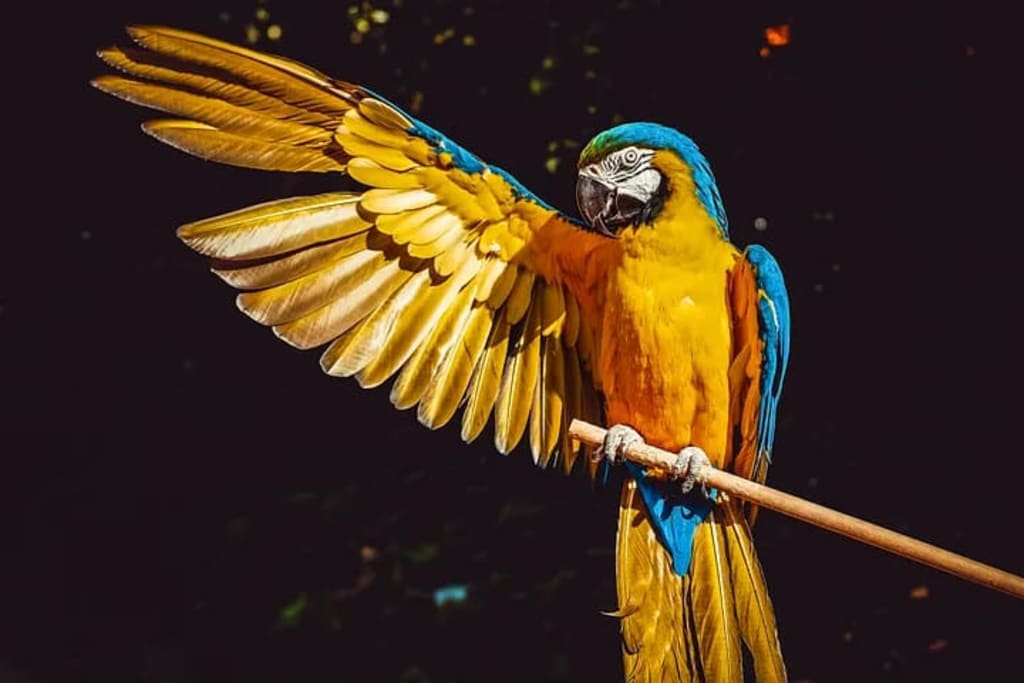
There (once) was a merchant. And he had a parrot,
imprisoned in a cage-- a beautiful parrot.
(Now) when the merchant prepared for a journey (and) was about
to travel to India,
He spoke to each male and female slave (and asked), out of
generosity, "What shall I bring (back) for you? Answer quickly!"
Each one asked him for something wished, (and) that good
man gave (his) promise to all.
(Then) he said to the parrot, "What present from the journey do
you want, so that I may bring it to you from the region of India."
The parrot answered him "When you see the parrots there,
explain my situation (and) say,
"'The parrot so-and-so, who is yearning to see you, is in my
prison by the decree of the heavens.
"She sends you greetings of peace and wants justice, and desires
a remedy and the path of right guidance.
"She said, 'Is it proper that I, in (such a state of) yearning,
should give (up my) life here (and) die in separation?
"'Is it right that I (should be) in (such) strict bondage, while
you (are) sometimes on the green grass (and) sometimes on the
trees?
"'Is the faithfulness of (true) friends like this, (that) I (am) in
prison and you (are) in the rose garden?'
"O great ones, bring (to mind) the memory of this weeping
bird, (by drinking) a dawn cup (of wine) among the grassy
meadows!"
. . . . . . .
(Since) the story of the [ordinary] parrot of the soul is like
this, where is one who is the [chosen] confidant of the birds?
Where is a bird (who is) helpless and without sin, and (yet)
within him (is a) Solomon with (his entire) army?
When he cries out bitterly, (but) without gratitude or
complaint, a clamor [to aid him] occurs in the seven heavens!
. . . . . . .
The man of trade accepted this message (and agreed) that he
would deliver the greeting from her to (her on) kind.
When he reached the farthest regions of India, he saw some
parrots in a wilderness.
He held back (his) mount (from going), then gave a shout: he
delivered the greeting and returned that (which he had been given
in) trust.
Among those parrots, one parrot trembled greatly, fell, died, and
stopped breathing.
The merchant became sorry about telling (such) news, (and)
he said, "I went in destruction of (that) animal.
"Is this one, perhaps, a relative of that little parrot? (Or) was
this, perhaps, (a case of) two bodies and one spirit?
"Why did I do this? Why did I deliver the message (and) burn
up the helpless (creature) by means of this crude speech?"
. . . . . . .
The merchant finished his trading (and) returned to (his)
home, satisfying (the best hopes of his) friends.
He brought a present to each male slave (and) gave a share to
each female slave.
The parrot said, "Where is (this) slave's present? Tell what you
saw and said!"
(The merchant) replied, "No. I am myself (very) sorry about that,
(and am) chewing my hands and biting (my) fingers (over it).
"Why did I foolishly bring (such) a crude message out of
ignorance and thoughtlessness?"
(The parrot) said, "O master, why are you (so) regretful? What is
it that calls for (all) this anger and sorrow?"
He replied, "I told your complaints to a group of your
fellow parrots.
"That one parrot-- her heart broke from getting wind of your pain,
and she trembled and died.
"I became regretful (and thought), 'Why was (the use of)
saying this?' But since I had (already) spoken, what was the benefit
of remorse?"
. . . . . . .
When she heard about what that parrot did, she then
trembled, fell, and became cold.
When the master saw her fallen like this, he jumped up and hurled
(his) cap on the ground.
(And) when the master saw her with this appearance and
condition, he leaped up and tore the upper front (of his robe).
He said, "O beautiful and sweet-crying parrot, what happened to
you? Why did you become like this?
"Oh what sorrow! My sweet-sounding bird! Oh what misery!
My close companion and confidant!
"Oh what regret! My sweet-singing bird! The wine of (my) spirit,
(my) garden, and my sweet basil!
"If Solomon (could have) had a bird like you, he never would
have become occupied with (all) those (other) birds.
"Oh what a pity! The bird which I got (so) cheaply! (Yet how)
quickly I turned my face away from her face!
"O tongue! You are a great injury to mankind! (But) since you
are talking, what can I say to you?
"O tongue! You are both the fire and the harvest stack. How
long will you set fire to this harvest stack?
"(My) soul is lamenting in secret because of you, even
though it keeps doing everything you tell it (to do)."
. . . . . . .
The merchant, in (a state of) burning, and agony, and
yearning, kept saying a hundred scattered and disturbed (things)
such as this.
. . . . . . .
After that, he threw her out of the cage. The little parrot flew
to a high branch--
The dead parrot made such a (swift) flight, (it resembled) the sun
when it charges forth, like a Turk, from the sky [and rises up at
dawn].
The merchant became bewildered by the bird's action. All of a
sudden, (still) without understanding, he saw (that there were)
secrets involving the bird.
He raised his head and said, "O nightingale, share a portion (of
wisdom) with us in explanation of the situation.
"What did (that parrot) do so that you learned (something),
prepared a trick, and burned us (with sorrow)?"
The parrot answered, "She gave me advice by her (very)
action, meaning, 'Escape from (attachment to) elegance of voice
and joyful expansion [of your breast in song].
"'Because your voice is keeping you in shackles.' She herself
acted dead for the sake of (sending me) this advice,
"Meaning, 'O (you who) have become a singer to (both)
commoners and the elite: become "dead" like me so that you may
find deliverance!'"
. . . . . . .
The parrot gave him one or two (pieces of) advice, full of
(spiritual) discrimination. After that, he said to him the
"salaam of parting."
The merchant said to her, "Go in the protection of god. You have
now shown me a new path."
The merchant (then) said to himself, "This is the advice for me: I
will take her path, for this path is luminous.
"How should my soul be inferior to a parrot? The soul ought to
(follow) such as this, for it is a (very) good track (indeed)!"
The body resembles a cage. The body has become a thorn to the
soul because of the deceptions of those (who are) inside and
outside.
This one tells her, "I am your confidant," and that one tells
her, "No, I am your companion."
This one tells her, "There is none like you in existence with (such)
beauty, and grace, goodness, and generosity."
(And) that one tells her, "Both this world and the next are yours,
(and) all our souls are the (eager) uninvited guests of your soul
When he sees the people drunk from (being with) him, he loses
control of himself and goes (about full) of pride and arrogance.
He doesn't know that the Devil has thrown thousands (just)
like him into the river's water.
About the Creator
SAQIB AKRAM
myself Saqib Akram,a beautiful time,many centuries,I have no past,no future,yes there are some moments a few steps away,and as for the present, they are also hidden from you, I should be acknowledged instead of criticized.
Keep reading
More stories from SAQIB AKRAM and writers in Fiction and other communities.
The king, the handmaiden and the doctor
There was once a king who held both political and spiritual power. One day, he went hunting with his courtiers. On the way, he saw a handmaiden and fell in love with her. He paid money to buy her and was able to fulfill his desire. However, she became ill as a result of destiny. In order to save her, the king gathered doctors from everywhere and told them, “Our lives depend on you. My life doesn’t matter, but hers does. I am in pain and she is my cure. Whoever can heal her will receive my treasure and pearls, big and small.” The doctors all promised to use their intelligence and risk their lives to help. They believed that each of them was the savior of a world and had a medicine for every illness. However, they were arrogant and didn’t say “if God wills it.” As a result, God showed them their own weakness. Omitting the phrase “if God wills it” shows a lack of humility. Saying the phrase doesn’t guarantee humility. Many people don’t say the phrase but still have humility in their hearts. Despite their efforts, the more treatments they tried, the worse the illness became and they couldn’t fix it.
By SAQIB AKRAM10 months ago in Fiction
Choose Your Own Adventure: St Helena Station
*****Preface***** I have been obsessed with Choose Your Own Adventure stories since I was a kid. I credit them with my love of reading and writing. I've been struggling to get my own kids to embrace words the same way I have but they love video games and our occasional Dungeon's and Dragon's game... which gave me an idea. I'll write an interactive story. So far its working; my middle son loves it and can't wait for the next section to come out.
By Sandor Szabo2 days ago in Fiction
When the City Forgot the Stars
The city never truly slept. It only pretended to rest between waves of noise and light. Neon signs pulsed like artificial heartbeats, flooding every street with color. Giant billboards promised happiness in bold fonts and perfect smiles. Cars rushed past like they were late for something important. And above it all, the sky stood silent, empty, stripped of its stars.
By Salman Writes2 days ago in Fiction



Comments (1)
Very well done! I really enjoyed reading this!