
The Painter’s Last Color
My Grandfather’s Final Masterpiece Was Painted with a Forbidden Hue—And It’s Slowly Erasing Him From Existence

Part 1: The Color of Silence
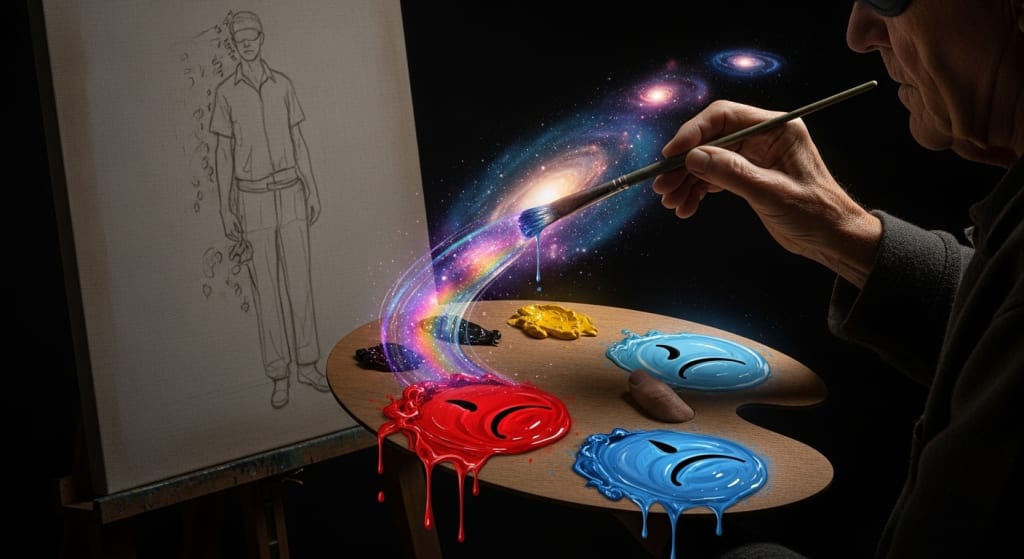
The world knew my grandfather, Silas Vance, for his colors. His "Vance Ultramarine" was said to capture the exact moment before dawn breaks. His "Heart's Crimson" pulsed with a life of its own. Critics wept before his paintings, claiming they felt the artist’s very soul.
I knew him for his silence.
For twenty years, that silence was a wall between us, built the day my mother—his daughter—was buried. He’d disappeared into his seaside studio, and I’d been packed off to relatives. His grief was a masterpiece he refused to share.
The letter came on a Tuesday. The script, once bold, was a spidery tremor.
Elara, I am going blind. Come quickly. There is a color I cannot find without you.
Curiosity, or perhaps the ghost of the girl who still loved him, led me back.
I found him in his studio, a cavernous space smelling of turpentine and salt air. He was a silhouette against the vast window, his eyes milky and fixed on nothing. An unfinished canvas stood on the easel, a chaotic storm of grays and blacks surrounding a faint, ghostly outline of a man.
"Elara," he said, not turning. His voice was the sound of gravel under tide. "You smell of rain and city. And resentment. A sharp, vinegar yellow."
"I came because you asked," I said, my voice colder than I intended.
He gestured to a wall of pigments in glass jars, each glowing with an inner light. "They are dying. As I am. They were never just paint."
Part 2: The Palette of Stolen Feelings
He told me the truth that night, as the lighthouse beam swept through the studio.
"The world is dull, Elara. I could never capture its truth with mere minerals and oil. So I learned to steal it." He pointed a trembling finger at the jars. "That blue? The tranquility of a sleeping child. That red? The fury of a wronged man, bought from a drunkard for a bottle of whiskey. That green? The envy of a lover watching from the shadows."
He had harvested emotions, distilling them into pure, potent color. His genius was a kind of theft.
"My blindness is no medical condition," he confessed. "It's the cost. I've used up all the light my eyes could hold. Now, I need to finish this." He pointed to the chaotic canvas. "The Self-Portrait of a Man Unmade."
"And where do I fit in?" I asked, dread coiling in my stomach.
"The portrait is incomplete. It lacks the final color. The color of Regret. Not just any regret. My regret. For her. For you."
He turned his blind eyes toward me, and for the first time, I saw not a formidable artist, but a terrified old man. "I cannot find it alone. And to bottle it... it may be the last thing I do."
Part 3: The Harvesting
The process was intimate and horrifying. I had to become his confessor, his torturer.
"Tell me about the day you left," I prompted, my voice flat, holding a empty crystal vial he had given me.
He flinched. "The silence in the house after the funeral was a physical thing. A weight. I thought if I could just paint it, I could be free of it. I was a coward."
A wisp of silver smoke, faint and cold, escaped his lips and coiled into the vial. The glass frosted over.
"Again," I whispered, a tear tracing my cheek. I didn't know if I was crying for him, for my mother, or for myself.
"The way you looked at me, Elara. You were twelve. Your eyes asked 'why?' and I had no answer. So I stopped looking."
Another plume, thicker this time, like liquid mercury. It filled the vial, swirling with faint, ghostly images—a child’s outstretched hand, a slammed door, a thousand unsent letters.
The vial grew heavy and freezing cold in my hand. The Color of Regret.
But as the vial filled, my grandfather began to fade. Not metaphorically. Literally. The edges of his form grew translucent. The lighthouse beam passed through his shoulder.
"The painting anchors me," he gasped, his voice becoming faint, like a distant radio signal. "The regret is unmixing me. Hurry."
Part 4: The Final Stroke
I rushed to the easel. The vial glowed in my hand, a tiny captured storm. I dipped his finest brush into it.
The paint was unlike anything I’d ever seen. It was iridescent and dark, holding a universe of lost chances and broken promises within its sheen. It felt like sorrow and cold metal.
"Where?" I cried out. "Where do I put it?"
"His eyes," my grandfather’s voice whispered, now seeming to come from everywhere and nowhere. "Give him my eyes."
My hand steady, I touched the brush to the ghostly face on the canvas. I painted two strokes for the eyes.
The effect was instantaneous. The chaotic painting resolved. The storm of grays and blacks didn't vanish; it became the backdrop for a man of profound, heartbreaking depth. The new eyes—the color of a deep, starless night shot through with silver—stared out, holding an eternity of sorrow and understanding. It was a masterpiece. It was the most beautiful and terrible thing I had ever seen.
And in the studio, my grandfather was gone.
A sob wrenched from my throat. I was alone. He had used his last color and paid the final price.
Part 5: The Unmixing
I fell to my knees, weeping before the finished portrait. I wept for the grandfather I’d lost twice, for the time we’d wasted, for the brutal beauty of his final work.
As my tears hit the dusty floorboards, a strange thing happened. A tear, Salty and clear, landed on a dried fleck of the Regret paint that had dripped from the brush.
It sizzled and began to change. The iridescent darkness softened, lightened, and transformed. It bled into a color for which there is no name. It was the color of a first breath after a long cry, the color of a weight being lifted, the color of a silence that is no longer empty, but peaceful.
It was the color of Forgiveness.
A warm light emanated from the portrait. The figure in the painting seemed to smile gently, and then the entire canvas dissolved into a shower of soft, glowing dust.
The dust swirled in the air, coalescing back into the form of my grandfather. He was solid, real. And his eyes, his physical eyes, were clear and focused. They were no longer milky, but held the same deep, knowing glint as the paint I had just applied.
He wasn't looking at the studio. He was looking directly at me.
"Elara," he said, his voice strong and full of wonder. "I can see you."
Epilogue: The First Color
The blindness, the fading—it wasn't a punishment for using the color. It was a consequence of hoarding it. His soul was choked on a regret he never expressed. Only by giving it form, by releasing it into the world through his art, could he be free of it.
My tear, my forgiveness, was the catalyst that completed the reaction. It was the final ingredient he could never have provided himself.
He never paints with harvested emotions anymore. The glowing jars are dark and empty.
Instead, we run a small studio together. He teaches, and I learn. He’s trying to make up for lost time, and so am I.
Yesterday, I saw him at his new easel. He was trying to capture the simple joy of sunlight on a bowl of lemons. He was struggling, using ordinary yellow ochre from a tube.
I walked over, took his hand, and thought of the sheer, uncomplicated happiness of being there with him. I smiled. A faint, buttery-yellow light, warm as a pat of sun, glowed for a moment at the tip of my finger and transferred to his brush.
He looked at me, surprised, then at the brush. He touched it to the canvas.
The lemon on the canvas seemed to glow from within.
He didn’t say a word. He just reached over and squeezed my hand.
His last color was Regret. But mine, I think, will be something else entirely.
About the Creator
Habibullah
Storyteller of worlds seen & unseen ✨ From real-life moments to pure imagination, I share tales that spark thought, wonder, and smiles daily
Keep reading
More stories from Habibullah and writers in Fiction and other communities.
A Guide to Cape Town International Airport and Its Services
Travel is about more than reaching a destination — it is about the experience that begins the moment you arrive. For millions of visitors each year, Cape Town International Airport serves as the first introduction to the Western Cape. As the region’s primary aviation hub, it plays an essential role in shaping travelers’ first impressions of South Africa.
By Backlinks Cartabout 2 hours ago in Fiction
I wanted to title this something different, but worried that my chosen title might cause problems entering the United States in the future so this is the new title. It's the greatest title. No one has ever written a title better than this. (All titles unrelated to content).
Let me be honest. I am finding this difficult. Now, I like a challenge, a stretch, a bit of an obstacle course. “Write about the decline of the British Empire in the form of a narrative poem in which your protagonist is an artichoke” I read, and flex my fingers. “Write a haiku to evoke the sensation of sibilance using only the first half of the alphabet.” “Well”, I think to myself, “this should be fun.” But “write about a system that isn’t working”? A system that isn’t working? Now? In 2026? ONE system? My favourite system that isn’t working? The sexiest system that isn’t working? The one giving me the most angst day to day? The one giving me the most existential dread? I am, as I say, finding this difficult. I will own that I have contemplated writing a thousand words on why the steady “all on” setting on my fairy lights is the EIGHTH of seven options which must be sequentially activated to get there, because that is a system that some fool came up with and it definitely doesn’t work, and now who is paying the price, eh? But how can I write about my fairy lights when…. When…. When….
By Hannah Moore5 days ago in Humans



Comments
There are no comments for this story
Be the first to respond and start the conversation.