

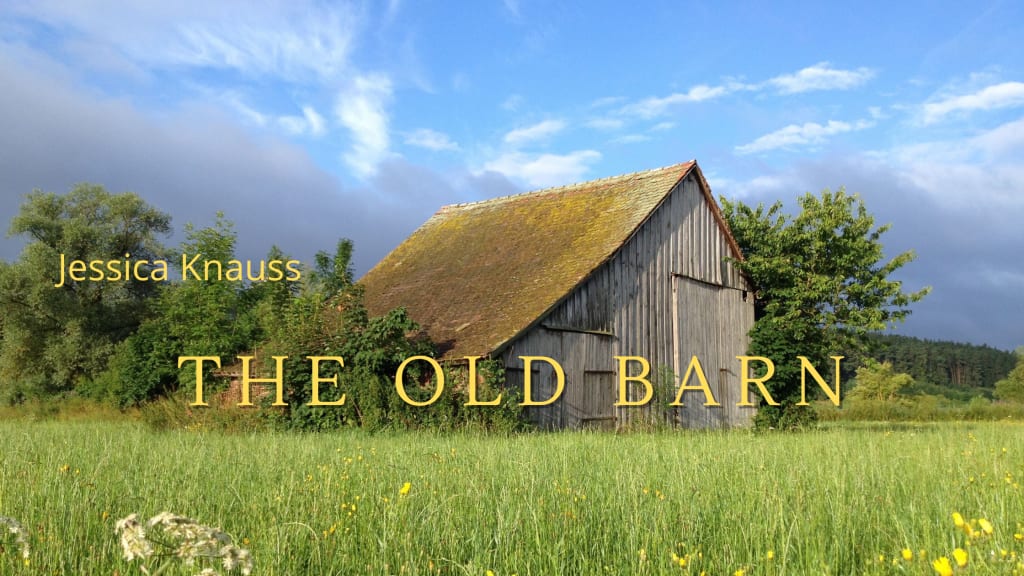
The old barn brooded in my imagination since the first time I glimpsed it in the wide-open field beside the highway on the way to grandma’s house. I couldn’t have been more than five.
“That’s where they recycle pet hamsters to resell,” said my big brother, Leo. “You never know if you’re getting an original or a recycled one. Zombie hamsters!”
I believed him. His hamster had died, and our parents hadn’t let him get another one. In case it was a zombie?
I took many more trips to Grandma’s in the backseat, staring out the car window at the faded siding of that barn under a cloudy sky in silent awe. When I was ten, and Leo decided to drag me along on his volunteer trip planting saplings along the highway, I still suffered from that repulsed fascination.
The volunteer group started close to our house, and each day we rode out a bit farther in somebody’s dad’s pickup. We dug holes and propped up little trees that had been paid for with my dad’s tax dollars, according to him.
It didn’t sink in that we would be working in the field with the barn until the day we just kept going down the highway, and it came into view.
My whole body tensed. “I don’t think I want to work here,” I said in what I was sure was a commanding voice. But ten-year-olds aren’t granted such privilege in society.
“Are you scared?” asked my brother.
“No.” I said it even though I’d been told brave people admit it when they’re afraid.
“You are. Why?” The adult had stopped the car, and he and the other kids were unpacking the supplies, but Leo stayed strapped in with me. He was already in high school by then, and his empathy and caretaking skills had improved leaps and bounds.
He followed my gaze, and a distant memory must’ve kicked in. “Zombie hamsters? Come on. I’ll show you all the zombie hamsters in that barn.”
He had to unbuckle my seatbelt and lift me out by the arms. Fear had stolen my motor coordination.
“We’ll be back in a second,” Leo told the group, who looked at us skeptically, then continued unloading the saplings.
When he saw where we headed, the adult said, “Be careful! Don’t fall through a rotten board or something!” If I hadn’t already been holding Leo’s hand, I would’ve grabbed it then.
There was no door, but Leo paused outside the faded red edifice. “There will probably be cobwebs. Out in this field, spiders don’t have many other places to do what they have to. But these spiders want to eat insects, not you.”
I took a deep breath, and we stepped inside.
There were a few arachnid structures, mostly up high, in the corners of the ceiling. But the bright sunlight striping through the slats removed any sense of threat. The floor was covered in spreading green vines and very old bits of hay. Rather than rotten, it smelled warm and alive.
I ran across the barn and climbed the ladder to the hayloft.
“Hey!” shouted Leo. “Watch out!”
He ran to catch up with me, and both the ladder and the loft were sound, so we spent a good two hours throwing old hay at each other as if it were snowballs.
Later, we gathered up the vines on the floor and arranged them like the Roman villa archaeological sites he’d been watching on TV. We decided I was a cloth merchant, come to show my wares to the master of the villa (more vines). As I headed out the door in order to make my entrance, I suddenly wondered if the group had finished planting and left us there.
But I saw them there, along the highway, still setting up.
“Where’s Leo?” the adult asked. “Come on, let’s get started.”
I helped as usual that day, fetching gloves and bottles of water, and occasionally being permitted to pat down the earth around a sturdy new sapling. But all I thought about was the inside of the old barn, and how time seemed to slow down there.
It was only when we were packing up and heading home that I realized Leo was right. There was nothing scary in that barn, zombie hamsters or otherwise.
After that day, on the few more trips to Grandma’s before Leo went off to college, I gazed out the car window with a sense of nostalgia rather than dread. The saplings grew slowly, but provided a cheerful foreground to the barn, like a buoy floating in a green sea.
I went off to college, too. What with fewer visits home, I was on that highway less often, and the trees seemed to grow that much more quickly. But I never visited the barn again.
Then Grandma died. It was very sad, even if the doctors had been expecting it for some time. I attended the reading of the will with my family, not expecting anything. I walked out of there with precisely enough money to buy the acreage along the highway and the old barn structure on it.
I returned to the old barn after signing the papers. It was completely shaded by the trees my brother and his group had planted so many years before, but the shade didn’t feel dark. I decided to build my house near the barn, not to clear away any of the wild growth of the trees and their generations of saplings, but to insert my residence in where it would fit.
Now, whenever I need time to think something over, I walk into the old barn. I stroll through the vines, still in the villa formation we left, but overgrown. If I make my way out of the maze too quickly, it means I have to go back and think again.
If I go in the barn and my grandma tries to talk me into something, it means I’m stuck in the past. As much as I still love her, I know I have to make the opposite choice.
If I’m leaving the barn and the difference in the air is as marked as if it actually had a door, I know I’ve made the right decision.
And if I look up into the rafters and hear Leo’s voice echoing, “Zombie hamsters,” it means the decision is an illusion. I can laugh it off the way I should have the first time I heard that phrase.
About the Creator
Jessica Knauss
I’m an author who writes great stories that must be told to immerse my readers in new worlds of wondrous possibility.
Here, I publish unusually entertaining fiction and fascinating nonfiction on a semi-regular basis.
JessicaKnauss.com
Keep reading
More stories from Jessica Knauss and writers in Fiction and other communities.
While the Dragon Slumbers
Pihlaja unfurled her scaly pink tail and inadvertently dashed it against the cave wall, making pieces of silvery rubble tumble down. She must’ve grown, again, during these last three months of rest. It was a sign of good health and spiritual development.
By Jessica Knauss3 years ago in Fiction
TUS NUA - ch 53
TUS NUA – ch 53 New Beginnings – Mia and Midnight (*)(*)(*) Finola knew Ali’s brother-in-law needed to put his mind at rest. She fed her arm through his and led him outside. “We’ll sit here. If you like, I can put a block around us so our conversation will be private.”
By Margaret Brennanabout 16 hours ago in Fiction


Comments
There are no comments for this story
Be the first to respond and start the conversation.