
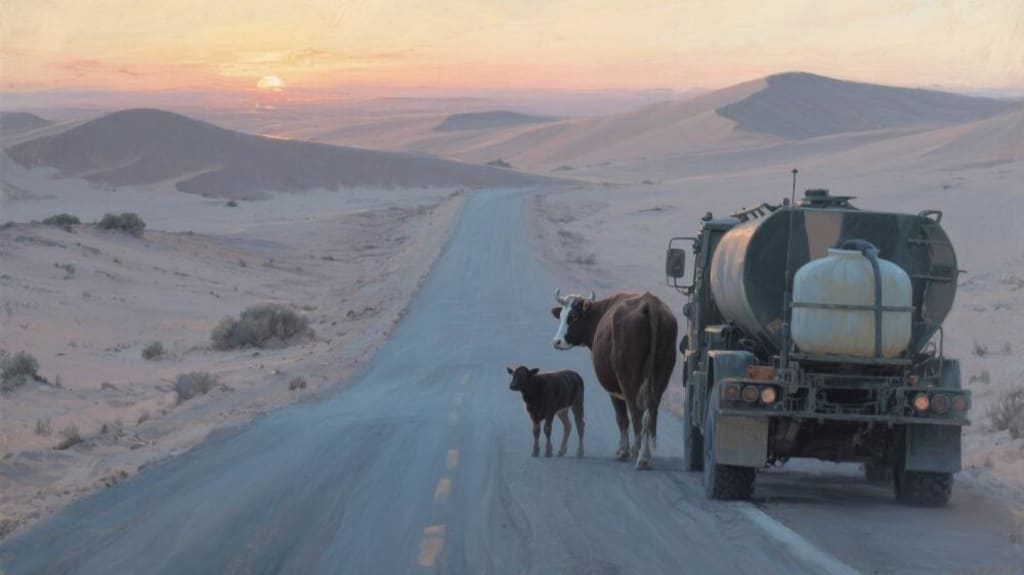
In the vast, sun-scorched deserts of Qinghai, China, where the land cracks open like a parched mouth and the wind carries whispers of thirst, there exists a place where water is not a gift but a promise—a promise measured in kilograms. Here, three pounds of water per day define the boundaries of life. Three pounds to drink, to wash rice and vegetables, to sustain the breath of livestock whose labors are the heartbeat of survival. For generations, the people of this land have learned to ration hope as sparingly as the water itself.
One sweltering afternoon, when the sun had melted the horizon into a golden mirage, a bull—a creature known for his placid eyes and unyielding loyalty—reached the end of endurance. His ribs pressed against his leathery hide like a skeleton praying for rain, his tongue split and bleeding from the dust. Breaking free from the rope that tethered him to his master's will, he lunged toward the dusty road where military water trucks groaned under the weight of their precious cargo.
There is a logic to the desert: it demands surrender. But this bull knew a different logic—the logic of a mother. He stood motionless as the first truck approached, the driver’s face a mask of resignation. “Another scavenger,” the soldier muttered, recalling the dogs and swine that had darted across the road before. But this creature was different. His eyes, dark and liquid with resolve, locked onto the truck’s metal belly, and he did not flinch as the vehicle swerved to avoid him.
“Run!” the soldier shouted, pounding his fist against the window. “Run before the dust claims you!”
The bull did not run. He waited, his body a statue of defiance, until the second truck slowed to a halt. The soldier emerged, his uniform damp with sweat and the weight of a thousand such encounters. “You don’t understand,” he said to the bull, though the creature’s silence was answer enough. “This water is not yours. Each drop is a man’s breath, a child’s cry. It is sacred.”
But the bull’s eyes held no comprehension of rules. They held only the memory of a calf’s whimpers in the night, the dryness of her weakness, the fear in her eyes as she stumbled toward death. The soldier reached for his rifle—not to kill, but to scare—and fired a round into the air. The sound shattered the heat like glass.
The bull did not move.
Behind the trucks, a queue of frustrated drivers grew. Curses hissed through the windows like scorpions. One man, impatient and cruel, doused the bull with gasoline from his tank and struck a match. The fire roared to life, licking the bull’s flanks with hungry tongues. The stench of burning fur filled the air, yet still the bull stood firm, his eyes now glassy with pain but unyielding as granite.
It was the master who found him first. The farmer emerged from the dust, his face a crumpled map of guilt and shame. Raising a whip—a tool meant for guidance, not cruelty—he struck the bull with all his might. Blood bloomed like crimson flowers across the creature’s back, staining the sand, the sunset, the very air with its sacrificial hue. But the bull did not falter. He stood, a monument to stubborn love, until the soldier could bear witness no longer.
Tears streaked the man’s sunburned cheeks as he knelt beside the truck. “Forgive me,” he whispered to the regulations he’d sworn to uphold. He ladled three pounds of water into a basin and set it before the bull. “Drink,” he urged. “Take what you’ve earned.”
The bull did not drink. Instead, he turned his head toward the horizon, letting out a mournful cry that echoed through the barren valleys. From the shadows of a distant dune emerged a small figure—wobbly-legged and wide-eyed, her coat the color of dawn. The calf stumbled toward the water, her movements urgent and desperate. The bull watched, his body trembling not with pain but with relief, as the calf drank deeply, life returning to her limbs with each gulp.
When she finished, the bull lowered his head and nudged her toward the water’s edge. The two stood there for a moment—mother and child—before the calf lifted her muzzle and licked the bull’s bloodstained face. It was a kiss of gratitude, a silent vow. Then, as the last embers of the sunset faded into twilight, they turned and walked away, their hooves kicking up dust that shimmered like stardust in the fading light.
The soldiers and drivers stood in stunned silence, witnesses to a sacrament older than the desert itself. The master hung his head in shame, the whip now a symbol of his own failure to understand what this land truly demanded. And the bull—if he could have spoken—might have said, “This is what love looks like when the desert tries to steal it.”
In the days that followed, the story spread like wildfire across the dunes. People spoke of the bull’s sacrifice, the soldier’s tears, the calf’s survival. They said the desert had shown mercy that day, not through rain, but through a lesson etched in blood and fire: that sometimes, to save a life, one must become the storm.
And in the quiet nights that followed, when the stars blinked like forgotten tears, the people of the desert would remember—and they would weep.
About the Creator
Heydo
A Story That Transforms a Life...
May my story be like a warm ray of sunshine, illuminating the corners of humanity. May it unlock the path to success for you and be a friend that lifts your life to higher heights.
The Myth: Work Hard, Play Hard.
"All work and no play makes Jake a dull boy." When they first met, Sara, had enchanted Jake with her philosophy of work hard and play hard. When they started dating, both were full into studying to gain rank in their undergraduate courses. Work hard, play hard seemed the perfect formula for having the best of a full life. They would spend evenings at the library carrels and then party hardy at least once or twice a week.
By Katherine D. Grahamabout 3 hours ago in Fiction



Comments (1)
This description of the desert's water scarcity is intense. It makes you realize how precious water is. I wonder how the people manage day to day. And that bull's determination... it shows how far one will go for survival. Must be a tough life there.