

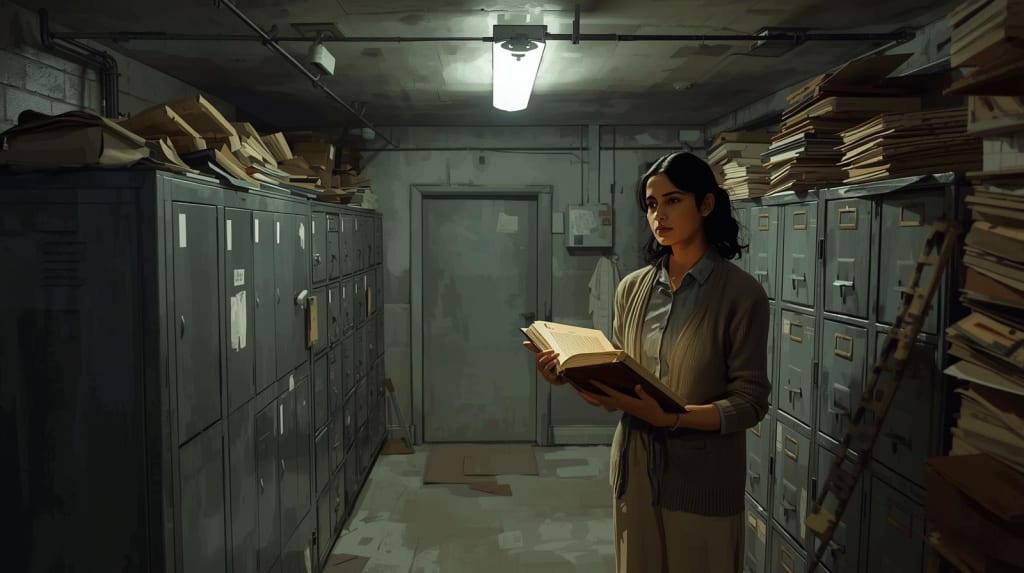
In the small town of Millford, Ohio, where the days blended into one another under a canopy of maple trees, 38-year-old Ellen Porter arrived in the spring of 2025. After years as an accountant in Cleveland, where the city’s noise and pressure wore her down, she’d taken a job at Millford’s town hall to escape the grind. The town was unremarkable—neat lawns, a single diner called Betty’s, and a library that doubled as a community center. Ellen, with her practical mindset and reserved nature, wanted a life with less chaos, even if it meant embracing boredom.
Her new role was straightforward: manage the town’s finances, update records, and ensure the annual budget balanced. The town hall, a squat brick building on Main Street, smelled of old paper and stale coffee. Ellen’s office was a windowless room at the end of a hallway, stuffed with filing cabinets and a desk that wobbled if you leaned too hard. She spent her days sorting through decades of ledgers, her fingers tracing columns of numbers. The townsfolk were polite but distant, offering smiles but little conversation. “Millford’s not exciting,” the mayor, a portly man named Tom Grayson, warned her on her first day, “but it’s steady.” Ellen nodded. Steady was exactly what she wanted.
She settled into a rented apartment above the hardware store, its walls adorned with faded floral wallpaper. Her mornings began with coffee at Betty’s, where she listened to farmers discuss crop prices and retirees swap gossip. Life was predictable, and Ellen liked it that way. She’d left behind a stressful job and a string of failed dates, craving simplicity. Millford, with its quiet streets and predictable rhythms, seemed the perfect fit.
The Lost Record
One humid afternoon in June, while organizing a cabinet labeled “Historical Accounts,” Ellen noticed a gap in the records. The ledger for 1985 was missing. It was a minor thing—most of the town’s finances were digitized now, and nobody cared about 40-year-old budgets—but Ellen’s meticulous nature nagged at her. She liked order, and a missing ledger felt like a loose thread. She asked her coworker, Doris, a chatty woman nearing retirement who’d worked at the town hall for decades. “Oh, probably misfiled,” Doris said, waving a hand as she sipped her tea. “Those old ledgers get shuffled around.” But Ellen couldn’t let it go.
She spent her lunch breaks searching, pulling open drawers and flipping through files. The cabinets yielded nothing but dusty folders and faded receipts for things like road salt and library books. In the basement storage room, among boxes of tax forms and broken chairs, she found a locked metal box labeled “1985–1986.” It was heavy, its lock rusted but intact. Ellen’s curiosity, usually buried under spreadsheets, stirred. Why lock a box of old records? She asked the mayor, who shrugged. “Probably just misplaced,” he said, adjusting his glasses. “Don’t worry about it.” But Ellen’s mind kept circling back to the box.
She started noticing small inconsistencies in the 1984 and 1986 ledgers—minor rounding errors, a few vague entries labeled “miscellaneous.” It wasn’t enough to raise alarms, but it fueled her need to find the missing record. At night, she’d lie awake in her apartment, the hum of the refrigerator her only company, wondering why a simple ledger mattered so much to her. Maybe it was the monotony of Millford—she needed a puzzle, however small.
A Trail of Paper
Ellen began asking around, casually at first. At Betty’s Diner, she chatted with Mr. Hensley, a retired postman who’d lived in Millford his whole life. He recalled 1985 as the year the community center was rebuilt after a fire. “Took a lot of donations,” he said, stirring sugar into his coffee. “Folks were proud to see it rise again.” His tone was casual, but he avoided her eyes when she mentioned the ledger, quickly changing the subject to the weather. Ellen’s suspicion grew. Had something been hidden?
Back at the town hall, she found a reference to the 1985 community center project in the 1986 ledger. A vague entry listed “miscellaneous donations” totaling $50,000, a large sum for a small town like Millford. No donor names were recorded, which struck Ellen as odd—donations were usually proudly listed. She visited the library’s newspaper archives, a cramped corner with a microfiche reader that smelled of mildew. Articles from 1985 described the fire and the community’s effort to rebuild, but details on funding were scarce. One photo showed the mayor at the time, Harold Vance, shaking hands with a man in a suit, captioned only as “benefactor.”
Ellen’s evenings became consumed with the mystery, though she admitted it was hardly thrilling. She’d sit at her kitchen table, sipping chamomile tea, jotting notes on a legal pad. The locked box gnawed at her. She tried picking the lock with a paperclip, feeling foolish but determined, her hands steady from years of balancing books. The lock didn’t budge. Finally, she asked Doris, who mentioned that Harold Vance’s widow, Clara, still lived in town, in a bungalow on Elm Street.
A Visit to the Past
Clara Vance was a frail woman in her 80s, her home tidy with lace curtains and a faint smell of lavender. Over tea, she listened to Ellen’s questions with a faint smile, her hands folded in her lap. “Harold was proud of that community center,” she said. “He worked hard to fund it.” When Ellen mentioned the locked box, Clara’s smile faded. “Some things are best left alone,” she said, her voice sharp. Ellen pressed gently, mentioning the $50,000. Clara sighed, her eyes distant. “It was a private donor. Harold promised to keep it quiet. That’s all you need to know.”
Ellen left, unsatisfied but sensing Clara was hiding something. Back at the town hall, she rummaged through a forgotten desk in the storage room and found a ring of keys, one labeled “Storage.” Her heart skipped as she tested it on the metal box. The lock clicked open. Inside was the 1985 ledger, its pages brittle but legible. It detailed the community center funds, confirming the $50,000 came from a single source: a company called Meridian Trust. A quick online search on her phone revealed Meridian was a shell company, dissolved in 1986, linked to a businessman who’d faced tax evasion charges in the ’90s. Ellen’s stomach sank. Had Millford’s pride been built on dirty money?
She sat in her office, the ledger open before her, the fluorescent lights buzzing. The discovery wasn’t earth-shattering—no ghosts, no conspiracies—but it was a blemish on Millford’s wholesome image. She wondered if Harold Vance had known the money’s origins or if he’d been desperate to rebuild and looked the other way.
Closing the Books
Ellen faced a choice: report the find or let it rest. The money was long spent, the community center a beloved fixture where kids played basketball and seniors held book clubs. Exposing it might tarnish memories, maybe even hurt the town’s spirit. She took the ledger to the mayor, who looked pale but unsurprised, his fingers drumming on his desk. “It’s history,” he said quietly. “No need to stir trouble.” Ellen agreed, not out of fear but practicality—digging up the past would hurt more than help. She filed the ledger away, adding a note: “Reviewed, no discrepancies.”
The strange occurrences stopped—though, in truth, there’d been none beyond her own imagination. The town hall felt ordinary again, its hum of fluorescent lights unchanged. Ellen settled back into her routine, balancing budgets, updating spreadsheets, and sipping coffee at Betty’s. Millford remained boring, just as she’d wanted, but she felt a quiet pride in solving her small mystery, even if no one else cared.
She donated a new filing cabinet to the town hall, ensuring the 1985 ledger was properly stored. Life went on, steady and unremarkable, and Ellen found comfort in the monotony. Her days were marked by the soft rustle of paper, the clack of her calculator, and the ticking of the office clock, each moment blending into the next in the quiet heart of Millford.
About the Creator
Shohel Rana
As a professional article writer for Vocal Media, I craft engaging, high-quality content tailored to diverse audiences. My expertise ensures well-researched, compelling articles that inform, inspire, and captivate readers effectively.
Keep reading
More stories from Shohel Rana and writers in Fiction and other communities.
The Lantern's Keeper
In the coastal village of Greyhaven, where the sea whispered secrets to the cliffs, 29-year-old Nora Hayes arrived seeking solace. After a corporate burnout in Boston, she’d impulsively taken a job as the keeper of the old Greyhaven Lighthouse, a weathered beacon standing alone on a rocky outcrop. The villagers called it cursed, claiming its light flickered even when no one tended it. Nora, skeptical but desperate for a fresh start, saw it as a chance to rebuild herself in 2025.
By Shohel Rana6 months ago in Fiction
Pandora’s Burden
“My brother warned me to not accept gifts from the one who commissioned you,” said Epimetheus to the woman clad in silvery raiments standing at the entrance to the temple. Her silver tiara and the silver rings on her fingers and toes glinted in the firelight cast by torches set on either side of the doorway. Lingering in the shadows, beyond the reach of the flames as she was, he could not tell what she held in her hands. At first what appeared to be a box was perhaps a funerary urn, or maybe merely an apple.
By J. Otis Haasa day ago in Fiction
Born of Blood
They never spoke my name. Never sang my praises. My brother’s name, though—everyone knows that one. I was born to live in his shadow. Not for lack of strength. My golden sword and I have conquered many foes. But strength means nothing when no one remembers you.
By Carolyn Sternesabout 23 hours ago in Fiction


Comments
There are no comments for this story
Be the first to respond and start the conversation.