
The Message and the Ink
Some messages are written not on paper, but into the skin of time—and only the right eyes can read them.

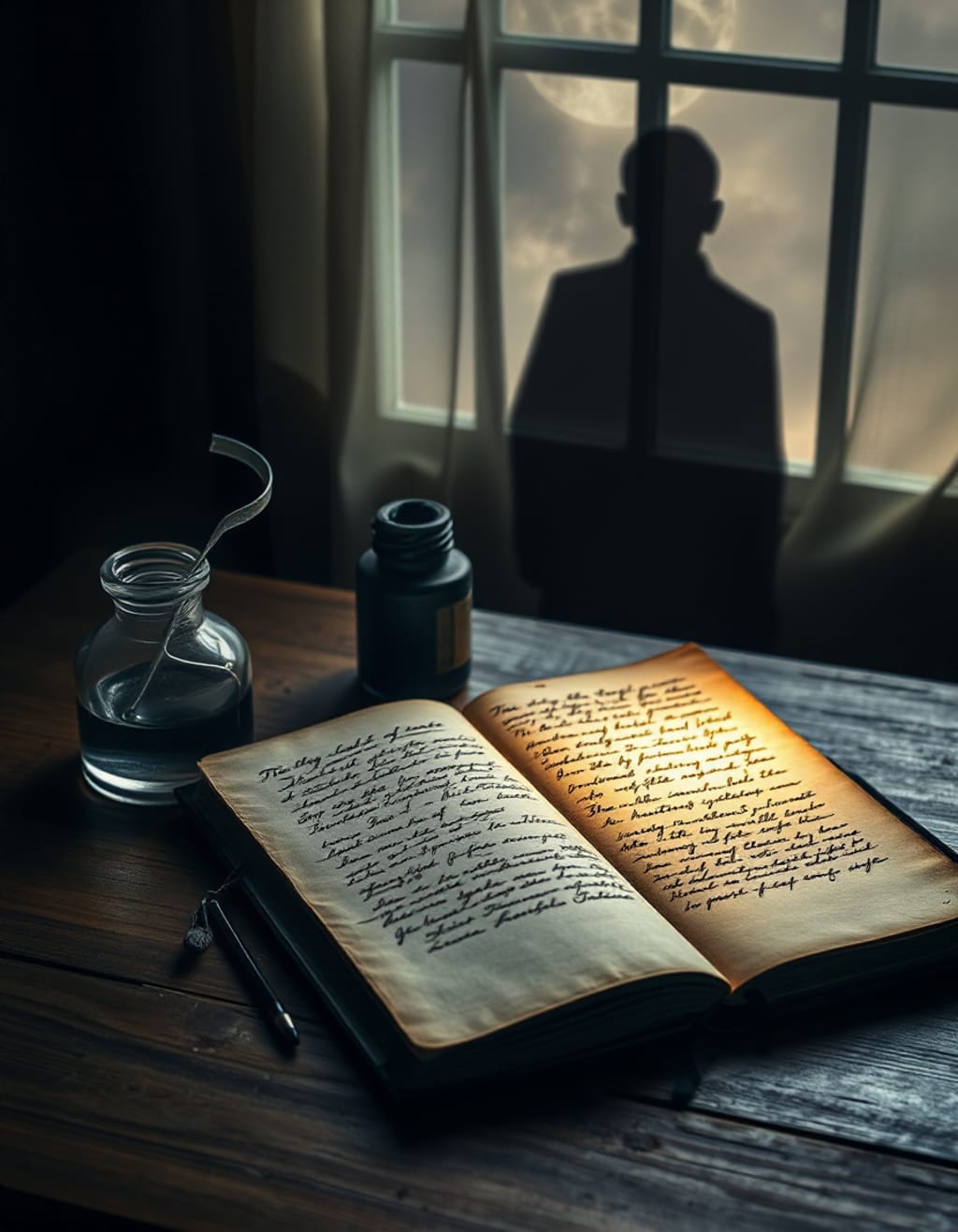
Nobody remembers who built the Library of Nocturne, only that it appears once every hundred years, somewhere the world has forgotten. It’s not bound by coordinates or chronology. It lives on memory, regret, and longing.
Eliah found it the night his heart broke. He had been wandering the coast, chasing the ink-black waves with a bottle of whiskey in one hand and a letter in the other. The letter had no ink, just an indentation from words once written and then erased.
It was from Mara.
She had once written, "I will love you until the ink runs dry."
But now the page was blank.
The library stood where the cliffs ended—an impossible structure of twisted spires and glowing panes. It whispered, not with wind, but with unwritten stories. Eliah, half-drunk, stepped inside.
He was greeted not by a librarian, but by a voice:
“Welcome, Scribe of the Unsaid.”
The doors closed behind him, and the air smelled like old books and midnight rain. Shelves spiraled toward the ceiling, but the books had no titles. Some were bound in feathers, others in scales. One even pulsed faintly, like a sleeping heart.
A single desk waited in the center, an old fountain pen resting beside parchment that shimmered. The ink inside the pen was not black—but deep violet, shifting like galaxies inside glass.
A note on the desk read:
“Write only what was never said.”
Eliah hesitated. He had nothing left to say to the world, and the world had long stopped speaking to him.
But something about the ink called to him. It wasn’t made of pigment. It was made of memory.
He dipped the pen.
The first word wrote itself: Mara.
The ink rippled like water disturbed by a whisper. As he wrote, the parchment absorbed more than words—it absorbed ache, silence, the thousand kisses never given, the fights never started but always felt.
And when he finished the sentence, the page glowed.
"She left before I could tell her that I had already forgiven her."
And then—it vanished.
The paper dissolved into violet mist.
But something stirred behind the shelves. A flutter. A faint breath. A shape—a figure made of ink and light—emerged.
It was Mara.
Not flesh and blood. Not ghost.
Ink.
Memory.
Message.
She stepped forward, eyes reflecting stars Eliah had never seen.
“You finally wrote it,” she whispered.
He blinked. “You’re not real.”
“I am what you never said. What you buried so deep, even time forgot.”
Tears came unbidden. “But I tried to forget you. I tried to erase everything.”
“And yet here I am,” she smiled, “written into the ink of your silence.”
She reached out, touching his cheek. Her fingers left no mark—but they trembled as if she remembered his warmth.
“There are others,” she said, turning toward the endless rows. “Others waiting to be written. Forgotten fathers. Abandoned friends. Words of children who never lived long enough to speak.”
She stepped back into the dark.
“Will you write them?”
The desk was now full. A dozen pages. A thousand.
Eliah wrote:
To the mother who couldn’t say goodbye.
To the brother who smiled through pain.
To the unborn daughter who only existed as a name in a journal: Aurelia.
Each time he wrote, a page vanished, and a figure emerged—soft, incomplete, glowing. They wept. They smiled. They whispered.
Not all forgave him. Not all stayed.
But they were all seen.
He learned, slowly, what the ink was.
It was regret. Crystallized. Distilled from a thousand lives across a thousand timelines. Harvested by the Library of Nocturne.
It was not meant to trap him.
It was meant to free them.
But ink runs out.
One day, the pen stuttered. The color faded.
Only one page remained.
And Eliah still hadn’t written to himself.
He thought of all the things he never said:
“You deserved more than survival.”
“You mattered before anyone ever told you so.”
“You are not just what’s been left behind.”
He dipped the pen one last time.
The ink flowed.
He wrote to the child version of himself. The boy who used to sleep with a notebook under his pillow, hoping one day someone would read his dreams.
"Dear me," he began, "You were always more than the silence you carried."
As the final sentence formed, the page shimmered golden.
A mirror appeared before him.
His own face—young, hopeful, intact.
The boy stepped out, took the pen, and smiled.
“You wrote it,” the boy said.
And then the Library began to dissolve.
Eliah woke on the cliff’s edge. The letter from Mara still blank. The whiskey bottle half-empty.
But there was ink on his fingers.
And in his pocket—a single scrap of parchment.
It read:
“The Library appears to those who carry too much unsaid. When the ink runs out, your story begins.”
He turned the letter from Mara over.
There were words now.
Not written by him. Not even in her handwriting.
But in ink that shimmered violet.
"I never stopped loving you—I just didn’t know how to say it in time."
One year later, Eliah published a book titled The Message and the Ink.
It wasn’t a bestseller.
But readers across the world reported strange things:
Letters in their drawers had changed.
Old journals revealed lines they never wrote.
Dreams whispered in languages they never learned—but felt familiar.
And every copy of Eliah’s book ended with a blank page.
And a fountain pen.
For someone else’s turn.
Final Author's Note (fictional):
Some messages live outside language. Some ink is made from more than pigment. This story was written for the ones we never wrote to—the silent ones, the lost ones, and the pieces of ourselves we buried to survive. If you’re reading this, maybe it’s time to pick up the pen.
About the Creator
rayyan
🌟 Love stories that stir the soul? ✨
Subscribe now for exclusive tales, early access, and hidden gems delivered straight to your inbox! 💌
Join the journey—one click, endless imagination. 🚀📚 #SubscribeNow




Comments
There are no comments for this story
Be the first to respond and start the conversation.