
The Memory Thieves
"In a world where memories are currency, one woman risks everything to reclaim the pieces of herself that were stolen."


I woke up with no name.
Not in the poetic sense—no amnesia cliché, no slow fade of recollection. It was gone. My actual name. The sound of it, the feeling of it, the weight it carried in my bones—stripped clean from my mind.
In our world, that’s not an accident.
The Memory Exchange Act legalized memory trade three years ago. At first, it was marketed as therapeutic—people selling traumatic events to lighten their burdens, or donating happy memories to the grief-stricken. But the black market bloomed faster than the law could keep up. Memory Thieves emerged—neural hackers, underground brokers—stripping strangers of their most precious moments and selling them to the highest bidder.
I’d worked hard to stay under their radar. But now, sitting in my cramped apartment with a half-empty mug of coffee, staring at a stranger’s reflection in the mirror, I knew they’d found me.
The official police term is “Cognitive Larceny.” The street name is “brain-jacking.” Either way, the only way to get stolen memories back is to track them to the buyer. And buyers—wealthy, paranoid, untouchable—don’t give them up willingly.
I wasn’t a cop. I wasn’t a thief. I was… something else. Or had been. My old life was a sealed vault, and I didn’t have the key.
What I did have was a lead.
A woman named Vega ran one of the largest memory-trading rings in the eastern sector. Her trademark? She didn’t just take random moments—she stole identity. Names, first kisses, the faces of parents. Whole pieces of the self. If she had me in her ledger, then somewhere, in some luxury high-rise, someone was sipping champagne and living inside my past.
Vega’s headquarters was hidden inside an abandoned subway terminal. I went in armed with nothing but a neuro-scrambler and a stun pistol—both bought with my last few credits. The place reeked of ozone and damp concrete.
She was waiting for me.
“You’re early,” she said, lounging in a cracked leather chair. Her hair was silver—not from age, but by design. Her eyes glinted like polished glass. “Usually my clients take longer to miss themselves.”
“I want my name back,” I said.
She laughed. “Darling, that’s not how this works. Memories aren’t property; they’re experiences. Fluid. Transferrable. Yours is already gone.”
“Then tell me who bought it.”
Her smile didn’t falter. “Even if I wanted to, you’d never get close. My buyers pay for exclusivity. Your past is their present now.”
I tightened my grip on the pistol. “Then I’ll take it from them.”
The buyer’s name was Cassian Roe. I got it not because Vega gave in—she didn’t—but because I stole it from her mind. The neuro-scrambler worked faster than she expected, short-circuiting her implants long enough for me to siphon the data.
Cassian Roe lived in a skyscraper called The Lattice, a vertical city for the elite. I walked through its chrome halls in stolen maintenance coveralls, my heart pounding.
When I found him, he was sitting in a sunlit penthouse, reading an old paperback with a look of quiet joy. The sound of my name—my real name—came from his lips as if it belonged to him.
“Who are you?” I asked.
He studied me with unfamiliar eyes. “I’m you,” he said simply. “Or rather… I was nothing until I bought you.”
In the black market of memories, ownership is intoxicating. Buyers don’t just remember—they become. Cassian had bought my childhood laughter, my mother’s lullabies, my teenage heartbreaks. Every corner of me lived inside him now, stitched into his mind like a second skin.
“I need them back,” I said.
“You think they’ll fit anymore?” His tone was almost kind. “Memories are like rivers. Once diverted, they carve new paths. Even if I gave them to you, they wouldn’t be yours. They’d be… copies.”
“I don’t care,” I said, voice breaking. “I just want to know who I was.”
He could have called security. Instead, Cassian poured two glasses of wine.
“Do you know why I bought you?” he asked. “Because you fought. Even in your darkest memories, you fought to survive. I wanted that strength. I thought if I had it, I’d stop feeling like an empty shell.”
I set the glass down. “So you stole mine to fill yours.”
“I paid for them,” he corrected.
We sat in silence for a long moment. Then, without warning, he activated the transfer link built into his neural port.
Light—warm and blinding—poured into my mind. Faces, voices, laughter, tears. My name, spoken in a thousand shades. It hit me like a tidal wave.
And then it was gone.
I collapsed to the floor, gasping. Not all of it had stayed. Just fragments. Enough to know my name, to see my mother’s face again, to remember the sound of rain on the old apartment roof.
Cassian looked smaller somehow, slumped in his chair. “I kept the rest,” he said softly. “I can’t give it all up. Without it… I’d be nothing again.”
I should have hated him. But in that moment, I saw the truth: memory theft wasn’t just about greed—it was about hunger. A desperate need to be someone.
I stood, my hand brushing the door frame. “Keep them,” I said. “But remember this—” I tapped my temple. “What you took from me made me who I am. What’s left will make me stronger.”
As I walked away, the city skyline glittered like a circuit board, alive with millions of stolen lives. I didn’t have all of mine back, but I had enough to fight.
And next time, the Memory Thieves wouldn’t see me coming.
About the Creator
Junaid Shahid
“Real stories. Real emotions. Real impact. Words that stay with you.”
“Observing society, challenging narratives, and delivering stories that matter.”
“Questioning power, amplifying the unheard, and writing for change—one story at a time.”
Keep reading
More stories from Junaid Shahid and writers in Fiction and other communities.
Big Horns, Bigger Lesson
Farmer Fred had just made an exciting new purchase for his farm — a young, strong, and remarkably large bull. He proudly named him Bill. With powerful legs, a broad chest, and two magnificent horns that curled gracefully from his head, Bill was an impressive sight.
By Junaid Shahid 7 months ago in Fiction
What We Say at the End of Things
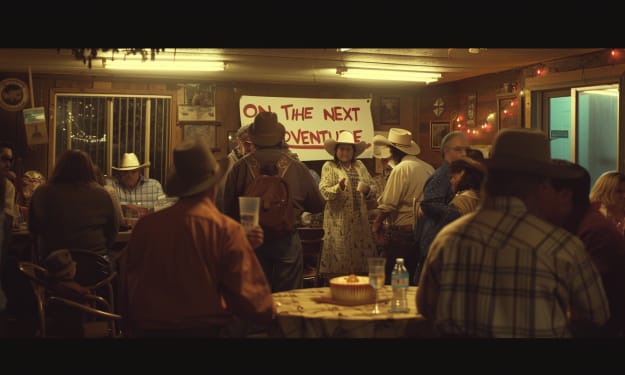
The party for the Black family had been Connie Portillo's idea, and everyone agreed it was the right thing to do. The Black family had ranched the same four thousand acres east of Marfa for a hundred and twelve years, and now they were not going to ranch it anymore, and the least the town could do was send them off properly. Connie had used the phrase send off without appearing to hear herself use it. She'd booked the back room at Mando's, ordered two sheet cakes from Lowe's, and made a sign on poster board that said CONGRATULATIONS BLACK FAMILY — ON TO THE NEXT ADVENTURE.
By Leslie L. Stevens Writer | Marfa, Texas4 days ago in Fiction


Comments
There are no comments for this story
Be the first to respond and start the conversation.