
The Memory Merchant
A woman walks into a shop to erase pain—only to find a memory that isn’t hers… and can’t be forgotten.

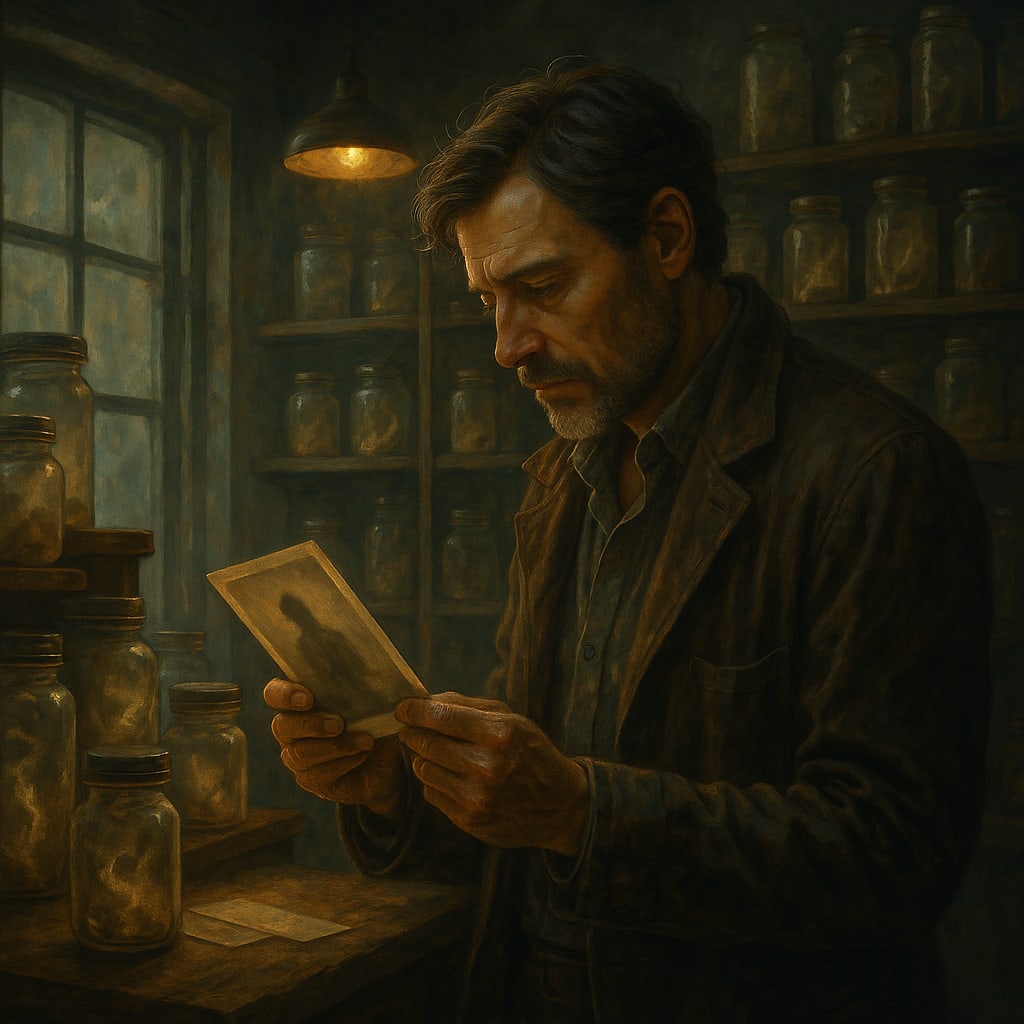
Some memories hurt too much to keep—others hurt too much to lose.
No one ever asked to remember.
They came to forget.
Heartbreaks. Accidents. Regrets that gnawed at the edges of sleep. People lined up around the block to step into a shop that promised peace—not truth. The kind of peace that comes not from healing, but from absence.
And Eliot had made a business of it.
1. The Shop Where Memories Go to Die
It was a narrow place tucked between a boarded-up bakery and a holographic tattoo parlor. No windows, only a faded sign overhead:
“E. Rhodes: Memory Adjustment & Archival.”
Inside, the scent of ozone and lavender greeted visitors like the past trying to smell like something softer. Shelves filled with glass vials lined the walls—each glowing faintly with the residue of someone else’s life.
Eliot didn’t wear a lab coat. He wasn’t a scientist in the traditional sense. But he was a technician of the soul. And his machine—a sprawling, vine-like neural interface of his own design—sat humming in the back room like a living thing. He called it Mnemosyne.
"Memories are just code," he often said. "Electrochemical imprints. Nothing more."
But even he didn’t fully believe it.
2. The Stranger with Nothing to Forget
One rainy evening, as neon signs reflected in puddles like broken constellations, the bell above the door rang. Eliot looked up from a half-dismantled interface.
She was soaked, her hair clinging to her face. No umbrella. No expression.
“Do you remove memories?” she asked.
He gestured toward the softly pulsing vials. “That’s what we do here.”
“But I don’t want one removed,” she said. “I want one restored.”
That gave him pause.
Her name was June. She carried no ID, no neural chip registry—only a photograph. Worn at the edges, faded to sepia.
“Who is it?” he asked.
“I don’t know,” she replied. “But I think I used to love them.”
3. Excavating the Ghost
No one had ever asked to recover a memory before. Eliot explained the risk:
“Memories aren't lost, not really. They're just buried. And sometimes, there's a reason they're buried.”
June nodded. “I don’t care if it hurts. I just want to know what I lost.”
They connected her to Mnemosyne. The machine unfolded like silver ivy, its tendrils mapping the synaptic highways of her brain. Eliot monitored the signals. Fragments floated into view—half-rendered images, voices without mouths, the echo of a laugh she didn’t recognize.
Then—static.
Something was there. Something strong.
He isolated the anomaly. A memory cluster surrounded by a dense tangle of emotional blockades. Trauma markers. Deep ones. Whatever was hidden had been locked away, either by the brain—or someone else.
“I can force it,” he said. “But it may come with everything that caused you to forget in the first place.”
“I’m ready,” June said.
4. The Memory That Wasn’t Hers
When the memory came, it arrived like a tidal wave.
She gasped, her body tensing beneath the wires. Eliot almost shut the system down—but she gripped the chair.
And then, the scene played:
A boy. Eighteen, maybe. Laughing in the sun. The sea behind him.
He turns to her—to the woman June used to be—and shouts, “This moment, remember it for me, will you?”
She asks why.
He says, “Because I won’t get to keep it.”
The next image: an accident. The screech of metal. Blood in the water.
Then silence.
When June came to, tears were pouring from her eyes.
“It wasn’t my memory,” she whispered.
Eliot nodded slowly. “No. It was his.”
5. The Merchant’s Confession
“How did it end up inside me?” she asked.
Eliot looked down at his hands. Hands that had erased hundreds of memories.
“Some people… come here not to forget themselves, but to give a part of themselves away. He came here a decade ago. Told me he was dying. He wanted to preserve a memory, give it to someone—anyone—so it could live on, even if he didn’t.”
He hesitated.
“I stored it in the archive. Meant to destroy it after five years. But something about it… I couldn’t.”
June wiped her face. “Why me?”
“Maybe,” Eliot said, “because you came in. And he was still waiting to be remembered.”
6. The Bottle and the Ocean
June didn’t ask for the memory to be removed.
She asked for a copy.
She wanted to keep the boy in the sun.
The sea.
The echo of a moment that once belonged to someone else—but now, in a strange and tender way, belonged to her too.
Before she left, she turned to Eliot.
“Do you ever keep any of them?” she asked.
He smiled sadly. “Only the ones that won’t let go.”
About the Creator
Ahmet Kıvanç Demirkıran
As a technology and innovation enthusiast, I aim to bring fresh perspectives to my readers, drawing from my experience.
Keep reading
More stories from Ahmet Kıvanç Demirkıran and writers in Fiction and other communities.
Where the Waves Remember Us
Some loves are not lost—just carried away. The sea did not keep time as humans did. But he did. Every year on the same day—August 17th—he returned to the shoreline where the cliffs curled like question marks and the wind never remembered to rest.
By Ahmet Kıvanç Demirkıran8 months ago in Fiction




Comments (2)
nice bro i like you
Excellent story♦️♦️♦️♦️