
The Melon and the Mango King
A whimsical fable from a bustling bazaar in Multan where fruits argue about pride power and survival.

The Tale of the Melon and the Mango King
BY:Ubaid
It was a bright Sunday morning in Multan. The streets bustled with unusual liveliness; the air hummed with the noise of bargaining voices, the jingling of coins, and the aroma of freshly baked bread wafting from nearby stalls. Being the weekly holiday, the marketplace was more crowded than usual. Everyone—from mothers carrying long lists to children pulling their fathers’ sleeves—had come to shop.
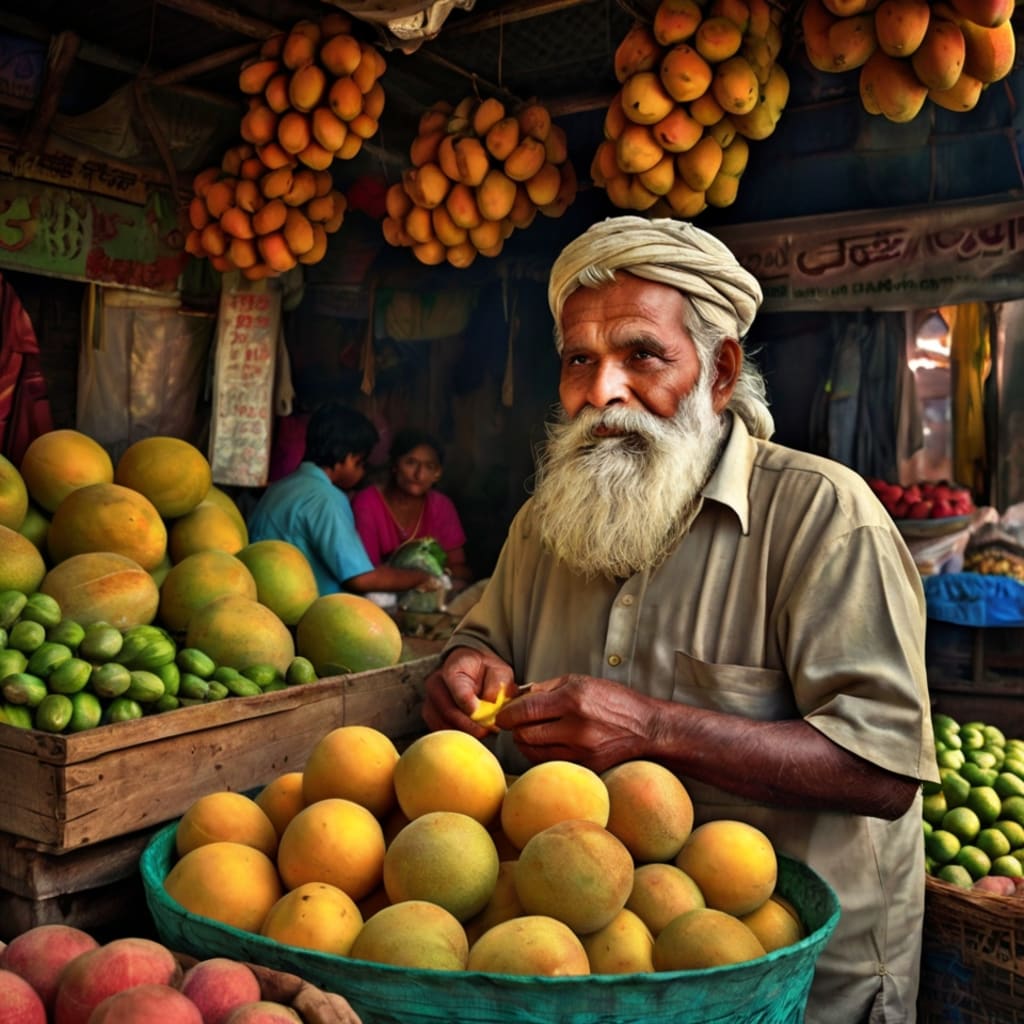
Among the many shopkeepers sat Hasho Bhai, the fruit vendor. For decades, he had worked on the same corner of the bazaar, selling fruits of every kind. His wrinkled face carried the marks of time, his long white beard gave him a gentle aura, and his almond-colored kurta and worn-out slippers added to his simple, saint-like appearance. People respected him not just for the freshness of his fruits but for his honesty and calm nature.
On this particular Sunday, Hasho Bhai had meticulously washed and arranged every fruit on his stall. Apples shone like rubies, guavas rested neatly in a wicker basket, and grapes dangled like tiny pearls in the morning sun. But what caught the eye most was his unusual decision—he had placed melons right next to the mangoes, the so-called king of fruits.
It was an unspoken rule in the fruit world: mangoes claimed the throne. No fruit dared to rival them. Yet here they were—bright golden melons sitting proudly beside the royal mangoes, attracting buyers with their sweet aroma.
The melons, thrilled by their new position, whispered among themselves. “Look at us today! We are the jewel of the stall. Everyone’s eyes are on us.” Their smooth yellow skins glistened under the sun, and they felt like honored guests at a royal feast.
But the mangoes were not amused. Their pride was wounded. Especially the Mango King, who had always enjoyed the limelight. Seeing melons placed beside him was nothing short of an insult. His face darkened with anger as he muttered, “How dare you, Melon, sit so close to my throne? Do you think yourself worthy of standing shoulder to shoulder with me?”
The poor melon shivered at these words. When Hasho Bhai stepped away from the stall for a brief moment, the Mango King raised his voice even louder:
“You impudent fellow! You know very well this place belongs only to me. What is next? Will you push me off the stall tomorrow?”
The melon, trembling but clever enough to know the danger of confrontation, bowed humbly and said softly:
“Your Majesty, may I beg your pardon before I speak?”
The Mango King, swelling with arrogance, smirked and replied, “You may speak. Consider it an act of my generosity. You shall remember this day.”
The melon, gathering courage, began flattering the king.
“Your Highness, I am but a worthless servant. My very presence here is because of your mercy. I would never dare to compete with you. If I sit close to you, it only raises my own honor, not yours. I am grateful beyond words.”
The Mango King puffed up with pride, his ego swelling with each sugary word. The melon continued:
“Everyone knows it is your name that rules every household. Children, elders, poets, and kings—all adore you. Even those who are forbidden to eat sweet fruits, such as the patients with diabetes, still crave you secretly. Great poets like Ghalib and Iqbal praised your glory. Compared to you, I am nothing but dust.”
The Mango King was nearly bursting with delight. “Yes,” he declared, “perhaps I have been too harsh. We shall consider your request for pardon.”
But before the conversation could go further, Hasho Bhai returned. He picked up a cluster of mangoes, including the proud king himself, and called out to a customer.
“Look here, Sir! These are first-class mangoes, special from Sindh. Sweet, juicy, unmatched in taste!”
The customer raised his eyebrows. “And what’s the price?”
“Two hundred and fifty rupees per kilo,” Hasho Bhai replied, “but for you, only two hundred.”
The man shook his head with a smile. “One hundred and fifty. I’ll take them all. We’re hosting a feast today.”
Hasho Bhai chuckled, weighing the mangoes. “These are five kilos, then. That will be seven hundred and fifty, but since you’re giving eight hundred, I’ll keep the change. Thank you, brother.”
And just like that, the Mango King’s reign ended—not on the throne of the fruit stall but in a plastic shopping bag, carried away to a stranger’s home.
As he looked back from inside the bag, the Mango King’s eyes fell on the melon still resting proudly on the stall. His voice trembled with bitterness:
“Laugh now, Melon, but remember—your turn will come. Soon you, too, will be sold, and you will meet the same fate.”
The melon, however, only smiled. He knew something the Mango King did not: while mangoes came and went in summer, melons held their charm through the hottest days, quenching the thirst of weary souls. For now, he had survived, and survival was victory enough.
And so, in the noisy bazaar of Multan, amid the clamor of coins and the chatter of buyers, the humble melon sat silently—grateful, patient, and a little wiser than before.
About the Creator
Bomb Scare
It was 2027, and the world never thought it would happen. A missle hit the United States, but it wasn't where they had anticipated. A little town in the northeast was hit by a missile strike, they didn't know why, and they didn't know exactly where it hit, but they did know it was a coastal community, somewhere between Maine and Delaware.
By Gregory Payton5 days ago in Fiction
Guard Your Battery
Why are some people so attractive just by standing there? It’s not because they are "likable," but because they don’t need everyone to like them. I realized later that truly charismatic people allow themselves to be criticized, but they never criticize themselves. They never try to please the world; instead, the world stops to watch them.
By Emily Chan - Life and love sharing6 days ago in Poets


Comments (2)
Nice bro i like it. Support of each other will grow us faster do you agree with me i am already your supporter but don,t forget me also i need support ok dear.
Der kha zama hum articles like ka