
The Man Who Cut a Mountain for His Village
A True Story of Love, Loss, and Unbreakable Will

The Man Who Cut a Mountain for His Village
Sometimes, the most powerful stories are not hidden in history books or movies but live silently in the hearts of common people. This is the story of a man who proved that love and determination can move mountains – literally.
His name was Dashrath Manjhi. Born in a small village called Gehlaur in Bihar, India, he grew up seeing the same sunrise, the same dusty roads, and the same mighty mountain that stood like a silent enemy between his village and the nearest town.
The people of Gehlaur were poor. Their children died without medical help, pregnant women could not reach hospitals on time, and farmers suffered because they could not take their crops to the market easily. The mountain had divided their lives into two parts – what could be, and what was not possible.
But for Dashrath, life was simple. He woke up every morning, worked in the fields, earned daily wages, and came back to his little mud house, where his wife, Falguni Devi, waited with roti and dal. Their love was silent and strong. She was his world, his peace after a tiring day.
One morning, as Falguni was climbing the steep mountain to bring him lunch in the field, she slipped. Her feet lost grip on the rough stones. Injured and bleeding, she somehow reached him, but the nearest hospital was more than 55 kilometers away because they had to take a long route around the mountain. He carried her, crying and running, hoping she would survive.
But life is cruel to the poor. She died before reaching the hospital.
Dashrath’s world broke that day. The silence in his house screamed at him every night. The mountain that took his wife became his enemy. People thought he would lose his mind in grief. And they were right – he did lose his mind, but he lost it to a purpose.
He decided no one else should lose their loved ones because of this mountain. But who was he? Just a poor labourer with no money, no education, and no support.
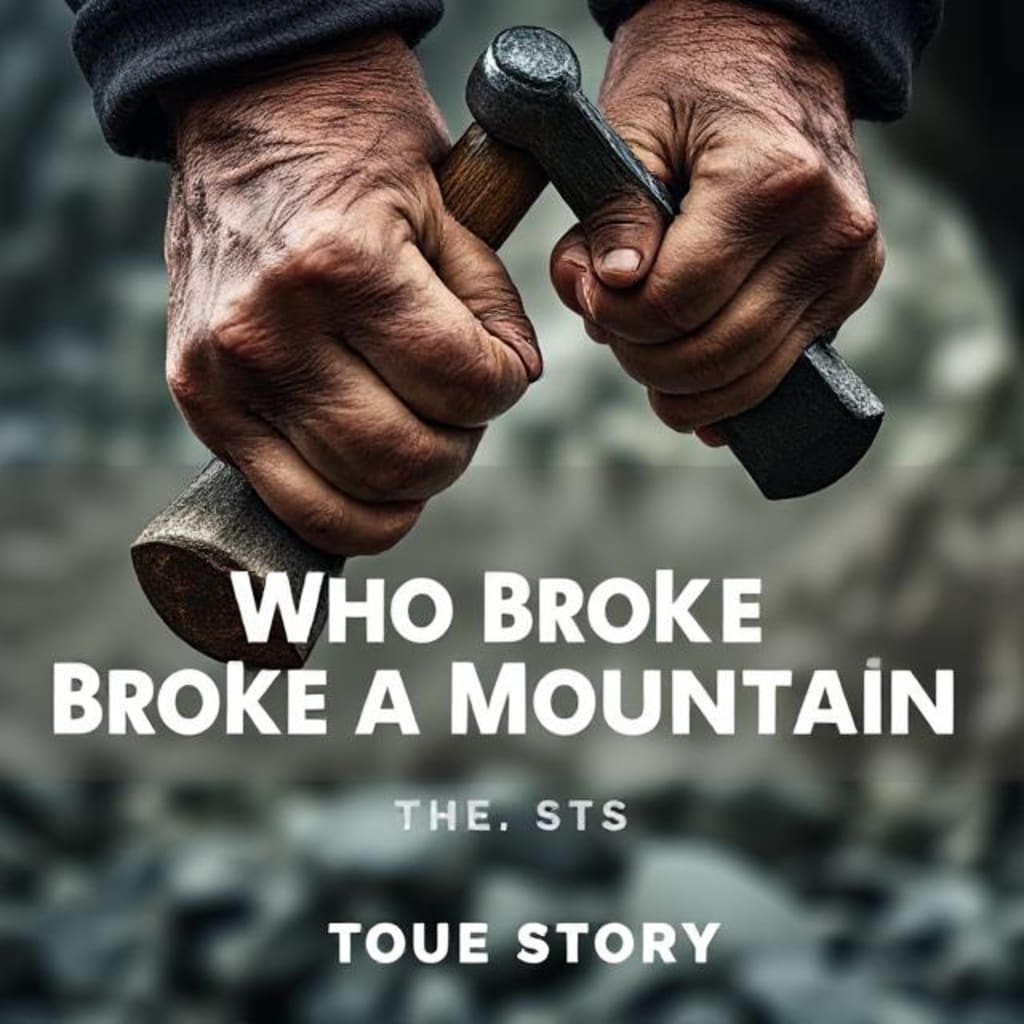
One morning, he picked up a hammer and a chisel.
People laughed at him. They called him mad. Children teased him. Elders said, “Pagal ho gaya hai.” But he did not care. Day after day, month after month, he climbed the rocky mountain and started cutting it – alone.
When the sun rose, he was there. When the sun set, he was still there. His hands bled, his feet cracked under the stones, but he did not stop. When he got tired, he sat down and looked at the rocks with tearful eyes and whispered, “I will defeat you.”
He sold his goats to buy better tools. He worked as a labourer in nearby towns to earn money for hammers. He ate less to save money. He wore the same torn clothes, his body turning darker and thinner under the sun, but his willpower grew stronger every single day.
Years passed. Ten years. Fifteen years. Twenty years.
People began to notice. The same villagers who called him mad started calling him “Baba” with respect. They saw the road growing every day. They saw the mountain breaking under the hands of one single man. They saw how grief can be turned into unstoppable power.
Finally, after 22 years, Dashrath Manjhi stepped back and saw what he had done. He had created a path 110 meters long, 9.1 meters wide, and 7.6 meters deep.
The distance from his village to the town reduced from 55 kilometers to just 15 kilometers.
Children could now go to school. Pregnant women could reach the hospital on time. Farmers could sell their crops in the market easily. The village was no longer locked in the prison of rocks. One man had freed an entire generation.
When journalists asked him, “Why did you do it?” he simply smiled and said,
> “Because I loved my wife so much. And I did not want anyone else to lose someone they love because of a mountain.”
Dashrath Manjhi died in 2007. The government gave him state honours at his funeral. They named roads after him, showed his story in movies, and gave speeches about his greatness.
But the real honour lies in the hearts of the villagers who walk on the path he carved with his bare hands. For them, he is not just the Mountain Man. He is the proof that love never dies, and if your purpose is pure, no mountain is too big to break.
---
،Moral of the Story: Greatness is not in power or money. Greatness is when you turn your pain into a path for others.
About the Creator
GooD BoY
Trust yourself, for you have that capability. Find your happiness in others' joy. Every day is a new opportunity—to learn something new and move closer to your dreams.


Comments
There are no comments for this story
Be the first to respond and start the conversation.