
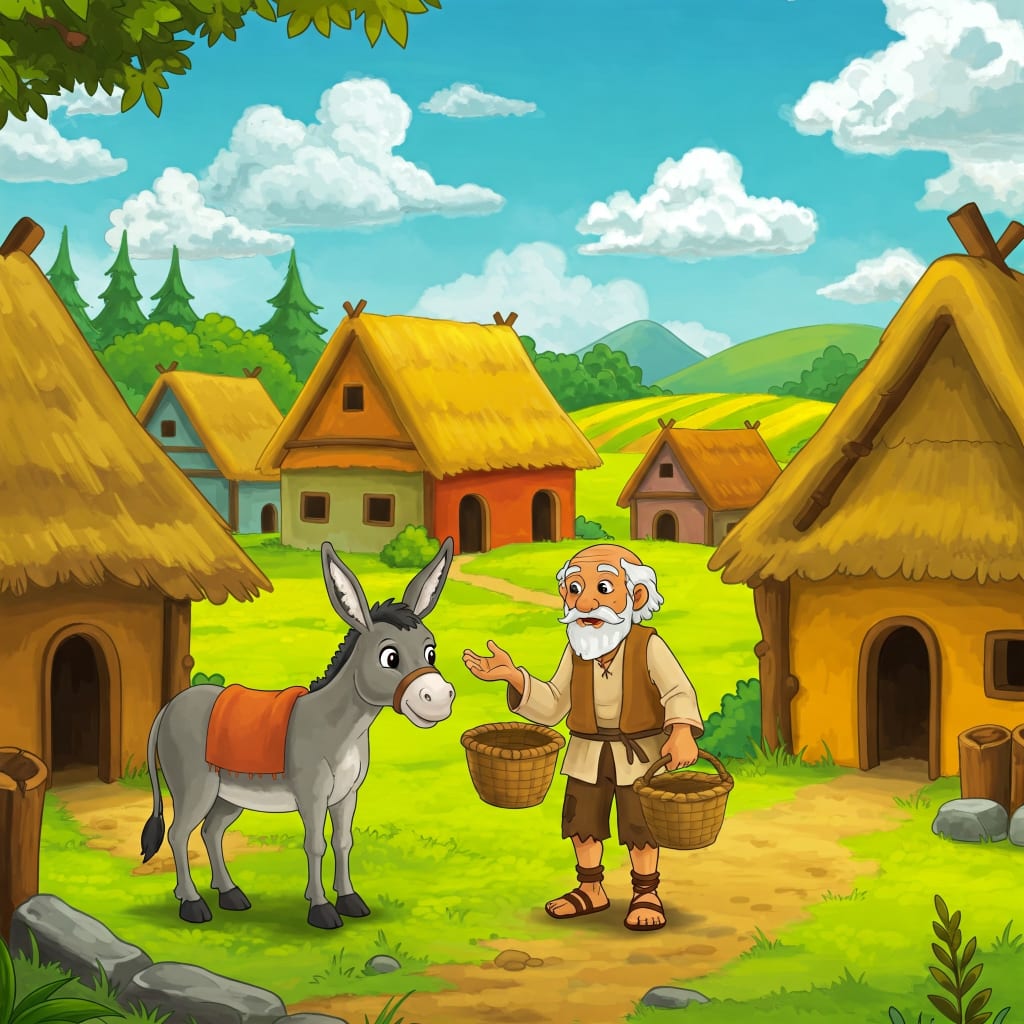
In the quiet village of Sera, nestled between sun-dappled hills and sleepy olive groves, lived an old man named Harun. He was wiry, weathered by years under the sun, and carried a stare that could unpeel the truth from any man’s lie. His companion, or rather his burden, was a shaggy donkey named Baruch—more temperamental than the winds of spring.
Baruch had been Harun’s sole company for over a decade. He was not a fast donkey, nor especially strong. But he was dependable. When he wasn't being insufferably stubborn.
Harun had long sworn off people. “Too loud, too greedy, too fast,” he would mutter. Baruch, on the other hand, demanded nothing—except occasional figs and never, under any circumstance, being told what to do.
One spring morning, the village baker offered Harun a job to deliver sacks of flour to the neighboring town of Doma in exchange for a week's worth of bread. It was a full day’s journey over the hills, but Harun, whose pantry was emptier than his patience, agreed.
“You hear that, Baruch?” Harun said, tossing a dusty saddlebag onto the donkey’s back. “We’re off to Doma. Try not to be a little demon today, will you?”
Baruch snorted, unimpressed.
They set off just past dawn, the air crisp and full of birdsong. The road snaked up into the hills, shaded by old cypress trees and lined with wild thyme. For the first hour, it was almost pleasant. Harun hummed an old tune, Baruch didn’t resist, and the flour sacks rode quietly.
But as noon approached, the donkey stopped in the middle of the trail.
Harun tugged on the lead. “Come on, Baruch. Don’t start.”
The donkey didn’t budge.
Harun sighed, then pulled harder. “You stubborn creature, we still have miles to go.”
Baruch dug his hooves into the earth like a sacred oath.
Harun tried coaxing. He offered a fig. He threatened to turn him into stew. Nothing worked. The man sat down, sweat dripping from his brow, staring at the donkey like it had just insulted his mother.
After nearly an hour of standoff, Harun muttered, “Fine. We rest.”
He leaned back against a tree, eyes closed. Baruch, smug in his victory, began to graze lazily. The breeze whispered through the leaves. And in the peace of that unwilling pause, something in Harun loosened.
“You know,” he said aloud, “you’re just like her.”
Baruch flicked an ear.
“Fatima. My wife. Gone ten years now. Stubborn as a mule, that woman. Wouldn’t admit when she was wrong. Wouldn’t let a man win an argument even if the sky was falling.”
The donkey didn’t respond, but something about the stillness felt like listening.
“I left the world because it reminded me of her,” Harun said. “Too full of memories. But you—you idiot beast—you reminded me of her too. That’s why I kept you. Maybe I liked the fight.”
Baruch brayed softly, chewing.
Harun chuckled, surprised at the emotion in his own voice. “You’re the only one left who makes me talk.”
He stood, brushing off his robe. “Alright, let’s try again.”
Without warning, Baruch straightened, stepped forward, and continued walking.
Harun blinked. “You did that on purpose.”
The donkey ignored him.
They moved through the hills in silence, both changed in some invisible way. The road tested them—slippery slopes, sudden gusts, and the occasional wandering goat—but they reached the outskirts of Doma just before dusk.
At the bakery, Harun handed over the sacks. The baker, a round man with flour in his beard, gave Harun a satchel of warm bread, cheese, and dried fruit. Harun thanked him, then turned to Baruch.
“You want to stay here tonight?” he asked. “We could sleep under the stars by the river.”
Baruch let out a long breath, then slowly sat on his haunches like a man easing into a favorite chair.
Harun laughed. “I’ll take that as a yes.”
That night by the river, with the moon glinting off the water and Baruch asleep beside him, Harun pulled out a piece of bread and tore it in half.
“One for me. One for you, partner.”
He tossed it over, and the donkey caught it mid-air.
Harun looked up at the sky. “You know, you’re not just a beast. You’ve got your own rhythm. Maybe I’ve been the stubborn one all along.”
The donkey, half-asleep, grunted.
“Yeah, yeah,” Harun muttered. “Don’t let it go to your head.”
They made the journey back home with less argument. Harun even sang a little louder. The donkey, for once, didn’t stop just to make a point.
And from that day on, the villagers noticed a change. Harun came to town more often. He talked more, listened more. Sometimes, he even smiled. All with that scruffy donkey beside him, like some old married couple that had finally learned how to share silence without resentment.
People would ask, “What changed, Harun?”
And he’d reply with a shrug, “Turns out, when two stubborn hearts walk the same road long enough, they figure each other out.”
Baruch never said a word. But if you looked close, you’d swear that donkey smirked.
About the Creator
AL - FAHAD
Just someone who loves writing and sharing stories. Always chasing ideas and good vibes."
Keep reading
More stories from AL - FAHAD and writers in Fiction and other communities.
“The Lion of Iskar Reef”
The sea had been quiet for days, too quiet for a man like Eli Crane, a seasoned sailor who had spent most of his life braving tempests and taming the wild waters. His ship, The Windless, drifted steadily across the azure mirror of the Southern Expanse. It was an unforgiving place—many had vanished in its endless blue. But Eli wasn’t afraid of the sea. Not anymore.
By AL - FAHAD10 months ago in Education
Off the Book
It ended like every other stupid idea. Badly, and alone. I’m researching digital confession ethics, he said. A tech ethicist. He gestured at floating data I couldn’t see then pulled out a physical notebook. Actual paper, fountain pen. He held it up like he was showing me scripture.
By Nicky Frankly3 days ago in Fiction
A Quandary in Quarantine
Chapter Two Most Monday mornings, I usually followed more or less the same routine. I would arrive at the library around 7:45 or 8:00 am, do a quick sweep of the reference department - which also housed our Adult non-fiction collection - for any obviously out-of-place materials, grab a book truck on my way past circulation, empty the book drop - which is usually full to overflowing after the library is closed all day on Sundays. Next, I take that cart back to circulation so the desk staff can work on getting those items checked in, then I head back to my desk in the reference area.
By Erin Lorandos3 days ago in Fiction



Comments
There are no comments for this story
Be the first to respond and start the conversation.