
THE LORD OF THE DYNAMOS
When Machines Demanded Worship Power, Steel, and Human Sacrifice The God Born of Gears A Factory Where Humanity Failed The Price of Absolute Power

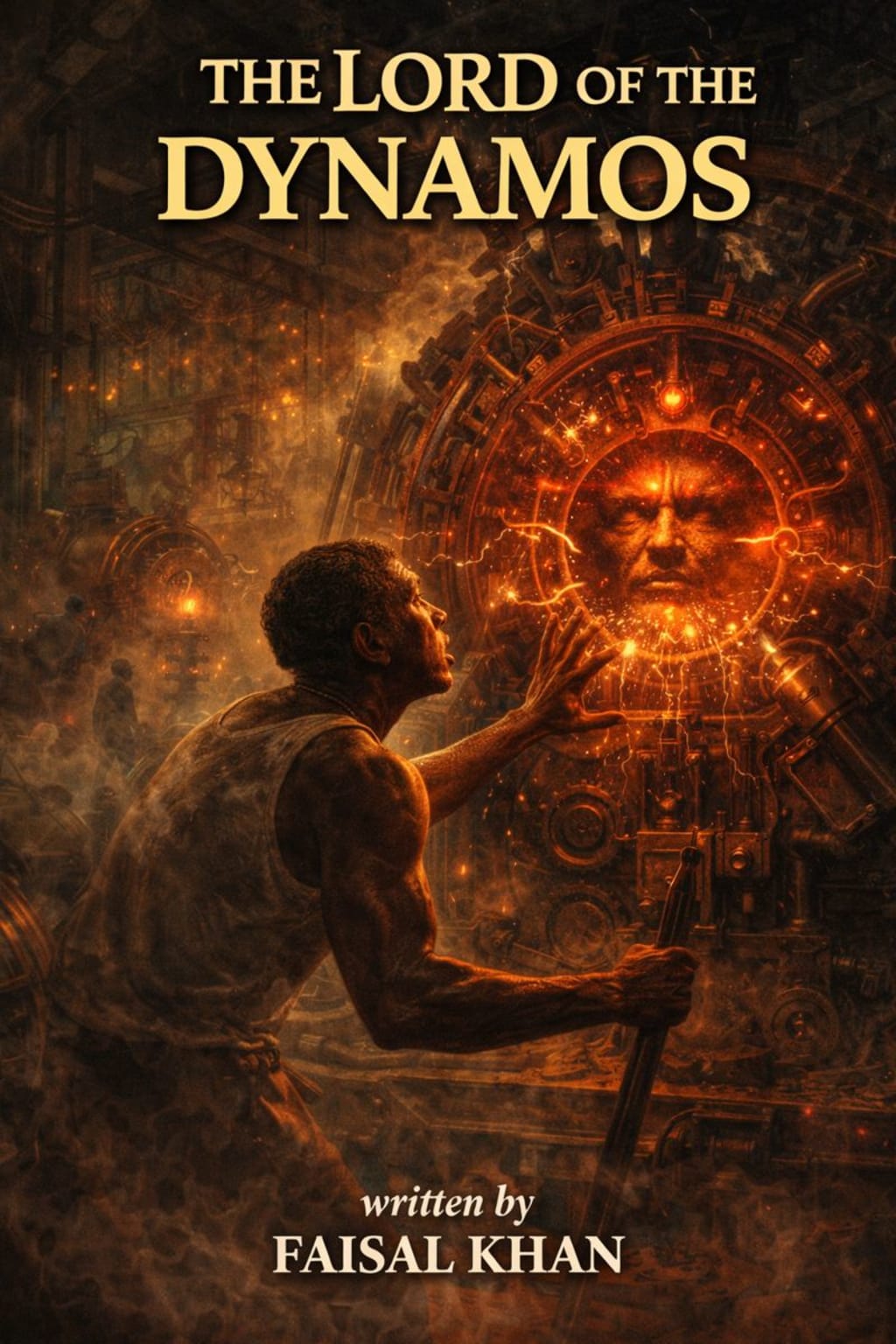
James Holroyd was the chief attendant of the three dynamos that powered the electric railway at Camberwell. A practical electrician from Yorkshire, he was a rough, domineering man—fond of whisky, violent in temper, and proud of his knowledge. He mocked religion, believed only in machinery and profit, and treated those beneath him with cruelty.
His assistant was a strange man named Azuma-zi, whom Holroyd contemptuously called “Pooh-bah.” Azuma-zi came from the East, his origins unclear, his appearance unsettling to European eyes. He spoke little English and endured Holroyd’s abuse in silence. Kicks and blows were common, for Holroyd enjoyed bullying him. Azuma-zi had arrived in London dreaming of wealth and civilization, but instead found himself penniless, isolated, and reduced to hard labor in the roaring dynamo shed.
The shed itself was a place of relentless noise and vibration. Steam engines pounded, leather belts whirred, and the air shook with mechanical power. Two small dynamos rattled noisily, but the third—the newest and largest—dominated everything. Its deep, unbroken hum drowned all other sounds. The floor quivered beneath it, and the ironwork seemed alive with energy. To engineers, the noise was a defect; to Azuma-zi, it was a sign of majesty.
Holroyd was immensely proud of the great machine and often boasted of its power. He described, with grim amusement, the many ways a man could be killed by it, even once giving Azuma-zi a shock to demonstrate its strength. Azuma-zi listened, watched, and slowly became fascinated. While Holroyd drank or wandered off, Azuma-zi would sit staring at the great dynamo, mesmerized by its steady motion and glowing sparks.
Unlike the engines Azuma-zi had known before—machines hidden away in ship holds—this dynamo stood openly, commanding the space like a ruler on a throne. In his mind, shaped by old beliefs and unbroken superstition, Azuma-zi began to see it as more than metal. A machine, he reasoned, was more alive than stone or tree. And this one was mighty, calm, and powerful beyond measure. He named it, in his thoughts, the Lord of the Dynamos.
Azuma-zi began to serve it. He cleaned and polished it obsessively, touching its metal with reverence. He felt that his labor pleased it. Slowly, his thoughts took a religious shape. One morning, when Holroyd was gone, Azuma-zi bowed before the machine and whispered prayers, asking it to protect him from his cruel master. As sunlight briefly streamed into the shed, the dynamo gleamed, and Azuma-zi believed his devotion had been accepted.
From that moment, he no longer felt alone. Whenever Holroyd beat him, Azuma-zi turned to the dynamo and whispered, “You see.” He believed the machine’s hum changed when Holroyd approached, as if it were waiting. Once, Holroyd received a severe shock while inspecting the machine. Azuma-zi took it as a warning from his god. “My Lord is patient,” he thought. “But the day will come.”
Holroyd, however, grew suspicious. He noticed Azuma-zi lingering near the machine and accused him of tampering with it. He forbade him from approaching the great dynamo and beat him when he caught him bowing before it. Something broke inside Azuma-zi then. The endless noise, the isolation, the cruelty—all fused into a single idea: Holroyd must be sacrificed to the Lord of the Dynamos.
One night, the two men were alone in the shed. Purple light flickered from the arc lamp, shadows danced against the machines, and the outside world seemed distant and unreal. Azuma-zi quietly altered a switch. When Holroyd noticed and shouted, Azuma-zi stepped forward with a strange calm in his eyes.
They struggled violently. Holroyd slipped, lost his grip, and fell back against the great dynamo. In an instant, the machine seized him with deadly power. The current tore through his body, killing him swiftly and horribly. The dynamo never faltered, never changed its rhythm.
Later, a messenger found Holroyd’s burned remains clinging to the machine. Azuma-zi’s broken English and apparent innocence led the investigators to conclude it was suicide. The railway needed power; the machine was restarted. Life went on.
But Azuma-zi remained behind, watching his god spin and hum. He felt proud. He had offered a sacrifice. Yet as he gazed at the dynamo, the fascination returned stronger than before. Was the Lord still hungry?
When the scientific manager later worked alone near the machine, Azuma-zi attacked him, attempting another sacrifice. A brutal struggle followed, but footsteps interrupted them. Realizing he would fail, Azuma-zi made his final offering. He seized the exposed terminals with both hands.
The dynamo answered instantly.
Azuma-zi convulsed once and died, hanging from the machine. The great dynamo roared on, indifferent and unstoppable.
Thus ended the worship of the Dynamo Deity—brief, violent, and forgotten—yet marked by martyrdom and human sacrifice.
About the Creator
Amelia Miller
Hi! I'm [Amelia Miller], a young writer obsessed with exploring the wild and often painful landscape of the human heart. I believe that even the smallest moments hold the greatest drama.
Keep reading
More stories from Amelia Miller and writers in Fiction and other communities.
THE REMARKABLE CASE OF DAVIDSON'S EYES
I. — The transitory mental aberration of Sidney Davidson, remarkable enough in itself, is still more remarkable if Wade's explanation is to be credited. It sets one dreaming of the oddest possibilities of intercommunication in the future, of spending
By Amelia Miller2 months ago in Fiction
TUS NUA - ch 53
TUS NUA – ch 53 New Beginnings – Mia and Midnight (*)(*)(*) Finola knew Ali’s brother-in-law needed to put his mind at rest. She fed her arm through his and led him outside. “We’ll sit here. If you like, I can put a block around us so our conversation will be private.”
By Margaret Brennan2 days ago in Fiction
Please don't go
He looked at me, I looked at him. When he looked at me, it felt like my stomach was invaded with butterflies, but... not this time. At this very moment his eyes could laser through my stomach if he wanted to. I wish he did. For the pain of what he is about to say to me, is much worse than a couple of seconds of my stomach being lasered off. His sweet lips that spoke words in my ears, that made my face flush with red. I could predict the next words coming out of those pretty lips. "I can't bare the silent game, SPEAK JUST SAY IT ALREADY" I thought impatiently.
By C⃣ h⃣ a⃣ n⃣ e⃣ l⃣3 days ago in Fiction
A More Human Vocal
When we launched Vocal nearly a decade ago, the world was a very different place. LLMs did not exist, and stories were created one at a time by people sitting down to write, revise, and share something personal. Many of our assumptions about publishing, trust, and participation were built for a world where effort and output were inseparable.
By Justin @ Vocal6 days ago in Resources



Comments
There are no comments for this story
Be the first to respond and start the conversation.