

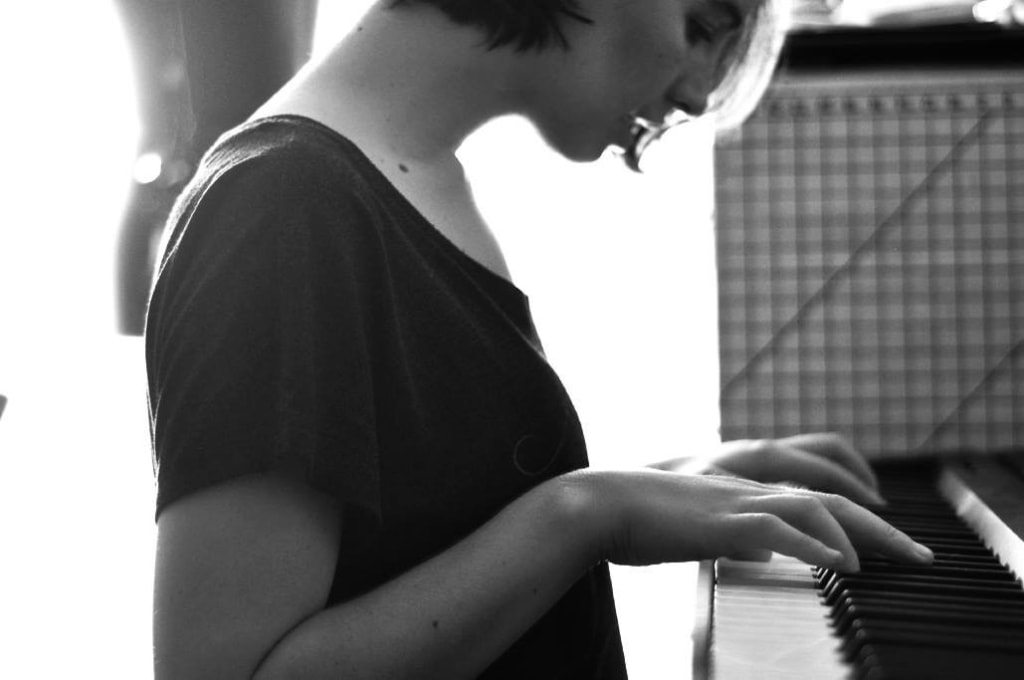
When I was three, I started taking piano lessons, after my mum discovered I’d been disappearing to the garage to play the neon-orange upright piano my parents picked up from an auction.
One afternoon, I’d been gone for quite some time, and my parents searched all over the house. They opened the garage door after hearing piano noises — piano noises that had suddenly stopped, and were then slightly horrified to find a three-year-old me trying to get the lid off of the top of said piano, so I could climb inside and find out how the noise was made.
I started piano lessons not long afterwards, the piano was repainted a more serious-looking shade of black, and I began learning to read sheet music.
We then quickly discovered that I had a very strong musical ear, and that I could pick up tunes from hearing other people play them.
My first piano teacher was a music college student named Matthew, and he was always setting sight reading homework. I was getting better every day, and going to piano recitals where I was the only three year old in a room full of six and seven year olds.
Mum recalls the other mothers being somewhat angry at my attempts to try and play the other children’s pieces by ear, followed by having to explain on the way home in the car that not everyone can do that, and that sometimes it can hurt people’s feelings when they’re still learning.
Once I realised, however, that I could pick up tunes just by hearing them,I began to let sight-reading fall by the wayside. I quickly discovered that if I asked my teacher to play a piece that I was learning, from start to finish, that I could memorise it. I began to feel like I didn’t need sight-reading, and I got very enthusiastic about it at one point, culminating in a recital where I was angrily told by some of the other student’s mothers to “Stop showing off!”, while attempting to improvise a piece I’d enjoyed listening to.
I began to feel ashamed. Up until that point, I was very innocently picking up tunes and having a lot of fun, and suddenly, I’d been made to feel like something about that was wrong.
Or perhaps, that something was wrong with me.
So I began to experiment with my improvisations at home instead.
We moved to a small country town when I turned eight, and I found a new piano teacher by the name of Elma, a talented elderly woman, a brilliant pianist, who was tough, but good. The best teachers often are. I remember trying to fake my way through sight reading, and getting whacked across the knuckles with a wooden ruler every time I was asked to point to where I was up to on the sheet music. I’d make a very vague guess, often nowhere near the section I was playing (and sometimes not even on the same page), so my knuckles got the ruler pretty much every single lesson. I think it’s important to point out here that my teacher grew up in an era where children got the cane if they did something wrong, and that I was young, I didn’t question it.
The funny thing is, that particular teacher is the one I remember most.
After my lesson, I’d wait for my mum to pick me up. My teacher would make tea and biscuits, and we would sit in her lounge room, eating, and drinking tea, while she’d tell me stories about her life growing up, and I’d tell her about how I was always getting picked on at school. When a decline in health meant that she was unable to continue teaching, she gave me a gift to unwrap once I got home. It was a ceramic heart trinket box that I had always admired in her lounge room, but had never said anything about. There was also a letter inside, in which she said I was her most challenging student, and therefore, one of her favourites, because I questioned everything and I was determined.
I bawled my eyes out when I realised she was my favourite teacher, and that my lessons with her had finished.
At 16 years old, I started with a new teacher, Karen, who introduced me to songwriting on the piano. I’d gotten knocked back for a VCE music performance program in the senior school I’d applied for, due to a lack of sight-reading skills. I explained to my new teacher that I had to be in that class, that I had one year before senior school started, and we set about a plan to help me learn to sight read. One year later, I had every scale down, and I was able to play, and to point out, if stopped, exactly where I was up to in my audition piece, Mozart’s ‘Piano Sonata no.16 in C, K545: III. Rondo’.
I’d also started writing songs prolifically. I still got knocked back for the music performance class, but I got accepted into the music history and styles program, and consistently received A++ grades. And then school finished. And my teacher moved away from town without letting me know. I turned up for my piano lesson, and there was a different family living in her house.
Confused and adrift, I walked back home, and promptly enrolled into a Bachelor of Nursing (we have a few medical people in my family, and at that point, I was under pressure to choose a career). I wrote songs during my lectures, failed consistently, refused point-blank to take part in dissection classes, and dropped out after six months. I had no piano teacher, no direction, and I’d stopped practicing my piano playing. My sight reading skills gradually dwindled down to zero, until I was back to improvising again.
I decided to take up singing, and auditioned for a pop-music school that had me songwriting and performing consistently in front of crowds. However, in the midst of being “trained for pop-stardom”, I found myself in a situation that made me want to sight read again.
At that point, a nineteen-year-old me used to take the train to singing lessons in Melbourne every week.
Occasionally on the train, there was this elderly gentleman who would sit across from me, tortoise-shell glasses perched at the end of his nose, reading the paper, and scribbling furiously on it with a pen.
For weeks, I thought he was just really into crossword puzzles. Then one day, he put down the paper to clean his glasses, and I noticed something. There were no crossword puzzles. He was writing sheet music in the margins, as easily as one might write a sentence. Or many sentences, in this case.
Back then, I was very shy about striking up conversations with people I didn’t know, and although I never got to speak with him, from that point on, I had a small dream that one day I would be able to write sheet music that well.
A decade passed. I left the singing school, became lead vocalist for two completely different bands (one in the bluegrass scene, the other heavy rock), and my dream of sight-reading and writing got tossed about and pushed to the back of my mind. It seemed too hard, too far away, covered by other obligations and the feeling that I had become ‘just a singer’.
Besides, I’d also put the piano aside at 16 — I hadn’t played in years.
Singing, being a lead vocalist was fun, but when I wrote lyrics, I’d hear the full orchestration in my head, and feel so frustrated and saddened that I couldn’t express it, I couldn’t get it out of there. Instead, I was settling for saying things like “It goes like this”, followed by singing the melody and harmony lines, and hoping people would understand. In a creative sense, my mind felt trapped.
When I’d sit down at the piano and try to decipher a piece of sheet music, a lack of understanding, coupled with the feeling that I should know this, but I didn’t, left me feeling disheartened and stupid.
Not long after turning 30, I left both bands I was in, and took a break for almost two years. In that time, I decided to give sight reading a proper shot, and began taking piano lessons again. This time, however, it was from a teacher who was also a professional composer.
I told my teacher what I’d been doing. She explained that plenty of musicians have gone through what I’d been through with sight reading, and that I owed it to myself to make it stick this time. It was incredibly humbling to go from belting out songs as a headliner at bluegrass festivals, and playing crowded rock gigs all around Melbourne, to sitting in front of a piano in a little room, and feeling like an idiot because I couldn’t point out where C sharp minor was on the one line of sheet music in front of me. Homework was learning how to read and write the C scale, and one Hanon exercise. I was determined not to give up, and I spent hours practicing like I was addicted to it.
Eventually, after my first year of study, I’d started writing, composing, and performing piano accompaniments for my own songs. I was singing and playing. To become better at sight-reading, I’d also enrolled myself into a six-month-long Certificate IV in Music Tuition (i.e. learning how to teach other people music). Having to get my head around sight reading complicated pieces, learning drum theory and notation, inversions, circle of fifths, very scary-looking time signatures, identifying pitch, a plethora of symbols that had always scared the shit out of me, in such a short space of time, and then teaching an actual music lesson to my classmates, was one of the most musically challenging things I’ve ever done. But it was worth it.
While I was studying, my piano teacher pointed out that the sheet music I was writing and bringing along to my piano lessons was starting to make much more sense, and the musical language I was using to describe sections of my own work was changing as well. The following year (2015), I recorded a couple of my songs, and was picked up by a small record label as a solo artist, but never I released anything through them. I left the label on my own terms in early 2016. I’d reached my goal of being able to write sheet music, and it felt like the right time for me to step back from being a performing artist, go quiet for a while, and just enjoying composing things on my own.
When you reach a long-held goal, there’s always the question of
“Well, where to now?”
I‘m not sure yet, to be completely honest. And that’s okay.
About the Creator
Keep reading
More stories from Genevieve Sommer and writers in Fiction and other communities.
Ten Reasons to Learn to Sew
A few years ago, I was on the train, commuting, listening to music and sewing part of the strap back onto my backpack. And I began to notice something. People were looking at what I was doing. And I carried on with what I was doing, as if sewing with needle and thread on a moving train was a completely normal thing to do at 5am in the morning. But the more the train filled with commuters, the more people were looking up and trying to work out what I was doing. Until a lady sitting across from me leaned over and said to me “I wish I knew how to sew”. And I realised something. In an increasingly mass market, fast fashion world, the skill of sewing — particularly sewing by hand — is becoming a lost art. I believe it’s an important skill.
By Genevieve Sommer4 years ago in Lifehack
Worth the Wait: Puerto Viejo, Costa Rica
Beach bumming in a small Caribbean beach town sounded like a perfect way to end our 6-month trip through Mexico and Central America. Or so we thought. The foul, fishy stench of rotten seaweed hit our nostrils as we stepped from the cramped bus and looked out at a rather depressing, empty, and underwhelming black sand beach. It was pouring with rain, and we had to quickly fish out our ponchos. We thought, this couldn’t be it, could it?
By Sh*t Happens - Lost Girl Travel4 days ago in Wander



Comments
There are no comments for this story
Be the first to respond and start the conversation.