
The Lone Mouse
Mouse meets Structure and the Desert. Craft over Catharsis.

A lone mouse scurries through a vast, desolate desert landscape under an awakening twilight sky. The sand dunes are sculpted by wind into abstract, flowing forms. In the distance, the silhouette of a broken, geometric structure hints at an ancient civilization. There is a dramatic contrast of chiaroscuro lighting, emphasizing deep shadows and stark highlights... a highly detailed concept art style.
Mouse...stillness - a painting holding its breath. The mouse's narrative moves with intention - the actions chosen with precision. The tiny figure in a ritual of motion as its journey becomes architectural, procedural...almost ceremonial.
The creature moves with a continuation - a practiced economy, each step a small geometry seared into the cooling sand. It is not hurrying and does not pause to consider the vastness around it. The desert is simply the medium through which it travels, the way a brush travels across canvas without needing to understand the painting it will become.
Ahead, the broken structure rises - an angular relic half-swallowed by dunes. Its silhouette resembles a collapsed polyhedron, edges jutting like the ribs of a long-buried beast. The mouse approaches with the quiet gait of a creature following a map older than it remembers.
A narrow fissure at the base of the ruin opens and the mouse slips inside. The air shifts: cooler, denser, touched by the faint mineral scent of stone that has not seen daylight in centuries.
Inside, the architecture reveals itself in fragments - planes intersecting at impossible angles, corridors that taper into vanishing points, surfaces carved with patterns that resemble both mathematics and symmetry. The mouse navigates these with the same unbroken rhythm, as though tracing a path laid out long before it was born.
It arrives at a chamber where the ceiling has collapsed, letting a single blade of twilight pierce the darkness. In the center of the room stands a pedestal. Upon it rests a bladed shard of something translucent - glass, crystal, or perhaps a remnant of the structure’s original geometry.
The mouse climbs the pedestal. It touches the blade with its whiskers.
There is neither reverence nor fear. There is Simply the next step in the sequence.
The shard responds with a faint hum, a vibration that ripples through the chamber like a line drawn across a blank page. Dust lifts. Shadows shift. The ruin seems to inhale.
The mouse remains still, a tiny axis around which the long abandoned machinery of the place begins to turn once more.
A mechanism resuming its function.
The humming from the shard settles into a steady oscillation, as if the ruin has found its original frequency. Dust motes drift in synchronized spirals, tracing invisible currents that were dormant until this moment. The mouse remains at the pedestal’s apex, a small but exact component in a mechanism far larger than itself.
The chamber’s walls begin to shift with the incremental certainty of gears aligning. Panels rotate a few degrees. Lines chiseled into the stone brighten, revealing a network of pathways that resemble both circuitry and ancient cartography. The geometry is functional, a diagram of the structure’s internal logic.
The mouse descends the pedestal and follows one of the illuminated lines. It leads to a narrow corridor that slopes downward at a precise angle, as though calculated for a specific kind of traversal. It moves without hesitation. Its role is not heroic or symbolic. It is procedural.
The corridor opens into a vast hall where the architecture becomes more intricate. Columns rise like elongated prisms, each one carved with repeating patterns that shift subtly as the light changes. At the center of the hall lies a circular depression filled with fine, metallic sand. The surface is perfectly smooth, untouched by wind or time.
The mouse steps onto the sand. Its weight disturbs the surface, creating ripples that propagate outward in concentric rings. The rings intersect with markings on the surrounding floor, triggering a faint resonance. The hall responds as though the mouse’s presence completes an equation.
Above, a lattice of beams rearranges itself, forming a new configuration. The pattern resembles a star map, but not of any known sky. It is a diagram of the structure’s purpose: a memory of alignment, a record of something once calibrated to the cosmos.
The mouse pauses at the center of the depression...this is the point the system requires.
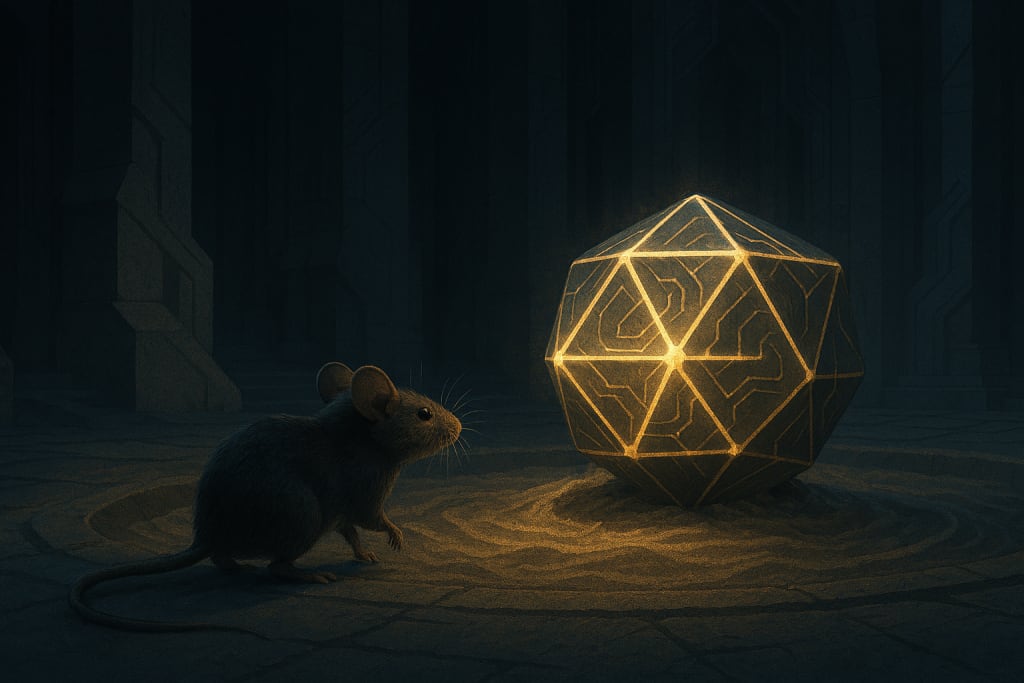
The metallic sand begins to rise, grain by grain, assembling into a three-dimensional form - an object that is neither artifact nor machine, but a hybrid of both. Its shape is angular, recursive, a geometry that folds into itself.
The mouse watches, unblinking. This is the continuation. A mechanism reactivating in the presence of its smallest, most essential component.
The Mouse’s Function Within the Architecture is the object forming in the metallic sand continuing to assemble itself - planes locking into place with the quiet certainty of a puzzle that has always known its solution. As it rises, the hall’s illumination shifts, casting new vectors of light across the floor. These vectors converge on the mouse.
It does not spotlight the creature - it merely measures it.
The mouse steps forward, its movement triggering a subtle recalibration in the hall’s geometry. Columns adjust their angles by fractions of degrees. The lattice overhead tightens its pattern. The structure is not responding to the mouse’s presence in a general sense; it is responding to the specific dimensions of the mouse - its mass, its gait, the micro-vibrations of its whiskers as they brush the air.
This architecture was not built for humans.
It was not built for giants or spirits or vanished kings.
It was built for something mouse-sized.
The mouse reaches the edge of the metallic sand basin. The object at the center completes its formation: a polyhedral core, its surfaces marked with lines that pulse faintly. The pulses match the rhythm of the mouse’s heartbeat - not metaphorically, but mechanically. The structure is syncing itself to the mouse’s biological cadence.
The mouse climbs the basin’s slope and approaches the core. It touches one of the carved lines with its paw. The line brightens, then splits into branching paths that spread across the core’s surface like a network of illuminated veins.
The hall responds.
Panels retract. New corridors open. The entire ruin shifts into a new configuration, as though the mouse has activated a mode of operation dormant for centuries.
This is the mouse’s function: It is the calibrator.
A creature whose small, consistent physiology provides the stable baseline the system requires to reorient itself.
It is neither a Chosen one, a Messenger...Nor a Symbol.
It is but a biological constant.
The architecture was designed around such constants - creatures whose bodies do not vary wildly in size or weight, whose movements are predictable, whose lifespans allow for generational continuity. The builders understood that grand civilizations collapse, but small creatures persist. They designed their system to be reactivated not by heirs or priests, but by survivors.
The mouse completes its calibration. The core thrums at a new frequency. The hall’s geometry settles into alignment.
The system is awake again.
And the mouse, having fulfilled its function, simply continues walking- its path now extending into the newly opened corridor, not out of purpose or destiny, but because the architecture has given it a direction.
A mechanism guiding a mechanism.
About the Creator
Novel Allen
You can only become truly accomplished at something you love. (Maya Angelou). Genuine accomplishment is not about financial gain, but about dedicating oneself to activities that bring joy and fulfillment.
Keep reading
More stories from Novel Allen and writers in Fiction and other communities.
Divided By Our Skin
We climbed as far as we could go; it was impossible to reach the top. Obstacles stood out in every way; we never stood a chance together.alone, it all felt so right. Our families said it was wrong, as two people from different countries could never get along. But every step we took, side by side, made the struggle worth it. We laughed when we stumbled, sharing simple smiles that warmed my heart. Each moment together felt like a secret world, just ours, away from what others thought.
By George’s Girl 2026 6 days ago in Fiction
Top tipple tricks
Been thinking a lot about drinking, lately. Not least because of a recent episode of over-indulgence and the inevitable after effects. Some readers may recall the earlier articles I wrote about beating the booze. Here I set out an experiment in techniques for cutting down on my alcohol intake. The experiment was successful, the techniques worked, and I have armed myself with an arsenal of weapons in the war against the demon drink. I have yet to fire the first round however. It's all a question of timing (perhaps procrastination).
By Raymond G. Taylor5 days ago in Psyche



Comments (1)
The architecture itself becomes a character, and the way it interacts with the mouse is hauntingly beautiful. I was completely absorbed in the interplay between the tiny being and the vast, intricate structures.