
The Load-Bearing Walls
A story arranged so nothing collapses

1. Inventory
The building is rectangular.
The street-facing façade has six windows, evenly spaced. Two are bricked over, though no record explains why. The door opens inward, left hinge. The lock works but is rarely used.
Inside, the rooms follow one another without surprise.
Room A: entryway.
Room B: corridor.
Room C: living space.
Room D: kitchen.
Room E: bedroom.
Room F: bathroom.
There is no Room G.
This matters later.
2. Principle
The narrator will not speculate on feelings.
Only on arrangement, sequence, stress points.
Emotion is treated as weather: observable only through effects.
3. Occupant
The occupant moved in on a Monday.
This is not sentiment. It is a scheduling fact. Utilities began at 08:14. Electricity before water. Internet last.
The occupant brought:
- one bed frame (disassembled)
- one mattress
- three boxes marked BOOKS
- one box marked OTHER
- no art
- no mirrors beyond those already fixed
The boxes were placed in Room C and not opened for three weeks.
4. Corridor (Room B)
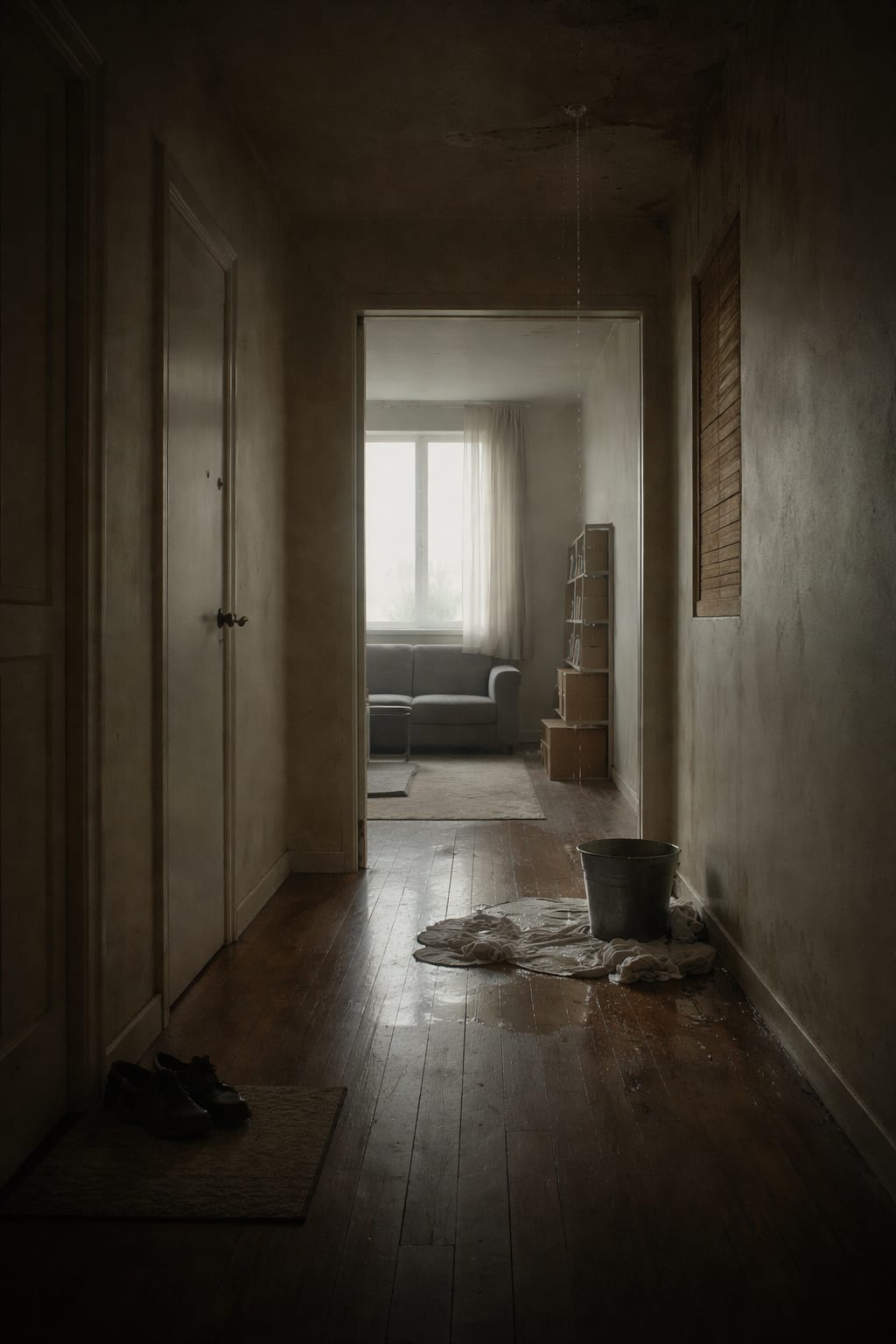
Room B is narrower than code recommends.
This is measurable. Shoulders brush the walls. The paint shows dullness at that height, evidence of previous bodies.
Room B connects everything. No room bypasses it.
Because of this, Room B absorbs wear disproportionate to its function.
This is structural, not psychological.
5. Rule Set
The story obeys the following constraints:
- Each room will be entered at least once.
- No room will be described twice in the same way.
- Nothing irreversible will happen.
- Any damage must be cosmetic.
- The final section will mirror the first, but imperfectly.
6. Living Space (Room C)
Room C contains a sofa inherited from no one. Purchased cheaply. Neutral color. Its cushions compress but recover.
The boxes remain unopened. They function as furniture.
The occupant sits on the floor instead.
From here, the windows align with the street. People pass. They do not look up. The bricked windows are on this wall. Their presence shortens the room optically.
Nothing is remembered here.
Nothing is anticipated.
7. Kitchen (Room D)
The kitchen has an L-shaped counter.
The refrigerator hums at a constant frequency.
The sink drains slowly but within tolerance.
There is a small crack in one tile. It does not spread.
The occupant cooks meals that require no chopping. This is efficiency, not avoidance. Knives remain in a drawer, unused, sharp.
No meals are shared. This is logistical.
8. Structural Note
The building is old enough to have settled.
Settlement is not collapse.
It is accommodation.
Cracks appear where weight redistributes. The building holds because forces find paths.
So does the story.
9. Bedroom (Room E)
The bed frame is assembled incorrectly the first time.
A slat is reversed. The mattress dips slightly on the left.
The occupant sleeps anyway.
Later, the frame is corrected. The dip disappears. Sleep does not improve measurably.
The bedroom contains one window, unbricked. It faces another building. Distance between them: approximately three meters.
At night, lights turn on and off across that gap. No pattern is discerned.
10. Bathroom (Room F)
The bathroom is smallest.
The mirror is fixed and cannot be removed without tools the occupant does not own.
The mirror shows what mirrors show.
This is not elaborated.
Water pressure varies by time of day. The occupant adjusts.
A towel hook loosens. It is tightened.
This is maintenance, not repair.
11. The Box Marked OTHER
The box is opened in Room C.
Inside:
- cables of unknown origin
- a manual for an appliance no longer owned
- a set of keys that fit nothing here
- one envelope, empty
The box is closed again.
Nothing is discarded.
12. Load Test
One night, during heavy rain, water seeps into Room B.
The corridor absorbs it first.
The occupant places towels. The towels darken. They are wrung out and replaced.
By morning, the water stops.
The walls hold.
The ceiling holds.
The incident does not repeat.
13. Design Choice
The story does not climax.
This is intentional.
Instead, it distributes weight evenly, so no point bears too much meaning.
14. Reuse
The occupant begins to use the boxes as intended.
Books are shelved alphabetically, then by height.
No favorites are displayed outward.
Spines face the wall.
This saves space.
15. Room A Revisited
The entryway accumulates shoes.
Pairs remain aligned.
One pair is rarely used but kept.
The door still opens inward.
The lock is tested once a week.
16. Absence of Room G
There is no extra room.
No spare.
No contingency.
The building was not designed for expansion.
This is not loss.
It is specification.
17. Minor Alteration
A nail is driven into Room C’s wall.
It holds nothing.
The nail remains.
18. Corridor Again (Room B)
The paint at shoulder height grows duller.
This is gradual.
The corridor continues to connect everything.
Nothing bypasses it.
19. Weather
Seasons change.
This affects heating costs, light angle, humidity.
The building responds within acceptable parameters.
20. Inventory (Revised)
The building remains rectangular.
The windows remain six.
Two are bricked over.
The rooms follow one another.
There is still no Room G.
The occupant remains.
Not because of attachment.
Because the structure holds.
21. Closing Condition
Nothing has been resolved.
Nothing has broken.
The story stands.
Not because it moved.
Because it was built to.
About the Creator
Alain SUPPINI
I’m Alain — a French critical care anesthesiologist who writes to keep memory alive. Between past and present, medicine and words, I search for what endures.
Keep reading
More stories from Alain SUPPINI and writers in Fiction and other communities.
Mastering French Without Losing Your Sanity: A Realistic Guide for Beginners
Learning French can feel like solving a Rubik’s Cube blindfolded. The tricky pronunciation, the never-ending grammar rules, and the surprising exceptions make it seem impossible. But don’t worry—equipping yourself with key expressions and effective strategies can turn frustration into fluency. Let’s simplify French and make learning enjoyable.
By Alain SUPPINIExclusive • 11 months ago
Off the Book
It ended like every other stupid idea. Badly, and alone. I’m researching digital confession ethics, he said. A tech ethicist. He gestured at floating data I couldn’t see then pulled out a physical notebook. Actual paper, fountain pen. He held it up like he was showing me scripture.
By Nicky Frankly5 days ago in Fiction
“The Girl Who Broke Willowford”
It's currently the summer of 1955 my name is James Hale, I live in the small town of Willowford. I work at my local diner, taking the same customers every day, receiving the same meals and life is good. It feels like every week repeats but nobody questions it, that's just how life is in Willowford. There’s a comfort to the routine, a rhythm to the days that never changes. People wave the same way, smile the same way, live the same way. Maybe that’s why I’ve never questioned it — Willowford feels safe, even when it feels strange.
By Christian Sanchez2 days ago in Fiction



Comments
There are no comments for this story
Be the first to respond and start the conversation.