
The Lion and the Monkey – A Sierra Leone Friendship
When the King of the Jungle Found a Friend in the Trees


Sierra Leone’s mornings are like no other—mist clinging to the tops of the Loma Mountains, birds waking the forest with their calls, and the smell of rain still lingering from the night before. In the lowland plains, where grasslands meet dense rainforest, the wildlife stirs to life—elephants move like silent giants, antelopes browse among the trees, and somewhere deep within, the roar of a lion rolls through the damp air.
This lion was called Kanu by the villagers—a name meaning “love” in the local dialect. Kanu was strong, golden, and feared by many, yet he carried a loneliness as heavy as his powerful frame. He roamed alone, marking his territory along forest edges and riverbanks, hunting when hunger demanded but otherwise keeping to himself.
One cloudy afternoon, Kanu followed the scent of fresh fruit. He padded softly through tall grass, his tail flicking, his ears twitching at every sound. The smell grew stronger until he reached a grove of fig trees. There, high in the canopy, a Diana monkey sat—her white brow like the bow of the Roman goddess she was named after. She was called Sia, and she was as quick with her wit as she was with her hands.
From her perch, Sia saw the lion and froze. Every instinct told her to leap away, but something in Kanu’s gaze was different—less hunger, more curiosity. He sat down, tail wrapping around his paws, and simply looked up.
“Why aren’t you chasing me?” Sia called down, her voice sharp with suspicion.
“I’m not hungry,” Kanu replied, his deep voice rumbling like distant thunder.
Sia laughed. “Lions are always hungry.”
“Maybe,” Kanu said with a small tilt of his head. “But not for you.”
That was the beginning.
In the days that followed, Kanu found himself returning to the fig grove. Sometimes he would arrive first and wait under the tree, other times Sia would already be swinging from branch to branch, tossing down ripe figs for him. She claimed she was only feeding him so he wouldn’t be tempted to eat her—but deep down, she enjoyed his company.
They explored together, each showing the other their world. Sia led Kanu into the high canopy where sunlight dappled the leaves, pointing out birds—African harrier hawks soaring above, their shadows gliding over the forest floor. Kanu showed Sia the rivers where African clawless otters played, and the quiet pools where pygmy hippopotamuses wallowed in peace.
The forest around them was alive with creatures—bongos stepping carefully among tree roots, red river hogs snuffling through the undergrowth at night, and Gambian epauletted fruit bats hanging like ornaments in the low branches, their dog-like faces watching the world with calm acceptance.
One day, as they walked along the edge of the grassland, Sia spotted movement—men, with guns and nets. Hunters. Kanu’s muscles tensed. He knew these men were dangerous, the kind who trapped and killed for profit. Sia gripped the branch tightly, fear making her heart pound.
“They’ll take me if they can,” Sia whispered.
“Not while I’m here,” Kanu growled.
The hunters hadn’t seen them yet. Using the tall grass as cover, Kanu moved silently, his body low to the ground. When the men drew closer to the grove, he stepped out—mane bristling, eyes blazing. His roar tore through the still air, so loud it sent flocks of birds screaming into the sky. The hunters froze, fear written in every movement, before they turned and ran, dropping their nets.
Sia climbed down to him. “You could have been hurt.”
Kanu shook his mane. “And you could have been taken. I won’t let that happen.”
From that day, their bond became unshakable. Sia would ride on Kanu’s back when they crossed open plains, her small hands gripping his mane as they passed herds of African bush elephants and servals stalking through the grass. At night, they would rest beneath the giant kapok tree, stars peeking through its leaves, the jungle humming with the songs of frogs and crickets.
But the seasons change in Sierra Leone, and with them, challenges come.
A drought settled over the land. Streams shrank to trickles, and the grass turned brittle under the sun. Animals moved farther in search of food and water. Even Kanu’s strength was tested as prey grew scarce. Sia noticed his ribs showing and his steps slowing.
One evening, she found him lying by the dry bed of the river, his breathing heavy. Without hesitation, Sia raced into the forest. She remembered a place high in the mountains where a spring still flowed, a secret known only to the monkeys. For hours, she leapt from branch to branch, carrying fruit and leading Kanu slowly toward the water.
When they finally reached the spring, Kanu drank deeply, his strength returning bit by bit. He looked at Sia, his eyes softer than she’d ever seen.
“You saved me,” he said.
“You saved me first,” she replied with a grin.
Years passed, and their story spread among the other animals. It was unusual, they said, for the king of the jungle to befriend a creature so small and quick. But Kanu and Sia didn’t care for what was usual. They cared for the way the other made the forest feel less lonely.
When Kanu grew old, his golden mane streaked with gray, he still made his way to the fig grove every morning. Sia, now a little slower herself, would be waiting. They would sit together, watching the mist lift from the Loma Mountains, sharing fruit and quiet conversation.
And when at last Kanu lay beneath the kapok tree for the final time, Sia was there, curled beside him. She sang softly, the same jungle song she had sung on the day they first met, until the forest was still.
From then on, whenever the wind rustled the fig leaves or the roar of a lion echoed faintly through the valleys, the animals would say it was Kanu, still watching over his friend.
About the Creator
Saeed Ullah
the store
Keep reading
More stories from Saeed Ullah and writers in Fiction and other communities.
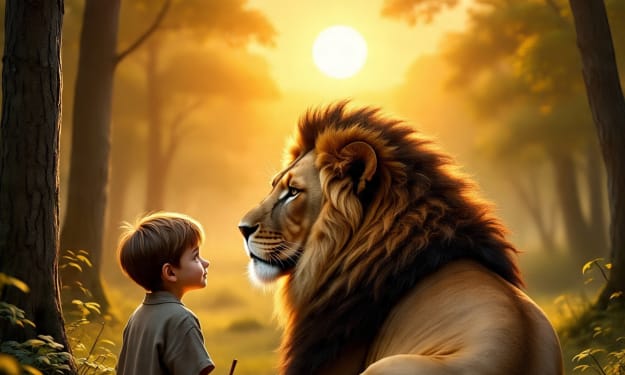
The Child and the Lion
The forest was old—its trees tall and thick, their branches weaving together like whispered secrets of time. Moss blanketed the earth, soft under bare feet, and the scent of pine, earth, and wildflowers filled the air. Birds chirped, wind hummed through the leaves, and somewhere in the distance, the low growl of a predator echoed faintly.
By Saeed Ullah 7 months ago in Fiction
When we shook the apple tree
The gates of Eden have long been locked away from human eyes. Centuries have passed without incident. One day, without warning, a mighty storm gathered over the garden itself. A terrible wind blew the vines and limbs loose, exposing the gates to prying eyes. Myron and Mirah, out for a stroll and trying to seek shelter from the deluge, discovered the gate and pried it open. Time had rendered it loose and it easily fell open.
By Novel Allena day ago in Fiction


Comments (1)
,,