

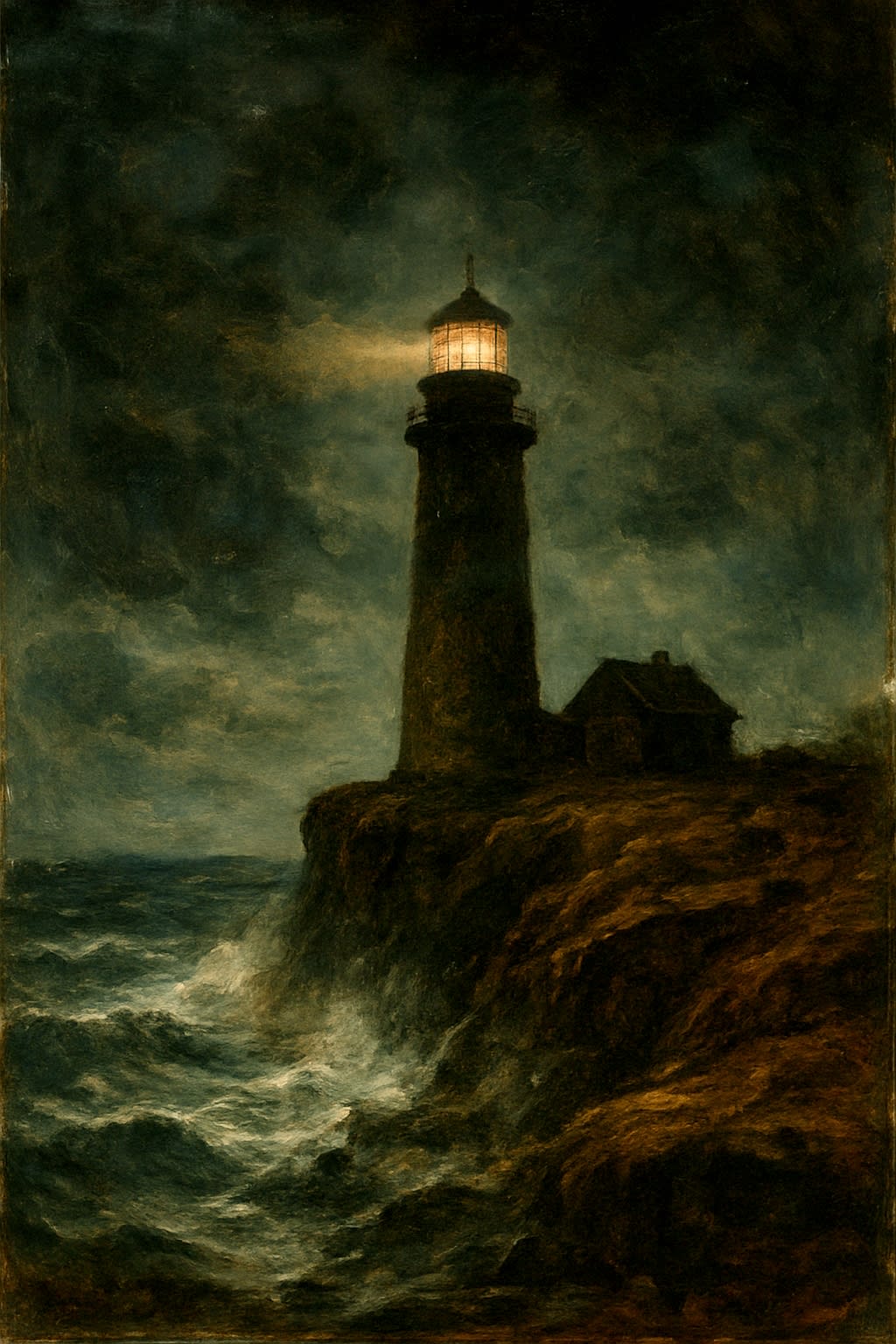
I inherited the lighthouse the day my father vanished. No note, no explanation—just an empty house perched on jagged cliffs where the sea screamed endlessly into the night. People in town said the place was cursed, said the last keeper went mad. I didn’t care. I wanted solitude, a place to escape the chaos of my life. I got more than I bargained for.
The first night, the light turned on by itself. I hadn’t even climbed the stairs. Its beam swept over the waves, cutting through the fog with unnatural precision, as though it knew where to look. I told myself it was a trick of memory, exhaustion—but the smell followed: salt, yes, but metallic, like blood soaking into the wood.
Then I began to see it. At first, just a flicker in the shadows of the cliffs, something crouched too tall, too thin, watching. It moved in the spaces my eyes shouldn’t reach. I would wake screaming, drenched in sweat, and yet somehow it felt familiar, as if it had always been there, waiting.
Sleep became a stranger. I dreamt of the lighthouse’s spiral stairs stretching endlessly into the void, the walls melting into black water that whispered my name. My father’s voice came through the fog, soft and pleading. I would reach for him, only to fall into nothingness, the abyss opening its mouth wide enough to swallow the world.
By the third week, I stopped seeing the shape only at night. I caught glimpses of it in mirrors, in the dark corners of the lighthouse, even in the glass of my coffee cup in the morning. It was always just at the edge of perception: tall, impossible, its form twisting, as though geometry itself feared it.
One stormy night, the wind carrying the smell of rust and decay, I climbed the lighthouse. The light beam sliced through the fog, revealing the ocean below. But the sea was wrong. Darker than night, it churned like liquid shadow, moving in impossible angles. And rising from it was a city—not made of stone, not made of wood—but of shapes that made my skull ache just to see. Spires that bent sideways, buildings stacked like impossible puzzles, streets that looped into themselves. And atop it all, a figure: tall, thin, impossibly patient. Waiting.
I understood then. It had always been here. Watching. Waiting. Every lighthouse, every beacon, every human soul—it had been waiting for me. For us.
The floor of the lighthouse groaned. I looked down. The stairs behind me had vanished. There was no escape. The walls bent around me, swallowing the light. I felt my mind splintering, fracturing into shards that each screamed a different truth. And in the center of the storm, I understood the enormity of it: a consciousness older than the stars, patient enough to wait for all of humanity to notice it, yet indifferent to our screams.
I screamed. I clawed at the walls. I tried to flee. But the lighthouse was no longer mine. It never had been. It was a vessel, a doorway, a mouth opening into something vast and eternal. The figure from the sea reached for me, its limbs bending impossibly, dissolving into fog and shadows.
I woke on the cliffs at dawn. The lighthouse stood silent, its light extinguished. The town was quiet, oblivious. But I could feel it in the corners of my vision, in the air around me, in the beat of my heart: it was still waiting, patient, eternal. I had seen it, and it had seen me. And I knew, without question, that it would return.
The wind carries whispers now, even in the calm. My father’s voice is gone. But another waits in its place. Patient. Unending. I cannot look at the sea without seeing the city beneath, and I cannot look at the lighthouse without seeing the figure on the cliffs, stretching, waiting, hungry for the next soul foolish enough to climb its stairs.
I will not go back. Not tonight, not ever. But I know it is watching, and in some dark, infinite corner, it is laughing. Because it knows: I will never stop looking.
About the Creator
E. hasan
An aspiring engineer who once wanted to be a writer .
Prodigal
David woke up on this partly cloudy Sunday morning intent to sleep in before the notifications on his phone started going off. “Bonus Pay on all orders” was the notifications he received from his DoorDash app. “Eh, I really don’t feel like dashing today, but why not? Maybe I’ll make a lot very quickly being that bonus pay is booming.” David thought to himself.
By Joe Patterson6 days ago in Fiction
When the Shelter Closes
Across the street from my house, a man slept under a tree, his dog by his side. My first, naive thought: he must be traveling through. But he kept coming back, often sleeping there during the day. Then it hit me—that person might not have a home.
By Bride of Sound3 days ago in Humans


Comments
There are no comments for this story
Be the first to respond and start the conversation.