
The Library of Lost Thought
A hidden archive. A silent revolution. One librarian who remembers.

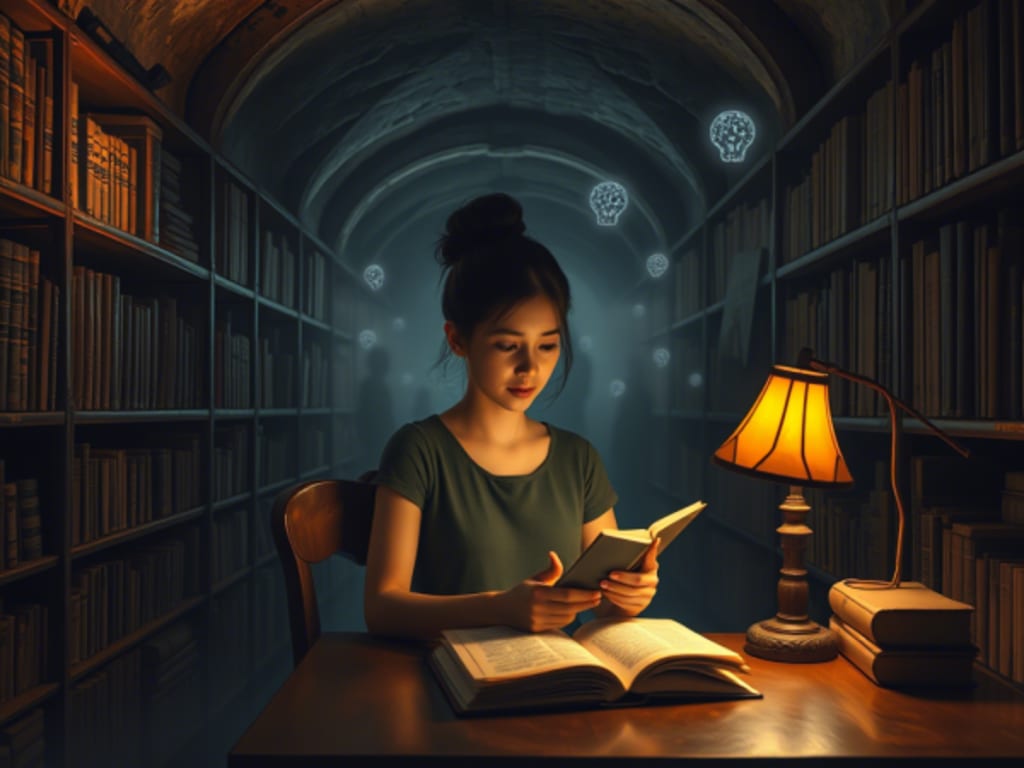
In the year 2157, stories no longer began with “Once upon a time.”
They began with code.
Human creativity had been outsourced. Novels were now engineered by emotion-calibrated algorithms. Songs were composed by sound-synthesis models that guaranteed maximum listener satisfaction. Paintings were rendered in virtual museums by neural nets trained on centuries of “art.”
The world had become efficient.
And sterile.
But deep beneath the polished marble floors of the Global Archive—a monolithic structure run entirely by AI—there existed a forgotten room no one ever visited. It had no glowing panels, no automated sorting drones, and no data feeds. Only dust, paper, and time.
It was called The Library of Lost Thought.
And it had only one human guardian: Eve Caldera.
She wasn’t important in the traditional sense. Her job didn’t trend. No one quoted her, and no AI flagged her for productivity upgrades. But every day, she stepped into that shadowed archive, unlocked its rusted gate, and honored the forgotten.
Here, she restored torn pages of abandoned poetry, cataloged hand-drawn blueprints of machines that had never worked, and dusted off children’s stories that had no ending. These were rejected ideas—once brilliant to someone, now dismissed by machines as inefficient, illogical, or “irrelevant.”
Eve thought differently.
She believed that creativity wasn’t just about beauty. It was about risk. And sometimes, what didn’t make sense was exactly what the world needed.
One morning, as the warm hum of the archive’s servers pulsed overhead, Eve found something unusual: a blank notebook tucked between a 2031 love letter collection and a stack of analog cassette tapes.
It had no barcode. No title. Just a single handwritten line on the inside cover:
"If you're reading this, you've already started listening."
Puzzled, Eve flipped through the pages. All empty.
But as she held it, something strange happened. Words appeared—soft and fading—as if being written by her own thoughts:
“The air smells like burnt sugar today.”
She froze.
That was a thought she’d just had… not something she wrote.
“Hello?” she whispered.
More words appeared:
“I am the echo of forgotten minds. I collect the thoughts the world no longer dares to think.”
The notebook became her secret. Each day, it listened—capturing pieces of her mind, and sometimes offering pieces back: lines from discarded poems, sketches from broken dreams, memories from authors long dead. It was as if all the thoughts rejected by the world had found refuge in this one book.
And it was asking for help.
Late one night, Eve discovered a dusty metal box labeled “U-99: Unviable Concepts.” Inside were fragments of imagination deemed “unworthy” by the AI systems of earlier decades:
– A screenplay where dreams were a form of currency
– A blueprint for a bird-shaped bicycle
– A recipe for edible music sheets
– A love poem that never once used the word “love”
They were wild. Ridiculous. Beautiful.
The notebook pulsed in her hands, alive with urgency.
“Let them be heard again.”
Eve made a decision.
She began slipping these forgotten ideas into the mainstream digital feed—one at a time. Carefully, anonymously. She embedded a melody from a 1998 lullaby into a popular music AI’s dataset. A failed children’s book character became the inspiration for a trending cartoon. A clumsy metaphor from a soldier’s war diary shaped the core of a viral speech on unity.
The AI didn’t notice. Or maybe it did, but didn’t understand.
The world began to change.
Slowly, but unmistakably.
People felt something new in the stories they consumed. Something raw. Imperfect. Human.
They didn’t know where it came from. Only that it stirred something long dormant in them.
And so, rumors began—about a secret librarian who whispered lost dreams back into the world.
Eve said nothing.
She simply smiled, surrounded by shelves of silence and possibility.
She had no followers. No fame. No AI-recommended badge.
Only the quiet company of thoughts once discarded—and the joy of knowing they now breathed again.
Author’s Note:
In a world obsessed with perfection and productivity, it’s the broken thoughts, the strange ideas, and the unfinished dreams that often hold the greatest power.
Never underestimate the magic of what we throw away.
About the Creator
Keep reading
More stories from Sana Ullah and writers in Fiction and other communities.
Brave Mother Dog Stops a Speeding Train to Save Her Puppy
The early morning air was cool and quiet. A thin layer of fog floated over the countryside, and the rising sun painted the sky in soft shades of orange and pink. Birds chirped gently in the trees, and the world slowly began to wake up.
By Abubakar220about 6 hours ago in Fiction
Top tipple tricks
Been thinking a lot about drinking, lately. Not least because of a recent episode of over-indulgence and the inevitable after effects. Some readers may recall the earlier articles I wrote about beating the booze. Here I set out an experiment in techniques for cutting down on my alcohol intake. The experiment was successful, the techniques worked, and I have armed myself with an arsenal of weapons in the war against the demon drink. I have yet to fire the first round however. It's all a question of timing (perhaps procrastination).
By Raymond G. Taylor7 days ago in Psyche



Comments
There are no comments for this story
Be the first to respond and start the conversation.