
The Library of Infinite Knowledge: A Discovery Beyond Imagination
The Library of Infinite Knowledge

The Library of Infinite Knowledge: A Discovery Beyond Imagination
Imagine a place where all the knowledge of the universe—past, present, and future—is stored, a repository so vast and limitless that it contains the answers to every question ever asked, every mystery yet to be solved, and every secret the cosmos has to offer. This is the concept behind the Library of Infinite Knowledge, a discovery so grand that it exists at the intersection of imagination, philosophy, and science fiction. While it may sound like something out of a fantasy or sci-fi novel, the idea of such a library challenges our understanding of knowledge, memory, and even the universe itself. In this article, we will explore the concept of the Library of Infinite Knowledge, its implications for humanity, and the ways in which it reflects our deep desire for understanding.
The Origins of the Concept
The idea of a vast, cosmic library isn’t new; it has roots in many mythologies, philosophical traditions, and modern narratives. Some ancient cultures spoke of divine libraries or hidden knowledge guarded by the gods. In ancient Greece, the philosopher Plato spoke of the realm of Forms, a non-physical realm where perfect versions of every concept and idea existed. This idea influenced many thinkers throughout history, leading to the notion that all knowledge may already exist in some perfect form, waiting to be accessed.
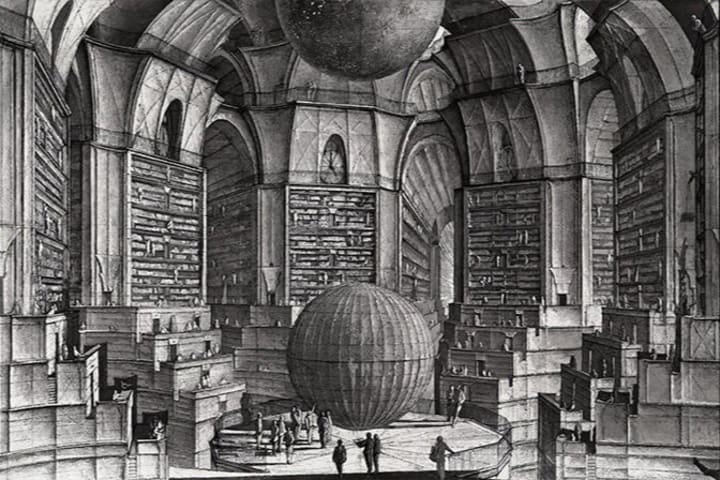
In the modern world, the concept was notably expanded by Argentine writer Jorge Luis Borges in his famous short story, "The Library of Babel". Borges described an infinite library containing every possible book, an endless collection of all possible combinations of letters and words. Though many of these books would be filled with meaningless gibberish, somewhere in the library would exist every conceivable piece of knowledge, every great work of literature, and the answer to every question ever asked.
In addition to Borges, the concept of infinite knowledge has been explored in other works of fiction and speculative thought, particularly in the realms of artificial intelligence, where some believe that advanced AI systems could one day become repositories of nearly limitless information.
What Would the Library of Infinite Knowledge Contain?
If such a library were to exist, its contents would be truly mind-boggling. Consider the sheer scope of knowledge across disciplines like science, philosophy, history, technology, literature, and art. However, the Library of Infinite Knowledge would not be limited to human knowledge alone. It could contain the accumulated wisdom of alien civilizations, insights into alternate realities, and even an understanding of dimensions and realms beyond our comprehension.
- Scientific Discoveries and Innovations: The library would contain answers to all the greatest scientific mysteries, from the nature of dark matter and dark energy to the origins of life and the secrets of quantum mechanics. It would hold the key to curing diseases, solving environmental crises, and mastering space travel. There would be knowledge of all technological inventions ever conceived, including those that humanity has yet to imagine.
- Historical Truths: Imagine having access to the complete, unaltered history of the universe. Every event, from the birth of stars to the rise and fall of civilizations, would be recorded in meticulous detail. No more mysteries about the lost cities of antiquity or the causes of ancient wars. The Library of Infinite Knowledge would preserve a perfect, objective account of everything that has ever happened.
- Philosophical and Ethical Wisdom: The library could also serve as a storehouse of philosophical thought, providing answers to age-old questions about the meaning of life, the nature of consciousness, and the existence of free will. It might offer ethical guidance for the future, teaching us how to create societies that are just, equitable, and harmonious.
- Artistic Masterpieces: Beyond science and philosophy, the library would be an unparalleled treasure trove of creative works. Every poem, painting, symphony, and film ever made would be preserved, along with infinite variations of them. New artistic genres, forms, and ideas could be explored endlessly, offering humanity an infinite well of inspiration.
How Would One Access Such a Library?
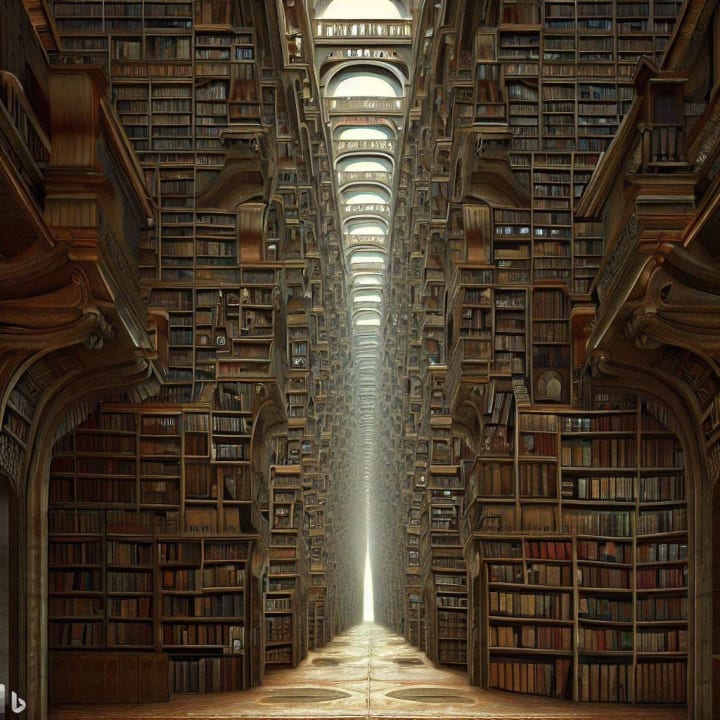
Accessing the Library of Infinite Knowledge poses an intriguing challenge. In Borges’ story, the library is infinite and virtually impossible to navigate, with most of the books being random and unintelligible. If such a library existed in reality, accessing meaningful information could prove equally difficult without some form of intelligent system to filter the vast sea of data.
- Artificial Intelligence and Quantum Computing: One possible way to access the knowledge in such a library would be through the use of advanced artificial intelligence (AI) and quantum computing. An AI system capable of processing information on a near-infinite scale could serve as a guide through the library, helping humans find the answers they seek. Quantum computing, with its ability to process vast amounts of data simultaneously, could provide the computational power needed to sift through the endless streams of information contained within the library.
- Telepathic or Intuitive Connection: Another possibility is that the Library of Infinite Knowledge might not be a physical or digital place at all. Instead, it could exist on a metaphysical or spiritual plane, accessible through the human mind or consciousness. Mystics, philosophers, and psychics throughout history have spoken of tapping into a universal consciousness or "Akashic Records," a hypothetical archive of all knowledge and experiences. Accessing such a library might require an altered state of mind or a deep intuitive connection to the cosmos.
- Virtual Reality and Immersive Interfaces: Another futuristic option for accessing the library could involve the use of virtual reality (VR) or immersive technologies. Imagine walking through a virtual space where the shelves stretch infinitely in all directions, each book containing a universe of knowledge. With the help of sophisticated VR systems, one could interact with knowledge in entirely new ways, perhaps even stepping into simulations of historical events or exploring scientific concepts firsthand.
The Implications of Infinite Knowledge
While the idea of having access to infinite knowledge is undeniably appealing, it also raises profound questions and concerns. How would such knowledge be used? What would happen to human creativity and discovery if every question could be answered immediately? And perhaps most importantly, is there such a thing as too much knowledge?
- The Burden of Omniscience: With infinite knowledge comes infinite responsibility. Those who access the library might feel the weight of having the answers to all of humanity’s problems. The power that such knowledge bestows could be overwhelming, and the consequences of using it incorrectly could be disastrous. Would the discovery of such a library lead to a utopian society, or would it trigger conflict over who controls and distributes the information?
- The End of Mystery and Exploration?: Human history is marked by the pursuit of knowledge, the excitement of discovery, and the process of trial and error. If we had access to every answer, would we lose our drive to explore and experiment? The joy of problem-solving, invention, and artistic creation might diminish if we knew that everything we seek is already cataloged in some cosmic archive.
- Ethical Concerns: Finally, the ethical use of such knowledge is a critical consideration. While the library could solve many of the world's problems, it could also be used for harmful purposes. How would society regulate access to the knowledge contained within the library? What safeguards could be put in place to ensure that the information is used for the betterment of humanity rather than for personal gain or destruction?
Conclusion
The Library of Infinite Knowledge represents the ultimate quest for understanding, a place where the mysteries of the universe are laid bare and the answers to every question are at our fingertips. While such a library may only exist in the realms of philosophy, fiction, or metaphysical speculation, the concept challenges us to reflect on the nature of knowledge, the limits of human understanding, and our place within the cosmos.
Whether accessed through artificial intelligence, spiritual enlightenment, or some other means, the dream of infinite knowledge remains a tantalizing, awe-inspiring prospect—a discovery beyond imagination.
About the Creator
The Path to Salvation
The late autumn evening air filled the monk's lungs, but it wasn't the season that chilled his bones. The heavy-handed presence of evil he had sensed upon entering the woods surrounding this mountain village had not bothered to conceal itself from him.
By Made in DNA2 days ago in Fiction


Comments