
The Letter Under the Floorboards
Some truths refuse to stay buried.
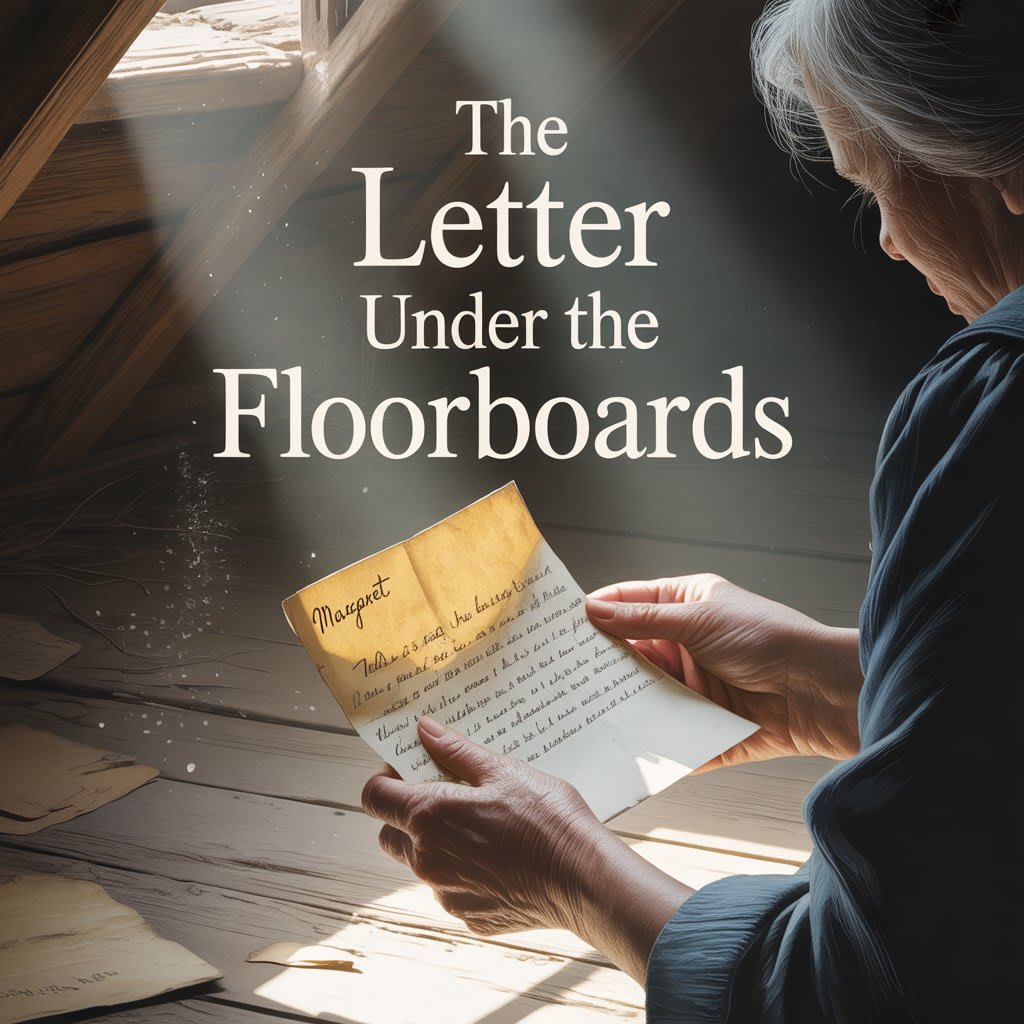
The night Margaret found the letter, the house was silent in that way only old houses could be—timbers sighing, pipes groaning, the air thick with the smell of dust and time. She had lived there forty years, long enough to know every creak of the floorboards, every stubborn window latch. Or so she thought.
It began with a loose plank in the upstairs hallway. She stepped on it and felt the wood give under her weight. She might have ignored it—old houses shifted, after all—but something about the hollow echo beneath made her pause. On impulse, she fetched a screwdriver and pried it up.
What she found was a yellowed envelope, brittle with age. Across the front, in careful script, was a single word: Margaret.
Her chest tightened. The handwriting was unmistakable. It was James’s.
Her husband had been dead twelve years.
Margaret sat on the floor, envelope in her lap, hands trembling. James had never been a man of secrets. Their life together had been steady, ordinary, built on the quiet rhythms of routine: morning coffee, Sunday church, the annual trip to the lake. He had died the way he had lived—suddenly, without fuss, a heart attack in his sleep.
And yet, here was his handwriting, addressed to her, hidden beneath the floorboards.
For a long moment, she couldn’t bring herself to open it. The air seemed heavier, the house listening. But at last, she slid a finger beneath the brittle flap.
Inside was a single page, folded twice.
My dearest Margaret,
If you are reading this, then I have failed in courage. There are things I should have told you, things I could not carry into the grave without shame. I loved you—God, I loved you—but love does not erase the past. And the past has a way of whispering through the cracks, no matter how tightly we board it shut.
Margaret’s pulse quickened. She read on, eyes devouring each line.
Before I met you, before I put a ring on your finger, there was another. Her name was Evelyn. She and I—well, we were young, and the world felt smaller, brighter then. She wanted me to marry her. I almost did. But the war came, and when I returned, she was gone. Or so I believed.
It was years later, after we wed, that she appeared at my shop one evening. She looked older, but her eyes… they had not changed. She begged for help. She said she had a child, a boy, and no one else to turn to. Margaret, the boy was mine. Our boy. His name was Peter.
The letter slipped in Margaret’s trembling fingers. She read it again, desperate to make the words shift into something else. But they stayed fixed, immutable ink on yellowed paper.
I gave her money. I saw the boy once, just once, from across the street. He had my eyes. I should have done more, but I was a coward. I told Evelyn never to come again. And she didn’t. Still, not a day has passed that I have not thought of him. Of Peter.
I wanted to tell you. I wanted to explain. But how do you shatter the life we built? How do you undo the years? If you hate me for this, I cannot blame you. But know this: loving you has been the truest thing I have ever done. And if there is any mercy in the world, perhaps someday you will forgive me.
—James
The page fluttered in Margaret’s hand. Outside, the rain tapped against the window like fingers.
A son. James had a son. Somewhere out there, perhaps still alive, was a man who shared his blood. A man who was also, in some tangled way, hers.
Margaret pressed the letter to her chest and closed her eyes. Memories reeled: the years of their marriage, the laughter, the arguments, the quiet evenings. Had it all been shadowed by this secret? Or was love still love, even when it hid a wound beneath?
She should have felt anger. Betrayal. But what came instead was something heavier, quieter: grief. Grief not only for James, but for the boy—Peter—who had lived his life unseen, unacknowledged.
The next morning, Margaret brewed her coffee as usual, though the taste was ash in her mouth. She carried the letter to the kitchen table and stared at it while the light shifted across the linoleum.
She thought of the years ahead. Of dying with this secret still hidden. The weight of it pressed on her chest like another kind of death.
No, she decided. The past might whisper through the cracks, but the truth deserved air.
Margaret rose, pulled the heavy phone book from the shelf, and turned to the listings. Her hands shook as she began to dial.
“Hello,” she said when the voice on the other end answered. Her throat felt dry, her words uncertain. “I don’t know if this is the right number, but… I think you might be family.”
About the Creator
MUHAMMAD BILAL
"Curious mind, lifelong learner, and storyteller at heart. I explore ideas, history, and technology, breaking them down into simple words so everyone can understand—and enjoy—them."
Keep reading
More stories from MUHAMMAD BILAL and writers in Fiction and other communities.




Comments
There are no comments for this story
Be the first to respond and start the conversation.