
The Lesson of the Red Light
How a Red Light Taught Me the Value of Life”

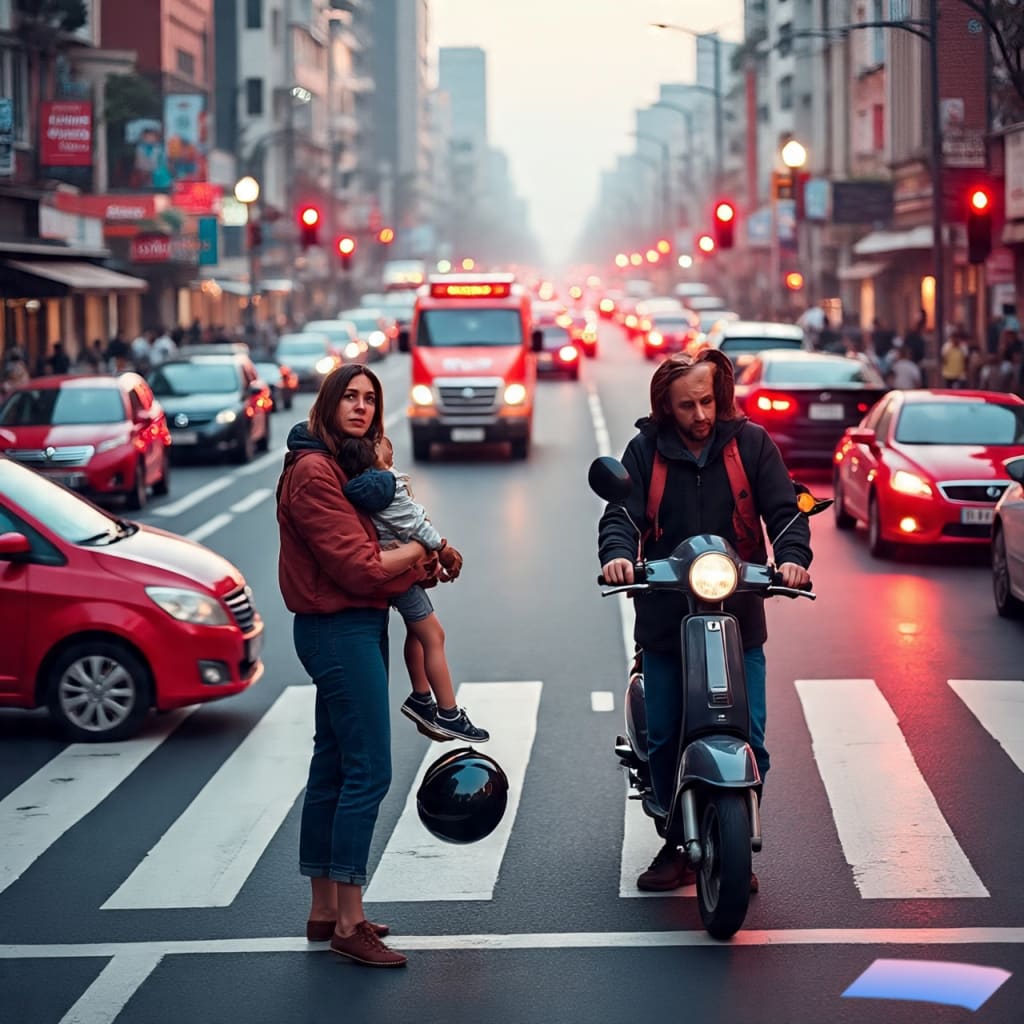
Ravi was a bright but impatient college student in Delhi. He lived in a fast-paced world — always on the move, always chasing time. Whether it was getting to college, meeting friends, or just going for a ride, Ravi believed speed was everything.
To him, traffic rules were more like “suggestions” than actual laws. Red lights were delays, helmets were optional, and pedestrian crossings were just painted lines. His parents warned him. His teachers mentioned it in class. But Ravi would laugh it off. “Life is short,” he would say. “Why waste it waiting at red lights?”
Every morning, Ravi would zoom through the narrow lanes of the city on his blue scooter, weaving through cars, auto-rickshaws, and bicycles. His friends admired his confidence. They called him “Rocket Ravi.” He liked the name. He thought of himself as someone who lived life on his terms.
One Monday morning, Ravi left home a bit late for his internal exam. He skipped breakfast, grabbed his bag, and flew down the road. The traffic was worse than usual. Horns were blaring, tempers were high, and every intersection was clogged with vehicles.
As he approached a busy traffic signal near a major hospital, the light turned red. A few people stopped, but most didn’t. Ravi, seeing an opening between two buses, accelerated. Just as he was about to cross the red light, he heard a sharp siren.
It was an ambulance.
The vehicle was coming fast from the right side, trying to cross the intersection and reach the hospital — just 500 meters away. Its lights flashed urgently, and the siren screamed through the humid air.
But something was wrong.
Several vehicles had already crossed the red light from different directions, blocking the path. A delivery van, a couple of bikes, and a few cars stood right in the ambulance's way. The drivers looked confused, not knowing where to go. The signal had become chaos.
Inside the ambulance, through the window, Ravi caught a glimpse of a woman clutching a small child. The girl was no older than six. Her face was pale, her body limp, and her mother’s expression was that of pure panic. She was shouting at the traffic to move, to make space, to let them pass.
But there was nowhere to go.
The chaos created by a few impatient people — including Ravi — had turned the signal into a deadly trap.
For the first time in his life, Ravi felt helpless. He watched the mother’s mouth move, but couldn’t hear her words. He saw tears rolling down her face. The siren kept wailing, but no one could help. He looked around and realized: this wasn’t just about a red light anymore. This was about a life.
His hands trembled on the handlebar. He slowly reversed his scooter, trying to make room. Others did too. A traffic policeman, visibly frustrated, ran into the mess, shouting at vehicles to move aside.
After a few agonizing minutes, the ambulance finally squeezed through.
Ravi stood there, frozen, even after the light turned green. Something inside him had shifted.
---
That evening, he didn't go out with his friends. He sat silently at the dinner table, thinking about the girl in the ambulance. His father noticed.
“What’s wrong, Ravi?” he asked.
Ravi looked up and said quietly, “I broke a rule today, Dad. And it could’ve killed someone.”
His father nodded. “It takes strength to admit that. What matters is what you do next.”
---
The next day, Ravi wore a helmet. He waited at every red light, no matter how empty the road seemed. His friends teased him.
“What happened, Rocket Ravi? Got scared?” one joked.
Ravi smiled. “No. I just realized rockets burn out fast. I’d rather reach late than never.”
Over the following weeks, Ravi started a campaign in his college. He gave presentations on traffic safety, told real-life stories, and even organized a helmet donation drive for students who couldn't afford one. Slowly, others began to listen. Some even changed.
He never found out what happened to the little girl in the ambulance. But he carried her image in his heart — not as a memory of guilt, but as a reason to change.
About the Creator
Becca
"Everything is so... flat." Denille said stupidly as she looked around her new neighborhood. She looked around at the muted desert where even the smallest sign of life seemed to have given up. The plant life was shrubs that were half cooked by the heat and where there should have been a lawn, a mess of white rocks laid glistening in the sun. Even the sky looked stretched thin, like the sun had ironed it smooth. She’d moved from Riverside, where at least there were hills, but here in Barstow, everything felt baked and brittle.
By Sara Wilson6 days ago in Fiction


Comments
There are no comments for this story
Be the first to respond and start the conversation.