
The Legend of Sempi and the Brave Buffaloes
How Courage and Creativity Triumphed over Tyranny

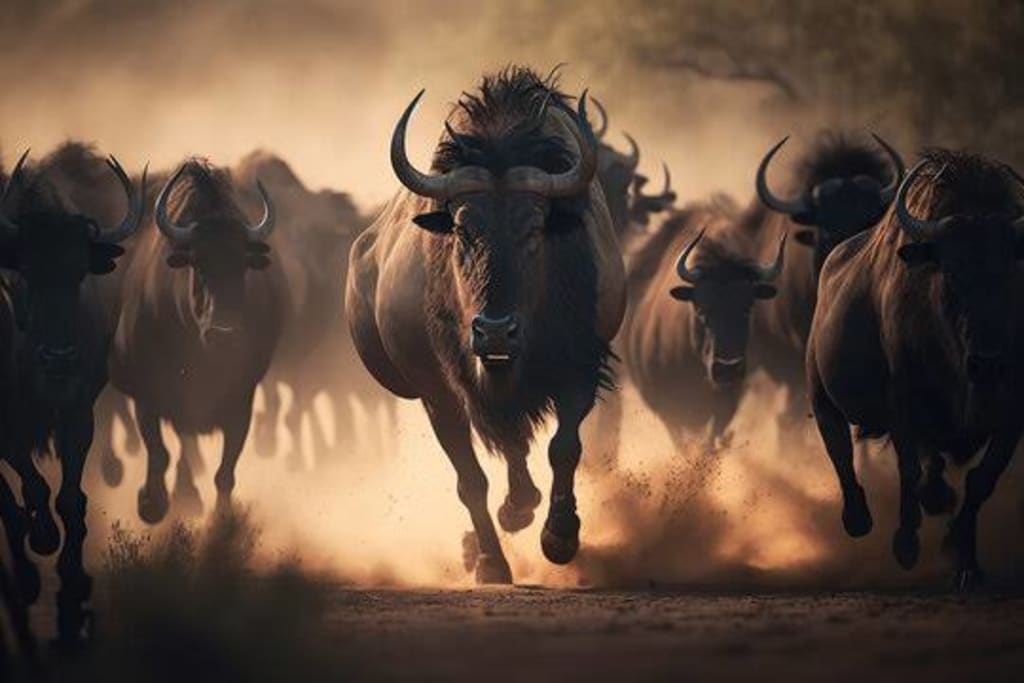
The Madili Empire had long been expanding its borders, conquering neighboring villages and tribes to fuel its own growth and wealth. Sempi, nestled in the hills, had prospered for years thanks to its fertile land and skilled farmers. But when the Madili army came knocking, Sempi knew it was in trouble.
The village had a small militia, but it was no match for the well-trained soldiers of the Madili Empire. The village council convened an emergency meeting to discuss their options. Ambuli, the chieftain of Sempi, listened as his advisors proposed different strategies, from surrender to guerrilla warfare. But Ambuli had an idea of his own.
"We have one advantage over the Madili," he said. "Our buffaloes."
The other council members looked at each other skeptically. Buffaloes were useful for plowing fields and transporting goods, but they were hardly weapons of war.
But Ambuli had a plan. He ordered his people to round up all the buffaloes in the village and prepare them for battle. They fashioned armor out of leather and metal for the animals, and trained them to charge on command.
The Madili army, meanwhile, had laid siege to Sempi, cutting off its supply lines and waiting for the villagers to surrender. But one day, they heard a loud rumbling in the distance. Soon, they saw a stampede of armored buffaloes charging towards them.
At first, the Madili soldiers were taken aback. They had never seen anything like it before. But they quickly regained their composure and prepared to face the beasts. The buffaloes crashed into the enemy lines, sending soldiers flying and trampling them underfoot. The Madili soldiers fought back with swords and spears, but the buffaloes were too strong and too numerous.
Ambuli and his militia watched from a safe distance, marveling at the effectiveness of their unusual strategy. The buffaloes were causing chaos and confusion among the enemy ranks, and their sheer size and ferocity were making the soldiers hesitant to engage them.
But the Madili Empire was not easily defeated. They regrouped and sent out their cavalry, hoping to take down the buffaloes from a safe distance. But Ambuli had anticipated this move, and had ordered his archers to take aim at the horses. The Madili cavalry was soon forced to retreat, and the buffaloes continued their rampage.
The battle lasted for several hours, but in the end, the Madili Empire was defeated. The surviving soldiers fled back to their own lands, never to return to Sempi again.
Ambuli and his people celebrated their victory, and the buffaloes were hailed as heroes. They had saved the village from certain destruction, and had proven that even the most unlikely weapons could be effective in battle.
From that day on, Sempi was known as the village of the brave buffaloes. Ambuli became a legend among his people, and his name was passed down through the generations as a symbol of courage and ingenuity.
The story of Sempi and its buffaloes has been told and retold for centuries, inspiring other villages and tribes to think creatively in times of war. It serves as a reminder that even when faced with overwhelming odds, there is always a way to fight back and win. All it takes is a little bravery, and a lot of imagination.
The victory of Sempi over the Madili Empire was not only a triumph for the village, but it also had larger implications for the region. The Madili Empire had been expanding aggressively, conquering neighboring territories and subjecting their inhabitants to their rule. The defeat at Sempi showed that the empire was not invincible, and that even smaller, seemingly weaker communities could resist their expansionist ambitions.
The news of Sempi's victory spread quickly throughout the region, and other villages and tribes began to take notice. Some sought to emulate Sempi's use of unconventional tactics, while others sought to forge alliances with the village as a means of protection against the Madili Empire.
Ambuli, for his part, became a respected figure among his fellow chieftains. He was sought out for advice and counsel, and his name became synonymous with the bravery and ingenuity that had enabled Sempi's victory. He used his newfound influence to advocate for peace and cooperation among neighboring communities, recognizing that unity was the best defense against the Madili Empire's aggression.
Over time, the legend of Sempi and its buffaloes grew even larger. The story was retold and embellished, with some versions depicting the buffaloes as giant, fire-breathing beasts that could shoot lightning from their horns. Others added further details about the battle, such as the use of flaming arrows and secret underground tunnels.
But despite the exaggerations, the core message of the story remained the same. It was a tale of courage, resourcefulness, and the power of community. It showed that even the most unlikely weapons could be effective in battle, and that a united front could overcome even the most formidable foes.
The legacy of Sempi's victory endured long after Ambuli's time. It inspired other communities to stand up against tyranny and oppression, and it became a symbol of hope and resilience for generations to come. And while the legend may have been embellished over time, the truth at its core remained the same: that with courage, determination, and a little bit of creativity, anything was possible.
About the Creator
The Red Hatred
Sometimes I feel like I hate you. A kind of red magma forms inside me, in my chest, and rises to my throat. In that moment, I want to destroy. I want to grab a plate and smash it into pieces. I want to take scissors and shred that red, sexy underwear I bought to please you.
By Anastasia Tsarkova3 days ago in Fiction


Comments
There are no comments for this story
Be the first to respond and start the conversation.