
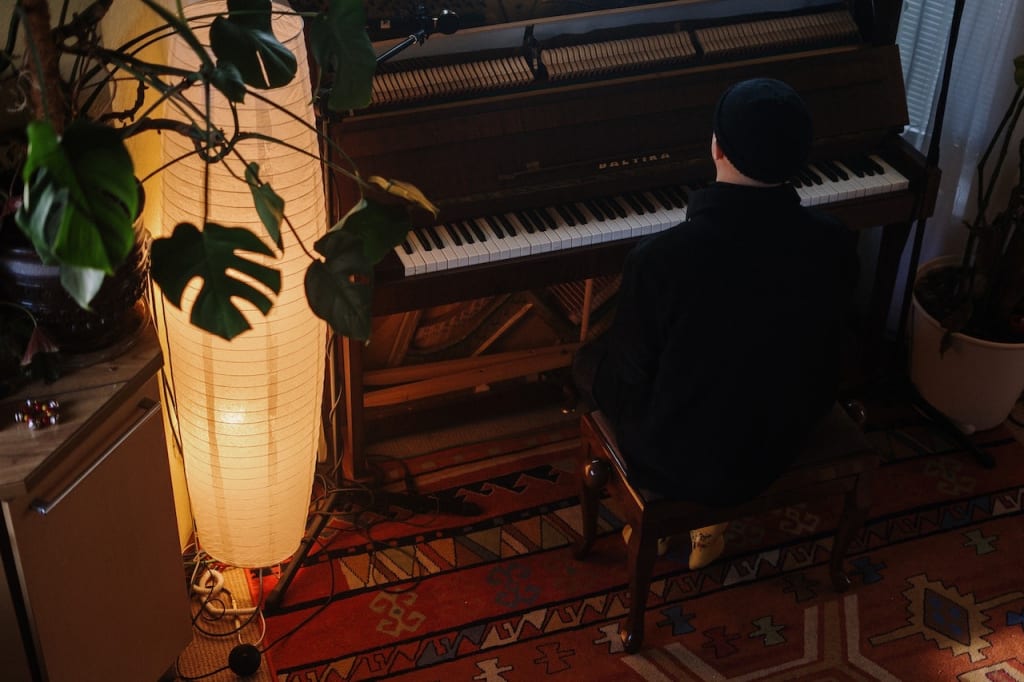
The orchestra had packed up and left. The crowd had filtered out into the moonlit streets of Paris. The only sound that lingered was the echo of the last note, still dancing in the air, seeping into the velvety darkness of the auditorium.
Leon, the janitor, shuffled onto the stage. His broom pushed aside the remnants of the night: discarded programs, forgotten scarves, the occasional misplaced ticket stub. His eyes, though, were focused on the grand piano that sat center stage, gleaming in the spotlight's afterglow.
Leon had a secret. For forty years, he had been the janitor at the Palais Garnier, the jewel of Paris. But in another life, before the weariness of time took its toll, he had been a pianist. He had once played to thunderous applause, bathed in the adoration of the crowd. But a cruel twist of fate had stolen his moment in the sun, an accident that crippled his hands. He was left with a broom instead of a baton, dustpans instead of sheet music.
Every night, once the audience had departed and the performers retired, Leon would approach the piano. He would caress the keys, reminiscing about the melodies he used to weave. He could still feel the music in his soul, yet his fingers would not obey his heart's command.
Tonight, as he stood before the piano, he felt an overwhelming surge of emotion. His heart ached with a symphony that yearned to be set free. He closed his eyes, placed his gnarled hands on the piano, and began to play. The notes were clumsy, the rhythm stilted, but he played nonetheless. He played for his lost dreams, his shattered hopes, his love of music that remained undimmed despite it all.
And as he played, something miraculous happened. His hands, once stiff and unyielding, began to move with an ease he had not felt in decades. The notes flowed freely, painting the air with a poignant melody. He opened his eyes, hardly daring to believe, and saw his fingers dancing across the keys with a grace he thought he had lost forever.
Word of the janitor's late-night performances began to spread. The orchestra members, intrigued, began to stay back to listen. Then came the stagehands, the costume designers, the ushers. Even the stern-faced director could not resist the magnetic pull of Leon's music.
The crowd grew, night after night. They watched in reverent silence as Leon, the janitor-turned-pianist, poured his soul into the piano. The applause that followed each performance was deafening, but Leon hardly noticed. He was lost in his world of music, a world he had longed to return to for years.
One evening, as Leon played to his captivated audience, a stranger entered the auditorium. He was an elderly man, renowned in the world of music. He had heard rumors of the janitor's performances and decided to see for himself. As he listened to Leon play, he was moved to tears. He saw in Leon a raw, unpolished talent that deserved to be celebrated, not hidden away in the shadows of the auditorium.
The next day, the stranger returned. He introduced himself as Maestro Ferrara, a famous conductor. He offered Leon a chance he had never dreamed of - to perform in a concert with the Paris Symphony Orchestra. He wanted the world to hear Leon's music, to experience the same emotion he had felt upon hearing it.
Leon hesitated, thinking of his hands, his age, the accident. But then he remembered the feeling of the keys beneath his fingers, the freedom ofexpression, the joy that music brought him. He looked at Maestro Ferrara, nodded, and accepted the offer.
Weeks later, the Palais Garnier was once again filled with the excited chatter of a crowd. They were not there for a regular symphony concert. The word had spread about the janitor who played the piano with an inexplicable magic, and they were there to hear him play.
Leon walked onto the stage, no longer dressed in his janitor's uniform but in a crisp, black tuxedo. The crowd fell silent as he approached the piano, his piano. He placed his hands on the keys, closed his eyes, and began to play. The music that filled the auditorium was nothing short of breathtaking. It was a melody that spoke of lost dreams and rediscovered hopes, of second chances and the enduring power of passion.
The last note hung in the air, then faded into a silence that seemed to stretch for an eternity. Then the applause erupted, a thunderous ovation that shook the auditorium. But Leon, lost in his music, barely noticed the applause. He was back where he belonged, not in the limelight, but in the world of melodies and harmonies that had always been his true home.
From that day forward, Leon was not just the janitor of Palais Garnier. He was Leon the Pianist, the man who reminded everyone that it was never too late to follow your dreams, that magic could be found in the most unexpected places, and that music, in its purest form, could heal, inspire, and transform.
About the Creator
Keep reading
More stories from Turan Kaynak and writers in Fiction and other communities.
Journey Through the Dark
Under the vast canvas of a starless night, a great forest lay. The trees, majestic and towering, stood as silent guardians over the world below. The darkness was near absolute, save for the flickering light of a single lamp standing at the edge of a clearing. It stood as a beacon in the relentless sea of shadows, a lone sentinel against the encroaching dark.
By Turan Kaynak3 years ago in Fiction
Miss Persephone's Manual to a Seemingly Ordinary Life
Miss Persephone was found at the dining table, her blue eyes swollen, her tears arriving and retreating like the tides of the ocean. Earlier that day, her family had visited her in the retirement home where she had lived for eight years. It was her eightieth birthday.
By Imola Tótha day ago in Fiction




Comments
There are no comments for this story
Be the first to respond and start the conversation.