
The Last Night at Dyatlov Pass
“A peaceful expedition turned into a terrifying escape into the night—what scared nine experienced hikers so badly that they ran barefoot into the frozen wilderness?”

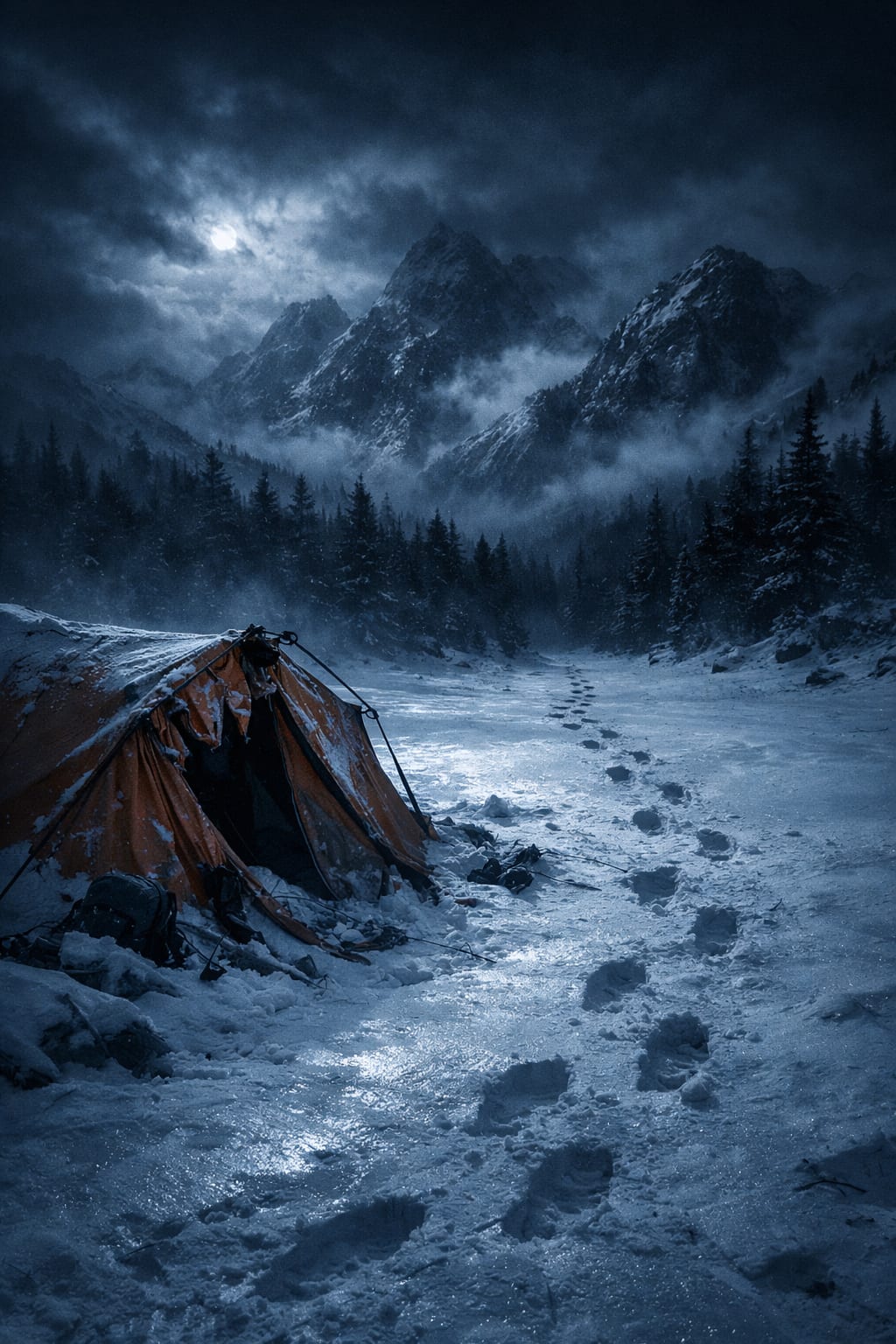
Winter in the Ural Mountains is not gentle.
The wind moves like a living thing, cutting through clothing and bone, whispering across endless fields of white. Snow stretches for miles in every direction, and the silence is so deep that even a single step feels like a disturbance.
In the winter of 1959, nine young hikers set out into that silence.
They were students, friends, dreamers—people who believed that adventure made life meaningful. Their leader was the determined and calm Igor Dyatlov, a 23-year-old engineering student who loved the mountains more than anything.
The journey was supposed to be difficult, but not impossible.
They laughed as they packed their equipment. They took photographs along the way, smiling at the camera with wind-burned faces and bright hopeful eyes. Their diaries spoke about the beauty of the mountains and the excitement of reaching their destination.
None of them knew that the place they were heading would later be known around the world as Dyatlov Pass.
And none of them knew it would be the last place they would ever see.
The expedition began with ten hikers, but one of them became sick early in the journey and returned home.
At the time, he felt unlucky for missing the adventure.
In reality, that decision saved his life.
The remaining nine continued deeper into the mountains.
Day after day, they pushed forward through snowstorms and freezing winds. They built campfires, joked with each other, and wrote small notes in their journals about how cold the nights were.
Yet the tone of those notes remained cheerful.
They were strong, young, and fearless.
The mountains were simply another challenge to overcome.
On the night of February 1st, the group pitched their tent on a slope of a lonely mountain called Kholat Syakhl.
The name came from the local Mansi language.
It meant something chilling.
“Dead Mountain.”
But the hikers didn’t know that.
To them, it was just another cold night.
They ate dinner together inside the tent. Someone probably told a joke. Someone else likely complained about the wind.
Outside, snow drifted quietly across the mountainside.
The temperature dropped far below freezing.
Then… something happened.
Something so terrifying that nine experienced hikers suddenly fled their tent in the middle of the night.
Without coats.
Without boots.
Without time to think.
Weeks later, when rescuers finally arrived, they found something disturbing.
The tent was still there.
But it had been cut open from the inside.
Not torn by animals.
Not destroyed by wind.
Cut.
As if the people inside had been desperate to escape as quickly as possible.
Footprints led away from the tent, heading down the mountain toward a small forest.
The footprints told a strange story.
They weren’t running.
They were walking.
Barefoot.
Into the freezing darkness.
The rescuers followed the trail.
Under a large cedar tree at the edge of the forest, they found the first two hikers.
They were lying near the remains of a small fire.
Both had died from extreme cold.
But something about the scene felt deeply human and heartbreaking.
The bark of the cedar tree was torn high above the ground.
One of them had tried to climb the tree.
Maybe to look for the tent.
Maybe to see what was chasing them.
Or maybe simply to survive.
Over the following weeks, search teams discovered the remaining members of the group scattered across the snow.
Three of them appeared to be walking back toward the tent.
As if they had finally decided the danger behind them was worse than the cold in front of them.
But they never made it.
Months later, when the last four hikers were discovered beneath deep snow, the mystery only grew darker.
Some had severe injuries—broken ribs and skull fractures—yet there were no signs of a struggle around them.
No footprints.
No evidence of violence.
Just silence.
Endless, frozen silence.
The tragedy became known as the Dyatlov Pass Incident.
Investigators tried to explain what had happened.
Some suggested an avalanche.
Others believed it might have been military testing or strange atmospheric phenomena.
Over the years, people have proposed countless theories—everything from secret experiments to unknown natural forces.
But none of them explain every detail.
Even today, decades later, the mystery remains unsolved.
Yet sometimes the most haunting part of the story isn’t the mystery itself.
It’s the humanity behind it.
Nine young people stood on that mountain together, sharing dreams of the future.
They trusted each other.
They laughed together.
And when something terrifying happened that night, they didn’t abandon one another.
They stayed close.
They tried to survive as a group.
Even in the final moments of freezing darkness, they were not alone.
If you visit the mountains today, the wind still whispers across the snow.
The same cold silence fills the valley.
But somewhere beneath that quiet landscape lies the memory of nine hikers who never returned.
Their photographs still exist.
Smiling faces.
Bright eyes.
Young lives filled with hope.
And every winter, when snow covers Dyatlov Pass, the mountains keep their secret.
A secret that the wind has carried for more than sixty years.
The question remains, drifting through the frozen air:
What happened on that last night at Dyatlov Pass?
About the Creator
Keep reading
More stories from imtiazalam and writers in Fiction and other communities.
Becca
"Everything is so... flat." Denille said stupidly as she looked around her new neighborhood. She looked around at the muted desert where even the smallest sign of life seemed to have given up. The plant life was shrubs that were half cooked by the heat and where there should have been a lawn, a mess of white rocks laid glistening in the sun. Even the sky looked stretched thin, like the sun had ironed it smooth. She’d moved from Riverside, where at least there were hills, but here in Barstow, everything felt baked and brittle.
By Sara Wilson3 days ago in Fiction
The Mundane Murders
It was a small town in Massachuttes, named Seaside, where the waves broke on the shores of this coastal town which was nestled between two larger cities. It seemed quiet for the most part, but there was darkness looming in the salty air, of this otherwise righteous town.
By Susan Payton7 days ago in Fiction
A More Human Vocal
When we launched Vocal nearly a decade ago, the world was a very different place. LLMs did not exist, and stories were created one at a time by people sitting down to write, revise, and share something personal. Many of our assumptions about publishing, trust, and participation were built for a world where effort and output were inseparable.
By Justin @ Vocal4 days ago in Resources



Comments
There are no comments for this story
Be the first to respond and start the conversation.