
The Last Message from Tokyo: A Wrong Number That Saved My Life
On a freezing night in Japan, a stranger’s accidental text stopped me from ending everything — and started a global movement of hope.

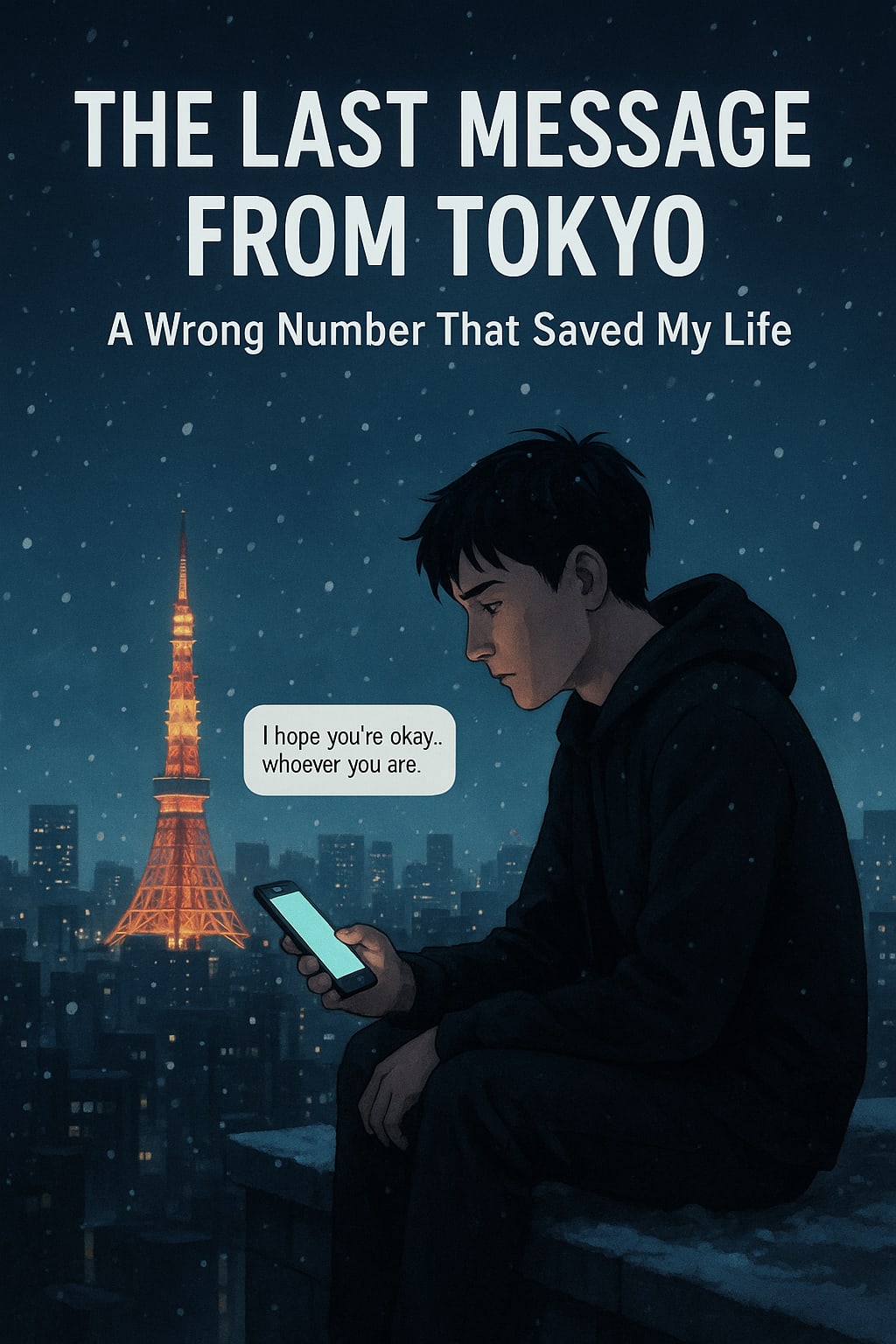
The Last Message from Tokyo
It was snowing again that night in Tokyo. The city looked quiet, almost sacred, beneath the streetlights. From the rooftop of my small apartment, I could see trains sliding like silver veins through the darkness. I had been in Japan for two years, studying engineering, but lately I felt more like a ghost than a student.
Homesickness had a strange way of creeping in — not through sadness, but silence. Every day looked the same. Study, part-time job, instant noodles, an empty room. No family dinners. No laughter. No reason.
That night, I stood on the edge of the rooftop, cold wind biting my face, thinking about how easy it would be to simply step forward. The thought terrified me, yet also calmed me. I had convinced myself no one would notice.
And then my phone buzzed.
> “I hope you’re okay… whoever you are.”
I frowned. Wrong number, I thought. Still, something about the message stopped me. There was no emoji, no punctuation — just quiet concern.
After a few seconds, I replied:
> “You have the wrong person.”
A few minutes later:
> “Maybe. But maybe not. Sometimes messages find who they’re meant for.”
That line made me sit down. Snow gathered on the railing beside me as we began to talk.
Her name was Hana. She said she was from Osaka, working in a hospital, and had just lost a patient she’d grown attached to. “I texted my friend,” she said, “but maybe I needed to text a stranger instead.”
For two hours, we talked — about fear, about the loneliness of living far from home, about how people always pretend to be fine. I told her about Pakistan, about my mother’s biryani, about how Tokyo felt like a beautiful cage.
> “Maybe you’re not trapped,” she wrote.
“Maybe you’re just waiting for someone to open the door.”
By midnight, I realized I was smiling. I hadn’t smiled in weeks. I told her that. She replied with a heart emoji and said she was glad.
Before we ended the chat, she wrote one last line:
> “Promise me you’ll still be here tomorrow.”
I promised.
---
When I woke the next morning, Tokyo was bright and loud again. I made coffee and checked my phone — but Hana’s profile picture was gone. Her number showed only “User not available.”
Maybe she had deleted her account. Maybe she had been a dream. But something in me changed that night. I left my apartment and walked through Ueno Park, watching the snow melt into puddles. For the first time in months, the world didn’t feel heavy.
That week, I went to my university’s counseling office. I started talking again — to people, to teachers, even to strangers. Every time I hesitated, I remembered her message: “Sometimes messages find who they’re meant for.”
---
Three weeks later, I received an email from an unknown address. It was written in Japanese and signed by Nurse Aki. The message said Hana had been her colleague — a young nurse battling depression after losing her brother. She had passed away the same night she texted me.
My chest tightened. The world blurred.
Aki wrote:
> “Before her last shift, Hana told me she had finally done something good — she had helped someone far away feel less alone.”
I didn’t move for a long time. The city outside my window kept living — trains rushing, people laughing, lights changing — but inside, time stopped.
I looked at Hana’s last text again: “Promise me you’ll still be here tomorrow.”
And I whispered, “I am.
---
Months have passed since that night. I created a small online project called The Hope Messenger, a website where people can send anonymous messages of kindness to strangers worldwide. The first message on the site is Hana’s line — translated into twelve languages.
Thousands have joined. People from Brazil, Nigeria, Japan, Pakistan, and Canada. They share stories, pain, gratitude. They remind one another that even a single text, a few words, can keep someone alive.
Whenever I read those messages, I imagine Hana smiling somewhere — her light still moving through the world, invisible but real.
Sometimes I still walk back to that rooftop. The same skyline, the same wind. But now, instead of stepping toward the edge, I look at the city and whisper a quiet thank-you.
We spend our lives waiting for someone to save us, never realizing that salvation can arrive in something as small as a notification sound.
One wrong number. One right moment. One life saved.
If you’re reading this, and tonight feels too heavy to carry, please remember Hana’s words:
About the Creator
Nimatullah
I share powerful stories, heartfelt poetry, inspiring speeches, and meaningful news that spark thought and feeling.
Every word is written to move, uplift, and connect.
Follow my journey through emotion, truth, and creativity —
Keep reading
More stories from Nimatullah and writers in Fiction and other communities.
Layla and Majnun – A Love Beyond Time
In the heart of ancient Arabia, where deserts stretched endlessly and stars told stories of the past, a tale of eternal love was born. It is the story of Layla and Majnun, a love so deep and pure that it defied all boundaries and continues to echo through generations as a symbol of devotion and madness in love.
By Nimatullah8 months ago in Fiction
I Heard Someone Breathing While I Slept Alone
The Night Everything Changed I woke up at 3:12 AM, a time I’ve always associated with nightmares and the “witching hour.” At first, I thought it was just the wind brushing against the window blinds. But then I heard it—a slow, deliberate breathing coming from the darkness beside my bed.
By Mohammad Hamid2 days ago in Fiction
Why Didn't Anyone Tell Us
Men, move along. This is not for you. This is for the women. I was forty-five when I began menopause. It is pretty young for that to be going on in a woman’s life, but I had undiagnosed PCOS, my entire life. Thank you to all the gynecologists I had seen my entire life. That in itself should encourage women to keep seeking second opinions, especially when you are not getting correct answers or any at all.
By Alexandra Granta day ago in Humans



Comments
There are no comments for this story
Be the first to respond and start the conversation.