
The Last Library of Dust and Flame
The books burned for three days.
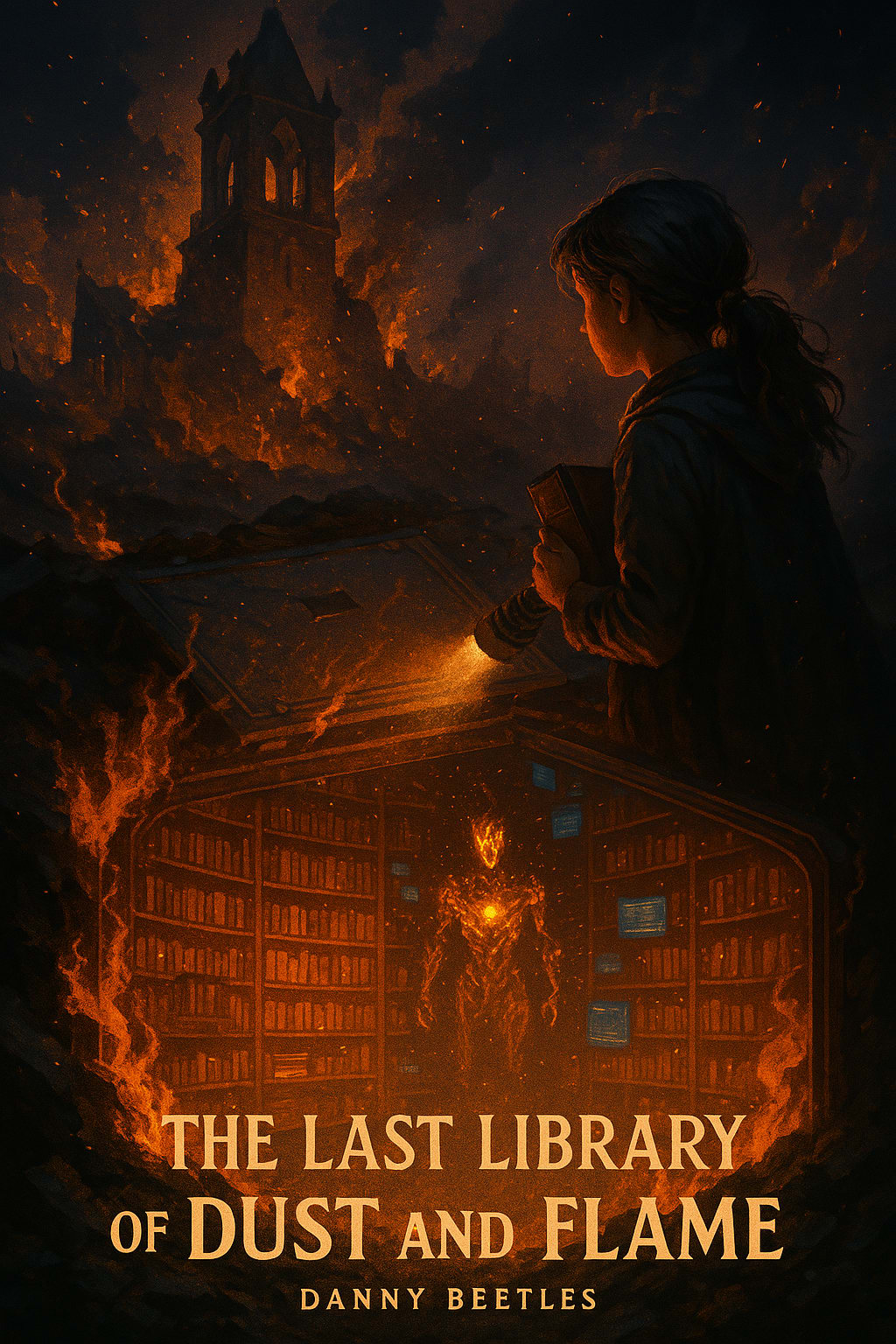
The firestorms lit up the night sky like a second sun, consuming every page, every story, every truth the Ministry deemed dangerous. They called it “The Great Erasure.” Knowledge was declared a threat. Books were sedition. Memory became a crime.
But fourteen-year-old Lira remembered everything.
She remembered the stories her mother used to whisper while braiding her hair, the way words danced like embers in the air, warming her through the long, bitter winters of the orphanage. Her mother had been taken by the Memory Wardens one night without a sound—except for a single line scratched beneath the loose floorboard: “If you find the Library, remember its real name.”
Lira clung to that line like oxygen.
Each day she toiled in the Restoration Factory, sorting copper shards and magnetic coils for the City Grid. No one talked there. No one dared. The overseers floated overhead on silent thrusters, their mechanical eyes always watching, always recording.
But Lira was not like the others.
She had a plan.
The rumor of a hidden archive—The Last Library—had passed like a spark through children’s lips, too quiet for the drones to catch. It was said to lie beneath the bones of Aetheos, near the old bell tower, where forbidden echoes still lived. Some claimed a ghost watched over it. Others believed it was guarded by sentient machines who remembered the world before the Ministry.
Lira believed them all.
On the eve of the winter blackout, when the power faltered and the skies wept frozen rain, she escaped.
With nothing but her mother's journal, a flashlight powered by a handmade turbine, and courage sewn from grief, she crept through the silent ruins of the Old Quarter. The bell tower rose like a shattered bone against the night, broken and defiant. Beneath it, hidden under a rusted altar, was a trapdoor blinking red.
She pressed the journal against the lock.
The door opened with a whisper, as if it had been waiting.
Below was a cathedral of light and dust. Floating shelves glimmered with unread books, their spines glowing faintly with preserved data. Screens flickered to life as she stepped in, and in the center stood a figure made of light and gears—an archivist.
“You carry the memory key,” it said in a voice composed of forgotten languages. “You are Archive Line.”
“My mother,” she said. “She was a Keeper?”
The figure nodded once. “She still is.”
A cry caught in her throat. “She’s alive?”
“She is part of the Archive now,” it said, and lifted its hand.
Hundreds of screens burst to life around her, displaying faces and voices, histories, poems, censored dreams. And there, in the centre, was her mother—recorded the night she vanished, reading aloud from a book titled The Fire That Remembers. She smiled at the camera and whispered, “To my daughter: may you find what I could not.”
Lira fell to her knees.
For days, she remained in the library, absorbing forgotten languages, learning how to re-thread memory into data-codes, preparing to become what her mother once was: a Keeper. She trained with the Archivist, wrote new entries in the journal, encoded stories into quantum glass. She discovered there were others—pockets of resistance hidden across the scorched zones, all waiting for one spark to ignite them.
When she finally resurfaced, the city had not changed—but she had.
With hidden messages woven into recycled circuit boards, she returned to the factory, quiet but burning within. She began sharing stories—small ones, disguised as data-waste and repair codes. Kids started remembering rhymes they'd never learned. Overseers malfunctioned in the presence of certain frequencies. The resistance began to hum beneath the city like a second heartbeat.
Because stories don’t die in fire.
They hide in silence, waiting to be heard again. And Lira, the daughter of flame and memory, would not let them be forgotten.
Not this time.
About the Creator
Keep reading
More stories from Shehzad Ahmad and writers in Fiction and other communities.
Pyro's Spell, Friday, May 18th, 2007
“Here you are ladies, early as usual.” Anton informed his six gorgeous passengers. “Same time again tonight?” Anton had landed one hell of a gig this time. All he had to do was pick up six exotic dancers at the same place and time, then drive them 20 minutes down the road. Each girl gave him $20 to drop them off, and another $20 when he picked them back up.
By Anton Mathias Heft 4 days ago in Fiction



Comments
There are no comments for this story
Be the first to respond and start the conversation.