
The Last Library
When Books Remember What People Forget


The world ended not with a bang, but with a slow, persistent silence.
Fifty years ago, the Great Forgetting began. It wasn’t a war or a virus—just... loss. People woke up not remembering their names. Entire histories faded from minds, cultures collapsed not from conflict, but from erasure. No one knew why. It was as if knowledge itself had slipped through the cracks of human thought.
Now, scattered settlements clung to survival, passing on scraps of memory like folk songs.
But there were still stories. Somewhere.
Mira had heard the legend since she was a child: of a library that remembered everything even when the world forgot. Her grandmother spoke of it in a whisper, eyes distant.
“The Library isn’t just books, Mira. It remembers. More than people do.”
So, at sixteen, Mira left the coastal enclave of her birth and followed maps made of rumor. For two years she wandered across wastelands and tangled forests, chasing echoes of the Library.
She found it on a morning stained with golden fog.
The building loomed like a forgotten cathedral. Shattered pillars, crumbling steps, ivy-choked windows. The once-grand entrance bore a Latin inscription nearly rubbed away: Scientia est Memoria — Knowledge is Memory.
The double doors, surprisingly, opened at her touch. Inside, the air was heavy with dust and silence. Shelves stretched beyond the eye, interrupted by pools of filtered light from above. But it wasn’t dead.
The books... whispered.
Not aloud, but in thought—fragments of voices, ideas, languages, some she didn’t recognize.
Mira stepped deeper into the vast hall, goosebumps dancing on her arms. She touched a book at random. Instantly, a flicker of something hit her—an image of the Eiffel Tower at sunset, laughter in a foreign tongue.
She gasped and staggered back.
It’s true. It remembers.
Over the next days, she explored the library’s endless sections. History, philosophy, poetry, science. Some books were locked behind strange mechanisms—gears, pulleys, riddles. Others hovered gently in place, glowing faintly, opening only when approached with the right intent.
And some whispered warnings.
She learned quickly. Read carefully. Ask permission. The library had a kind of sentience. It offered knowledge, yes—but it guarded memories, and did not take kindly to greed.
In the biography wing, she found her grandmother’s name. Inside the book, not written in ink, but lived—pages that bloomed with sound and sensation. She heard her grandmother’s voice as a girl, saw her first kiss, felt the terror of losing her mother.
When she closed the book, tears traced silent lines down her cheeks.
One night, Mira lit a fire in the center hall and sat cross-legged before a stack of books. She had begun organizing them, translating forgotten scripts into symbols her village might learn again. It was slow, sacred work.
But she was not alone.
A sound broke the silence. Footsteps—not ghostlike whispers, but solid, echoing boots.
Mira extinguished the fire and pressed into the shadows.
A man emerged—tall, bald, clad in scorched armor. His eyes scanned the shelves hungrily.
“The girl’s here,” he called. Another figure joined him—a woman with silver lines tattooed across her scalp.
Raiders.
Mira had heard of them. Not all survivors feared memory—some sought to own it. They stole books and demanded tribute from settlements in exchange for pieces of the past. To them, knowledge was power to be hoarded, not shared.
“They say the Core is still intact,” the woman said. “The Origin Book. The first.”
Mira held her breath.
The Origin Book. She had found it once, locked beneath a sealed atrium with a living tree grown through its center. She hadn’t dared open it yet.
The man moved toward the corridor that led to it.
She had to stop them.
Mira crept from her hiding place and slipped between shelves until she reached the Archive heart. There, under a dome of stained glass, stood the Origin Book on a pedestal of white stone. Roots from the tree above wound lovingly around it, as if protecting it.
She didn’t know what would happen if someone took it—or if it was destroyed.
“Forgive me,” she whispered to the library.
Then she placed her hand on the cover.
The world tilted.
She was no longer in the library, but everywhere—inside memories, timelines, thoughts. She saw the rise of cities, the fall of empires, the day language was born. She became the library.
When she returned to her body, the raiders stood frozen, caught in a whirlwind of pages that tore through the chamber.
The books were alive. Defending themselves.
The woman screamed. The man tried to run. But the wind grew louder, filled with voices—not angry, not cruel. Just... remembering.
When silence fell, they were gone.
Mira knelt, trembling. The Origin Book glowed faintly beneath her hand.
From that day, she became its Keeper.
She stayed in the library for years, tending to its halls, guiding those who came seeking knowledge. Not all were worthy. But many were.
She taught them to read what had been lost. To listen. To remember.
The world didn’t return to what it had been. But it began to heal.
Villages grew into towns. Language spread again. Stories were shared, not stolen.
And deep in the heart of the Last Library, Mira sat beneath the tree, transcribing new memories into books that would outlive them all.
Because some things deserve to be remembered.
About the Creator
Ashley Anthony
✨ Storyteller | 💭 Deep Thinker
📚 Genres I breathe: Drama | Mystery | Sci-Fi | Real-life Confessions
🎤 Every story is a voice someone’s afraid to use — I lend mine.
💌 Let’s connect through the unwritten.
Keep reading
More stories from Ashley Anthony and writers in Fiction and other communities.
The Clockmaker’s Heir
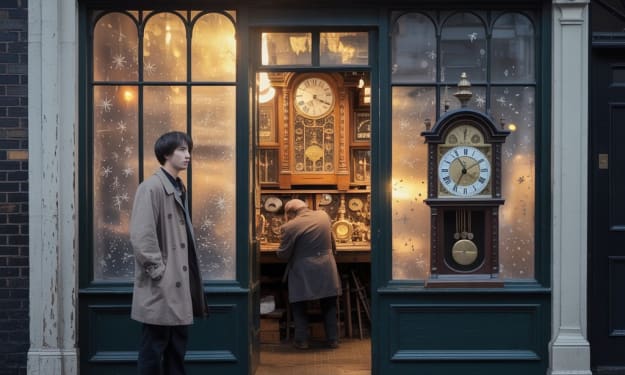
The bell over the door tinkled with a sound as delicate as a whisper, despite its rusted spring and age. Elliot Travers stepped into the clock shop his grandfather had owned for nearly sixty years, inhaling the scent of varnished wood, oil, and time. It hadn’t changed in the two decades since he’d last visited as a boy—though the man who once stood behind the counter, stooped and grinning, was now gone.
By Ashley Anthony9 months ago in Fiction
As the World Turns...and turns
I take up my pen and go back to the time, only a year or so ago...when the world felt almost peaceful - except for the regions and corners of life where people insisted on wars. But somehow, they then seemed like another whole world away from me.
By Novel Allena day ago in Fiction
Cassie and Johnny
I’m the kind of dame you notice. I’m no femme fatale, but you can’t ignore me, at least not until I warn you about what’s coming, then everybody ignores me. Hell, they usually blame me afterwards and give Johnny all the credit for saving the day, but my Johnny couldn’t save a seat at the movies without my help. Sure, he’s brawny, but brainy? Not so much. Like that time I asked him to spot me five bucks, and he said he didn’t see it anywhere on me, and believe you me, he looked but good.
By Harper Lewis7 days ago in Critique



Comments
There are no comments for this story
Be the first to respond and start the conversation.