
The Last Library at the End of the World
In a ruined future where books are forbidden, a boy discovers the final library—and the librarian guarding secrets too powerful to forget.
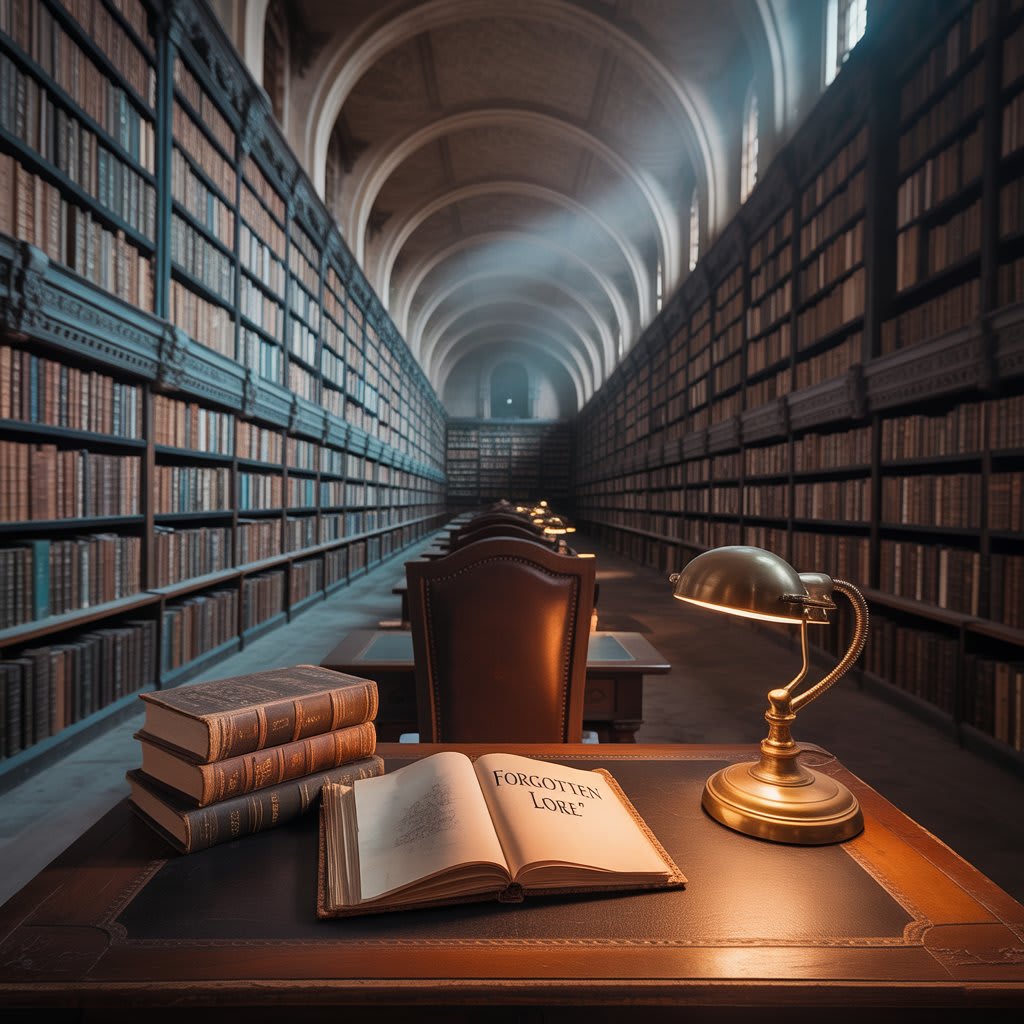
The year was 2147, and words had been outlawed.
Screens ruled the world now—short bursts of images, endless noise, hollow distractions. Books had been burned decades ago during the Silence Act, when the ruling Council declared that written stories were dangerous. They said books gave people “too much memory and too much imagination.”
And yet, somewhere in the dead city, a boy named Elias found one.
It was not large, not heavy, just a leather-bound journal buried in the rubble of what had once been a school. Its pages smelled of dust and ash. The letters inside were strange, but they hummed with life. Elias traced them with his finger, whispering them under his breath. Though he did not yet understand the words, they awakened something deep inside him—like remembering a song half-forgotten.
From that moment, he was no longer the same.
That night, Elias dreamt of shelves stretching into eternity, candles flickering, voices whispering from books stacked high. He awoke with a burning certainty: there was still a library left, somewhere beyond the ruins. And it was calling to him.
He packed what little food he had, clutched the journal, and followed his dreams into the wastelands.
For days he walked, across cracked highways and hollow buildings where silence grew thick as dust. Until, one evening, he saw it: a crumbling tower hidden behind vines. Its heavy doors were carved with symbols like the ones in his journal. With trembling hands, Elias pushed them open.
The air inside was warm, rich with the scent of paper. Candles burned, though no one had lit them for years. And there, at the center, sat a woman in a dark robe, her eyes glowing faintly like embers.
“You found me,” she said. Her voice echoed like turning pages.
Elias clutched the journal. “Are you the librarian?”
She smiled. “The last one.”
Her name was Maren, and she explained the truth. The library was no ordinary place—it was alive. Every book here contained not just stories, but memory itself. To open one was to step into another life, to feel another soul’s joys and sorrows. The Council had destroyed the others because too much memory made people question, and too much imagination made them rebel.
“But the library remains because it must,” Maren whispered. “Every story must have a guardian.”
For weeks, Elias stayed, devouring books. He lived lifetimes in days—sailing oceans, fighting wars, falling in love, raising families. Each story stitched him together, making him whole. But the more he read, the more he understood the danger.
The Council would come.
They always did. Rumors of hidden books drew their soldiers like moths to flame. And this library was the last flame.
One night, Maren gave Elias a choice. She led him to a door deeper than the others, carved with a thousand names. Inside lay a single book bound in iron chains.
“This,” she said, “is the Archive. Every story ever told, every memory ever lived, is written inside. If the Council finds it, they will end the world of words forever. But if you take it, the library will fall.”
Elias stared at the book, his hands trembling. To take it meant saving the Archive but losing this place. To leave it meant risking everything.
At dawn, the ground shook. Soldiers approached. Maren pressed the iron book into Elias’s arms. “Run,” she said.
“But what about you?” Elias whispered.
She smiled sadly. “I am only a page. You… are the story that continues.”
The last Elias saw of her was the glow of candles as the doors shattered and soldiers stormed inside. He ran into the wasteland with the Archive clutched against his chest.
Behind him, the library collapsed, dust and fire swallowing the shelves. The last sanctuary of words was gone.
But the Archive was safe. And with it, Elias carried not just stories, but the future.
For as long as someone remembered, the library would never truly die.
About the Creator
Keep reading
More stories from MUHAMMAD SAIF and writers in Fiction and other communities.
The Painter of Forgotten Dreams
Adrian Hale was a painter who had long stopped believing in himself. His canvases collected dust in a small attic studio, ignored by galleries and unseen by the world. Once, he had painted with fire in his soul, chasing dreams of capturing emotions too fragile for words. Now, his brushes lay idle, their bristles stiff, his hands too tired to chase inspiration.
By MUHAMMAD SAIF5 months ago in Fiction
Miss Persephone's Manual to a Seemingly Ordinary Life
Miss Persephone was found at the dining table, her blue eyes swollen, her tears arriving and retreating like the tides of the ocean. Earlier that day, her family had visited her in the retirement home where she had lived for eight years. It was her eightieth birthday.
By Imola Tóth6 days ago in Fiction


Comments
There are no comments for this story
Be the first to respond and start the conversation.