

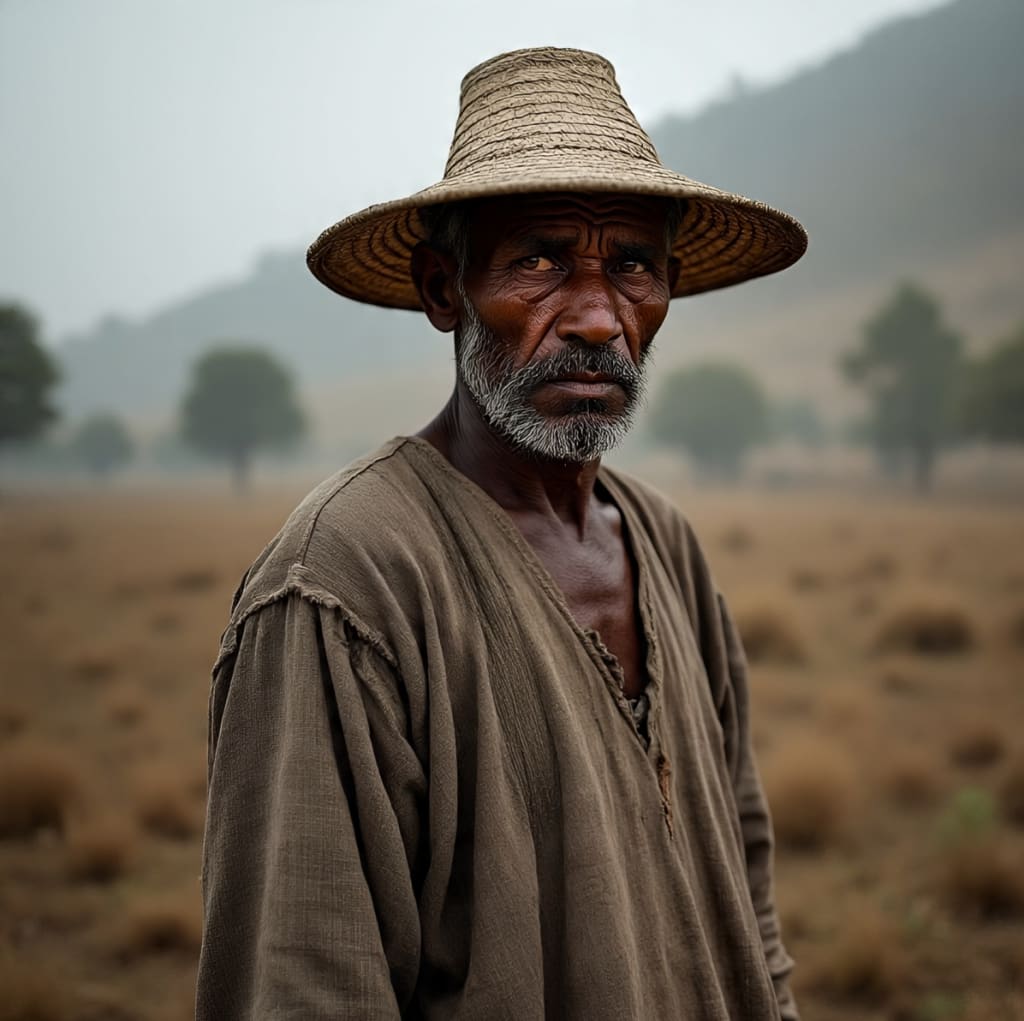
The Last Letter
In a quiet village tucked between fields of sunflowers and dusty roads, lived an old man named Raman. His house was small, with peeling paint and creaky doors, but his garden bloomed like a secret the world had forgotten. Everyone in the village knew him—the kind man with sad eyes who always sat on his porch at sunset, holding a faded envelope in his hand.
No one knew what was in the envelope. But he held it like it was the most precious thing in the world.
Years ago, Raman had been different. Young, strong, and full of dreams, he was a carpenter who built houses with his bare hands. He had laughter in his voice and mischief in his smile. And beside him was Meera—his wife, his childhood friend, his everything.
Meera had hair like the night sky and a laugh that could stop storms. They married under a banyan tree, with nothing but garlands of jasmine and hearts full of hope. Life was simple—two plates on a wooden table, morning tea in clay cups, and stories shared under moonlight.
But life, as it does, changed.
One winter, Meera fell sick. At first, it was just a cough. Then fever. Then weakness that wouldn't go away. The village doctor came and went, offering medicines that didn’t help. Raman stopped working. He sat beside her day and night, feeding her with trembling hands, whispering prayers he hadn’t said in years.
She held on for weeks. And then, one morning, just as the sun rose over the wheat fields, she let go.
Raman didn’t cry. Not that day. Not the next. Not even at her funeral. But something inside him shattered—a silence that spoke louder than tears.
Days turned into months. People came and went. But Raman stayed still.
Until one day, a letter arrived.
It had Meera’s handwriting on it. The postman, confused, gave it to Raman without a word.
It read:
My dearest Raman,
If you’re reading this, it means I’ve gone before you. I didn’t want to leave, but I knew I might. So I wrote this letter while I still had the strength.
You always said I was stronger, but I disagree. You have the strength of the earth—you carry things silently, without breaking. But don’t carry my absence like a burden. Live. Smile. Eat your favorite sweets again. Fix the old swing in the garden. Talk to the neighbors. Tell your stories.
And when you miss me—which you will—come sit in our garden. I promise, I’ll be there with the breeze, with the sunlight, with every jasmine bloom.
Love always,
Meera
Raman read that letter a hundred times. Maybe more. Each time, something inside him softened.
He planted more flowers. He opened his door to village children who wanted to learn carpentry. He began telling stories—of how Meera once danced in the rain, how she burned the rice the first week of marriage, how she laughed at her own jokes.
But every evening, as the sun dipped behind the hills, he sat on his porch, holding that same letter.
He never remarried. He didn’t want to.
One night, a young boy from the village, curious and bold, asked him, “Uncle, do you still miss her?”
Raman smiled, a smile that carried both sorrow and sweetness.
“Every day,” he said. “But I don’t miss her with pain anymore. I miss her like a favorite song. You know it by heart. It’s not playing, but it’s always with you.”
The boy didn’t quite understand, but he nodded anyway.
Years passed.
One morning, the neighbors noticed Raman hadn’t come out for his tea.
They found him on his porch, eyes closed, the letter resting gently in his lap, jasmine flowers scattered around his feet by the wind.
Author’s Note:
Love doesn’t always need monuments or grand gestures. Sometimes, it lives quietly—in a garden, in a letter, in an old man’s porch.
About the Creator
Keep reading
More stories from zafar abbas and writers in Fiction and other communities.
A Glass of Milk
Once, there was a poor boy who made a living by selling various objects from door to door. This was the way he earned money to pay for his school. One day, as he was walking from house to house as usual, he felt very hungry and weak. He felt that he couldn't walk even a few steps. He decided to ask for food at a house. He knocked on the door and was stunned to see a beautiful young girl open the door. With much hesitation, he asked the girl for a glass of water. The young girl understood his condition and offered him a huge glass of milk.
By zafar abbas6 months ago in Fiction
Rage
Content Warning: Domestic Violence, Assault Rage D. A. Ratliff “Who did this?” My voice echoed through the house. All I wanted was a cup of tea, but one of the twins, running through the house like maniacs, knocked it over. My nerves tingled, and every muscle in my body felt coiled like a spring. Survival seemed out of reach.
By D. A. Ratliff6 days ago in Fiction
Jameela The Camel
Part-1 There once used to live a man whose name was soemthing. He used to go to his office by walking 8 kilometres every day. One day, before sleeping a thought struck in his mind. He thought why not buy a camel as it will make his travelling easy. He didnot thought about a car, a cycle but a Camel. He also had 1 week of holidays, so he woke up the next morning, ate his breakfast and walked to the camel shop which was 10 kilometres away. After 4 hours, he finally reached the camel shop. He found a camel and brought it for 30000 money and kept its name "Jameela The Camel". He tried to drift on it, but he failed and fall down.
By Abdullah Shahzad7 days ago in Fiction




Comments
There are no comments for this story
Be the first to respond and start the conversation.