
The Last Letter
A soldier’s promise, delivered eight decades late

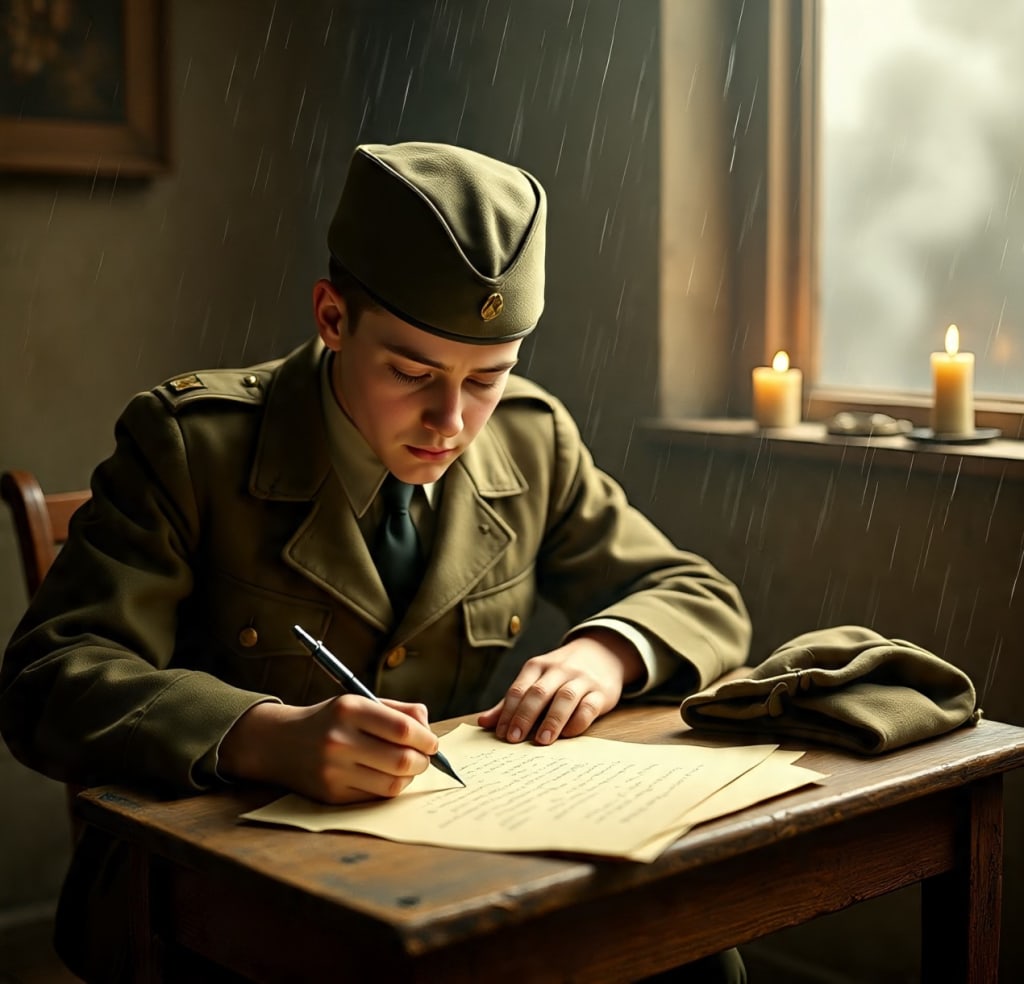
London’s libraries have always been places of quiet discovery, but Emma never expected that one ordinary afternoon would lead her to uncover a love story buried for more than eighty years.
Emma had worked in the city’s oldest public library for three years. She enjoyed the silence, the smell of aged paper, and the comfort of order. One rainy evening, while cataloging a collection of donated books, she pulled a dusty volume of poetry from the bottom of the box. As she flipped through the brittle pages, something unusual slipped out—a sealed envelope, yellowed with age and marked with the year 1941.
Her curiosity overcame her hesitation. The envelope was addressed simply to “Margaret,” with no last name, no street, only the words: For you, my dearest, when the world is quiet again. Emma’s heart raced as she carefully opened the fragile seal.
The letter inside was written by hand in neat cursive.
It began:
“My dearest Margaret,
If you are reading this, then perhaps I was braver with my words than I could ever be in person. The world is at war, and though the noise surrounds me, it is thoughts of you that keep me alive. Every dawn I imagine the life we promised each other—a small house, laughter by the fire, children running across the garden. I do not know if I will return, but know this: my love for you is stronger than any battle, any fear, any distance. Yours always, William.”
Emma read the letter twice, her eyes stinging. This was not just ink on paper; it was a soul reaching out through time. But one thought would not leave her: Why had Margaret never received it?
Over the following week, Emma began to investigate. She asked her colleagues, searched local archives, and traced records of soldiers named William stationed in France during World War II. It was painstaking work, but finally, one name appeared: William Hartley, a young soldier from East London who had gone missing in 1942.
Through further searching, Emma discovered an address linked to William’s fiancée—Margaret Collins. Emma’s heart leapt when she found a recent record of Margaret’s daughter, Eleanor, who still lived in London.
Nervous but determined, Emma reached out. Eleanor, now in her seventies, invited Emma to visit. When Emma arrived at the modest home, she felt the weight of history pressing against her.
Eleanor welcomed her kindly, though puzzled about the visit. Emma explained that she worked in the library and had found something she believed belonged to Eleanor’s family. With trembling hands, she produced the letter.
For a long moment, Eleanor simply stared at it. Then she unfolded the paper, her eyes scanning the familiar, looping handwriting. Tears spilled silently down her cheeks.
“My mother used to speak of him,” Eleanor whispered. “William. She said he was the great love of her life. He went missing in France, and she never heard from him again. She waited for years, but… no letter ever came.”
Emma sat quietly, her own chest heavy with emotion. Eleanor held the letter as though it were the most precious treasure in the world.
“She loved my father too,” Eleanor continued, “but I always knew a part of her heart belonged to someone else. To William. She told me once that love doesn’t vanish just because time moves on—it stays, like a shadow, always with you.”
Eleanor placed the letter gently on the table, beside a small box of keepsakes she retrieved from a drawer. Inside were photographs of a young woman with dark hair and bright eyes, smiling at a tall soldier in uniform. Margaret and William, side by side, captured in happier days.
The letter slipped neatly into the box, finally where it belonged.
For Emma, the experience was profound. She realized that the past never truly disappears. It lingers in forgotten drawers, hidden in books, waiting for someone to notice. And when it is rediscovered, it has the power to heal, to connect, and to remind us that love is the most enduring story of all.
As Emma left Eleanor’s home, the evening light was fading, and the city hummed with its usual noise. Yet she felt a quiet peace. She had carried a soldier’s voice across eight decades, delivering it to the woman who needed to hear it most.
William’s promise, though delayed by history, had finally arrived.
And in that moment, Emma understood: some letters are never truly lost. They are only waiting for the right hands, the right time, and the right heart to read them
About the Creator
Keep reading
More stories from arsalan ahmad and writers in Fiction and other communities.
The Forgotten Diary at Grand Central
Grand Central Station was alive with its usual symphony of footsteps, rolling suitcases, and the echo of train announcements. People rushed in every direction, their faces buried in phones or hidden beneath the collars of winter coats. Among the crowd walked Daniel, a college student with his backpack slung lazily over one shoulder. He wasn’t in a hurry; his train wouldn’t leave for another hour.
By arsalan ahmad7 months ago in Fiction
Pandora’s Burden
“My brother warned me to not accept gifts from the one who commissioned you,” said Epimetheus to the woman clad in silvery raiments standing at the entrance to the temple. Her silver tiara and the silver rings on her fingers and toes glinted in the firelight cast by torches set on either side of the doorway. Lingering in the shadows, beyond the reach of the flames as she was, he could not tell what she held in her hands. At first what appeared to be a box was perhaps a funerary urn, or maybe merely an apple.
By J. Otis Haasabout 13 hours ago in Fiction
The Edge of Something
She kissed me. She kissed me, and I just stood there. I didn't understand what was happening until it was already over. Did I lean in? I don't know. She did — I know that much — because I would never have been the one to close the distance. I had only been thinking that I was having a nice time with a girl I met in class. A nice time. That's all.
By Eddamar González3 days ago in Fiction


Comments
There are no comments for this story
Be the first to respond and start the conversation.