
The Last Lantern
When the night grew darkest, she learned what it meant to carry her own light.

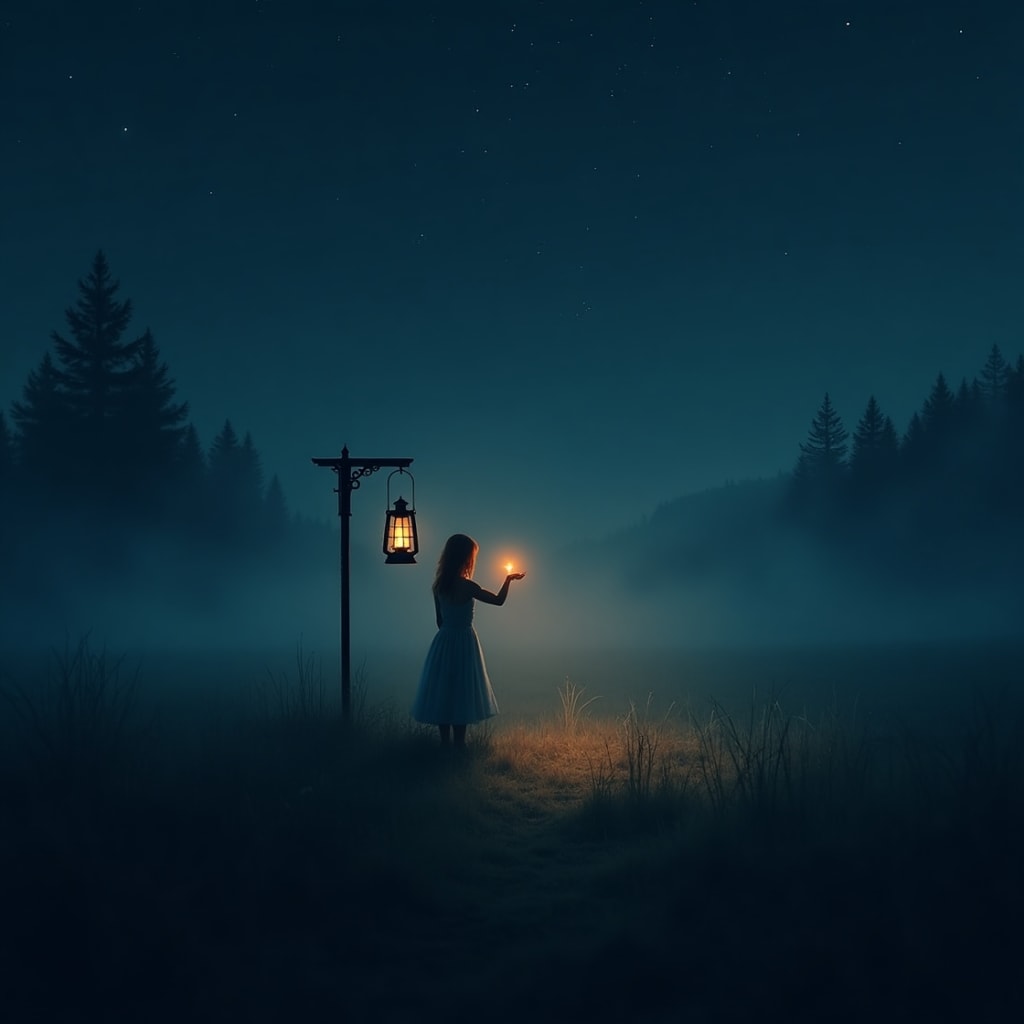
The first time Lydia saw the lantern, she almost mistook it for the moon.
It hung on the far edge of the meadow, beyond the worn wooden fence, glowing faintly against the dark. The strange thing was, it never flickered — not when the wind rose, not when the fog crept in, not when the stars themselves blinked out in the heavy clouds. It was steady. Patient. Waiting.
She was seventeen then, too proud to admit to anyone how lonely the world felt after her mother passed. Her father had buried himself in work, the house growing quieter by the day. Friends came around at first, then stopped calling. And Lydia began taking long walks at dusk, past the edges of town, toward the places where streetlights ended and silence began.
That’s where she first noticed it — the lantern, the glow.
At first, she thought it must be someone’s campfire. But when she drew closer, she saw it hung high on a black iron pole, swaying just slightly as if it breathed. She stared at it a long time before turning back.
But the next night it was there again. And the night after.
By the fourth evening, Lydia couldn’t stand her own curiosity anymore.
She crossed the meadow, climbing over the splintered fence. The grass was slick with dew and tugged at her shoes. When she finally reached the pole, she could see the lantern clearly.
It was beautiful — not like anything she’d seen before. The glass was etched with patterns of stars and vines. The light inside pulsed softly, golden and warm, though she saw no flame.
A tiny plaque was bolted to the pole. The words were worn but legible.
"For the weary ones who dare to keep walking."
Lydia swallowed hard, reaching out to touch the lantern’s handle. It was warm to the touch, almost alive.
And then she heard the voice.
“Why have you come?”
It wasn’t loud — more like a whisper inside her head. She jerked back, looking around, but there was no one.
“I—” she stammered, “I… wanted to know what this was.”
The lantern’s glow brightened a little.
“You have walked far,” the voice said, “through silence and sorrow. You may carry me now, if you choose.”
Lydia blinked at it. “Carry you? Why?”
“Because,” the voice replied gently, “there are places only you can light. Roads only you can walk.”
Her hands shook as she reached for the handle. It lifted easily, lighter than it looked, the warmth seeping into her fingers, into her chest.
When she turned back toward town, she found the path behind her glowing faintly with each step she took, like the earth itself remembered her passing.
The days that followed were strange, but in a quiet, wondrous way.
Lydia began walking every night, lantern in hand, venturing farther and farther. Sometimes she’d find others — other wanderers who had lost their way. They would see her light from afar and wait. She’d pass them, pausing just long enough to nod, and the light would seem to grow a little stronger as they found their own steps again.
She discovered old trails she never knew existed. Forests where even the stars hid, but her lantern never dimmed. She walked through ruins of forgotten houses, across frozen streams, through fog so thick she couldn’t see her own feet — yet she always kept going.
Every now and then, the voice in the lantern would speak again.
“You’re doing well,” it would say. Or sometimes: “Don’t be afraid of the dark. It’s only waiting for your light.”
Years passed. The town grew smaller in her memory. She kept walking, always toward the next place where the dark pressed in hardest.
One winter, she came to a village where no one dared leave their homes after sunset. Shadows curled through the streets like smoke, and every door was barred, every window shuttered.
When Lydia arrived at the edge of town, carrying her lantern, a child peeked through a cracked door and whispered, “Who are you?”
She knelt down and smiled.
“Just someone who keeps walking,” she said, holding the light a little higher.
And the child’s face softened, just slightly, at the sight of it.
That night, she walked the entire length of the village. When the sun rose, the streets looked brighter than they had in years.
Lydia grew older, but the lantern never did.
When her hands grew tired, she sometimes wondered who would carry it next. But the voice only said, “When it’s time, you’ll know.”
And one spring evening, as she rested by the same meadow where it all began, she saw someone coming toward her — a young woman, shoulders slumped, eyes tired, looking as though she’d been walking alone for a long time.
Lydia rose to her feet, holding out the lantern.
“It’s your turn,” she said simply.
The girl stared at it, then slowly took the handle.
The glow flared warmly between them.
And then Lydia smiled, stepping back into the dark, finally unafraid.
About the Creator
Kamran khan
Kamran Khan: Storyteller and published author.
Writer | Dreamer | Published Author: Kamran Khan.
Kamran Khan: Crafting stories and sharing them with the world.
Keep reading
More stories from Kamran khan and writers in Fiction and other communities.
Flower Bloom 369
FLOWER Bloom 2/25/26 Wednesday By Mariann Carroll Karen had been with Tony for 7 years. Tony started acting strangely after her surgery. He would mow the lawn in the rain and be on his cellphone. He started pushing Karen away. Tony came clean about seeing someone. Karen moved out two months later. Karen moved in with a friend. She felt betrayed.
By Mariann Carroll5 days ago in Fiction


Comments (1)
Beautiful story 🩵