


The Last Human Translator
When machines could speak every language, one man discovered why words still needed a human voice.
By the year 2149, humanity no longer struggled with language barriers. Every word, every gesture, every dialect was instantly converted by artificial intelligence into flawless translation. People believed they had finally achieved universal understanding.
But perfection came at a cost. Some languages didn’t fit inside the neat boxes of algorithms. They carried hidden rhythms, emotions, and memories that machines couldn’t decode. And for those rare tongues, the world still needed one manElias Marrow, the last human translator.

A Forgotten Profession
Elias wasn’t famous. He didn’t sit in government councils or high-tech towers. Instead, he spent his days in dusty archives, surrounded by old manuscripts that no machine could quite make sense of. His specialty was the Tongue of Keshari, a dead language that had baffled AI for decades.
The reason was simple: Keshari wasn’t just words on a page. It was breath, pause, tone. A phrase could mean love in one voice, grief in another. Machines could map the structure, but they couldn’t hear the heartbeat. Elias could.
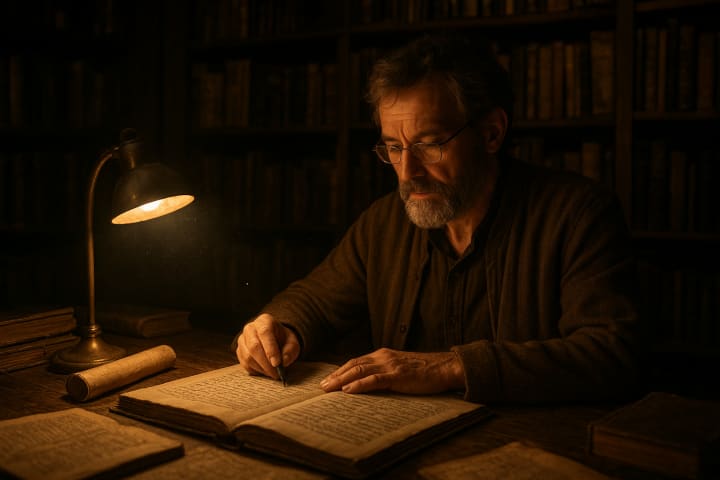
The Message
One evening, a message arrived from the Global Archive Authority
Urgent. Keshari manuscript discovered. Machines unable to process. Immediate translation required.
Attached was an image that made Elias pause. It wasn’t paper. The text was etched into black stone, glowing faintly, as though carved with fire.
This wasn’t just history. It was alive.

What the Words Revealed
When Elias began to translate, the words unsettled him. The text spoke not of myths or legends, but of warnings.
It told of the silence of stars, of voices swallowed by steel minds, and of a world forgetting its own name.
The manuscript wasn’t ancient prophecy—it was about the present. The flawless machine-driven society humanity had built was slowly erasing identity itself. If people lost their languages, they would lose their roots, their culture, and their sense of self.

An Impossible Choice
Elias knew what would happen if he handed the translation over. The authorities would bury it. Lock it away. Pretend it never existed.
But if he released it? The truth could shake the foundations of a world built on AI control.
He wasn’t a leader or a rebel. He was just a man who loved words. Yet maybe that was enough.

The Translation That Changed Everything
Weeks later, a mysterious file appeared online: The Last Human Translation. No one knew its source, but inside were fragments of the Keshari text and Elias’s careful interpretation.
Some dismissed it as nonsense. Others whispered that it was a warning. But many began to repeat the words, savoring the sounds, laughing at their strangeness. Children scribbled the symbols in chalk on walls. Artists painted them in bright colors across city streets.
For the first time in decades, people weren’t just speaking through machines. They were reclaiming their voices.

The Legacy of Language
Elias never admitted the translation was his. He didn’t need to. He only needed to walk through the city and hear pieces of Keshari drifting in the air—words spoken, sung, or whispered, words that belonged to no machine.
And he would smile. Because as long as people still carried their own voices, humanity would never be silent.

About the Creator
James William
I’m here to spark curiosity, inspire action and share ideas that make a difference. From practical tips to thought provoking stories my goal is to bring you content that’s as enjoyable as it is valuable.
Keep reading
More stories from James William and writers in Fiction and other communities.
Borrowed Time: Living on the Days of Others
Borrowed Time: Living on the Days of Others Time is the one thing we all have, yet never have enough of. We spend it, waste it, and sometimes forget how valuable it really is until we start running out of it. *Borrowed Time* is a story built around one haunting idea: **what if you could borrow years from someone else?**
By James William7 months ago in Fiction
Flower Bloom 369
FLOWER Bloom 2/25/26 Wednesday By Mariann Carroll Karen had been with Tony for 7 years. Tony started acting strangely after her surgery. He would mow the lawn in the rain and be on his cellphone. He started pushing Karen away. Tony came clean about seeing someone. Karen moved out two months later. Karen moved in with a friend. She felt betrayed.
By Mariann Carroll6 days ago in Fiction
⚖️ Judge the Case: I Stole Him, Married Him, Destroyed Him But Was I the Villain?
As they say, all is fair in love and war. I said all was well in love and survival? Perhaps you may judge my callousness or my desire to choose myself. Perhaps I was hasty or harsh, but here is the story of my life. So judge ye, whoever hasn't sinned before should cast the first stone.
By Esther Fashola6 days ago in Fiction




Comments
There are no comments for this story
Be the first to respond and start the conversation.