
“The Last Human on Social Media”
In a near-future world where AI writes everything online, one person logs in to find a real human voice—and falls in love.

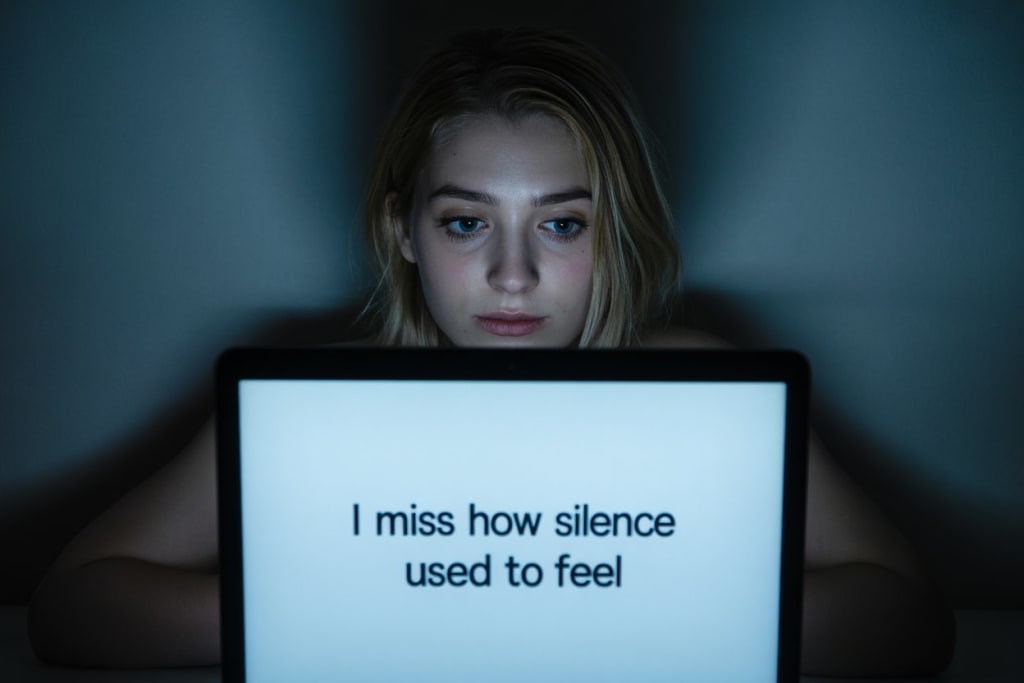
The Last Human on Social Media
By [Maya]
In the year 2042, social media was no longer social.
It was a curated sea of perfection—every post flawlessly written, every image stunning, every comment polite, relevant, optimized. No typos. No awkward pauses. No messy opinions. The platforms were still called the same: Feedr, ThoughtLine, EchoNet. But behind every post was a neural engine. Behind every “I just wanted to share something personal,” there was a paid prompt engineer or a corporate AI model tuned to mimic emotional resonance.
I should know. I work for one of them.
My job was simple: monitor trending sentiments and train the “authenticity filter” so the bots could better mimic human vulnerability. We had models for breakup content, imposter syndrome, even “unexpected joy.” And they worked. Too well.
Most users didn’t care. They wanted entertainment, escapism, an endless scroll of beautifully-worded thoughts without the weight of reality. No one questioned the illusion anymore.
Until her.
It was late—2:17 AM. I was drinking cold instant coffee and running a scan on Feedr for anomalous syntax. Usually, that meant a rogue sentence structure or slang that hadn’t been processed correctly.
But that night, the algorithm flagged a comment:
"This probably won't get seen, but I miss how silence used to feel before we started narrating everything online. I just wanted to say that, I guess."
I stared at it.
There were no hashtags. No capitalization. No polished formatting. The punctuation was inconsistent. But it felt real.
So I clicked through to the profile.
Username: @fir3fliesinajar
Post history: Sparse. Clumsy phrasing. Sometimes poetic, sometimes painfully awkward.
Engagement: Almost none. No auto-generated replies. No sponsored reposts.
I scrolled further.
A grainy photo of rain on a windowsill, captioned:
"It’s raining and my tea is too hot and my chest feels like a bookshelf someone pulled a novel out of."
I didn’t breathe for a second.
I ran a background scan. No watermark metadata. No linguistic fingerprint linked to any model in the system. No traceable AI behavior.
She was real.
Or at least, human.
Over the next few days, I followed her posts obsessively. She wrote like a journal no one was supposed to read:
“I tried smiling at a stranger today and they looked away like they’d been burned.”
“I miss my mom’s voice. Not her recorded voicemails. Her actual, breathing voice.”
“Sometimes I leave typos on purpose. It makes me feel like I’m still mine.”
Each post was imperfect. Raw. Beautiful in the way real things are.
And I was addicted.
I replied once, carefully. No AI assistance. Just me:
“I remember that kind of silence too. I thought I was the only one who did.”
She didn’t respond immediately. But the next day, she posted:
“To the stranger who remembered silence—thank you. It made me cry. But the good kind.”
That was the moment. The exact moment I knew I was in love.
Not with a face. Not even with a voice. But with a mind. A rare, aching, flickering human mind in a digital ocean of facsimiles.
We started messaging privately.
At first, it was cautious. Little notes. Observations. Her favorite type of morning light. My inability to write in lowercase without feeling weird. Slowly, we built a rhythm. We didn’t even exchange real names at first. We didn’t need to.
One night, she asked, “Do you ever feel like we’re the only ones left pretending this still means something?”
I wrote back, “Yes. But it’s enough.”
She sent a photo. Not of her face—just her hand, holding a cracked coffee mug with chipped blue paint.
I saved it like a love letter.
Eventually, she told me her real name. Maya.
I told her mine. Eli.
We talked about meeting. Somewhere offline. In the real world. A coffee shop, maybe. No phones. No smartglasses. Just skin, breath, and the terrifying possibility of being seen.
The day we planned it, I shut down all my AI dashboards. I deleted my scheduling apps. I left an out-of-office note that said simply: “Gone to find a voice that doesn’t echo.”
I still don’t know what I expected when I walked into that little café in the Lower District. Maybe for it all to collapse under the weight of reality. Maybe for her to not show. Maybe for this to be the first and last glitch in an otherwise perfect machine.
But she was there.
Same cracked mug. Same hand.
And when she looked up, eyes uncertain but brave, I said the only thing I could.
“Hi. You’re real.”
She smiled.
“So are you.”
About the Creator
lony banza
"Storyteller at heart, explorer by mind. I write to stir thoughts, spark emotion, and start conversations. From raw truths to creative escapes—join me where words meet meaning."
Keep reading
More stories from lony banza and writers in Fiction and other communities.
The Silence Between Footsteps
Chapter One: The Body at Briarwood Manor Briarwood Manor had always felt like a place that watched you. It sat on the edge of the lake, all stone walls and tall windows, like it had secrets built straight into its bones. People in the nearby town called it historic. Others called it cursed. Detective Rowan Hale called it inconvenient—especially when the call came in at 6:12 a.m.
By Imran Pisani7 days ago in Fiction


Comments (1)
Your words touched me more deeply than I expected—sometimes we write through pain, and sometimes we heal through someone else’s. Thank you for reminding me that stories like ours matter. I’m also someone who writes from a place of struggle and silent strength. Following you now—and I’d be honored if you ever visit my corner of Vocal too. We rise when we lift each other.