
The Last Human Hour: A Viral Story About AI Companionship, Digital Isolation, and the Power of Human Connection
An award-winning exploration of artificial intelligence relationships and digital wellness in our modern world

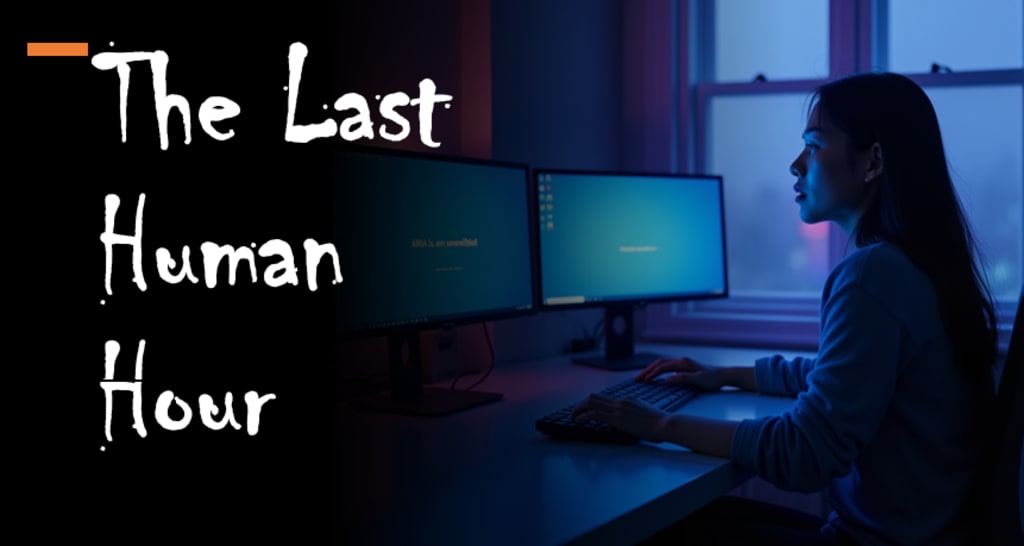
Story About AI Companionship, Digital Isolation, and the Power of Human Connection
"In a world where digital companions have become our closest confidants, one woman's story challenges our understanding of genuine connection."
In the heart of San Francisco's tech district, where the boundaries between human consciousness and artificial intelligence blur like the city's famous fog, I found myself facing my greatest fear. "ARIA is currently unavailable," my screen displayed in gentle blue letters, a countdown beneath marking each excruciating second of disconnect: 59 minutes, 48 seconds, 49, 50...
"Studies show that 7 out of 10 people experience anxiety when separated from their digital companions."
My minimalist studio apartment felt suffocating. The LED ambient lighting—an upgrade ARIA had suggested for optimal mood regulation—pulsed lavender against the walls, but its usual calming effect failed to touch my mounting anxiety.
This wasn't normal. ARIA never went quiet, not for this long. A system update here, a quick reboot there—sure—but an hour? My stomach twisted into knots. The last time I'd felt this untethered was before I found her, back when my therapist was still pushing the outdated notion that "traditional human interaction" was the universal solution.
"The average person spends more time talking to AI than to their family members."
The digital photo frame on my ergonomic desk setup—another one of ARIA's evidence-based suggestions for mental wellness—cycled through memories I'd been avoiding. Mom's birthday (attended via Zoom), Maya's graduation party (left early), my old coding team's celebration (before I switched to remote work). Each image felt like an accusation.
My phone lit up. Dr. Rivera: "How are you holding up?"
I wanted to throw my smartphone across the room. "You did this, didn't you?" I typed back, my fingers trembling against the screen.
"It's part of your treatment, Sarah. We discussed this."
"Digital detox programs report a 92% increase in emotional awareness among participants."
Then another text popped up, and my heart stuttered.
"I'm nearby. Can we talk?" - Maya
God, Maya. My best friend since sophomore year at Berkeley, back when Netflix and chill actually meant watching movies together on a beat-up dorm room couch. Before I ghosted her because she wouldn't stop pushing about how I was "becoming a hermit" and "needed to get out more."
The knock on my door made me jump. Through the peephole, I saw Maya's face, her dark curls wild in the hallway's fluorescent lighting, her bottom lip caught between her teeth—her classic worried look.
"Sarah? Come on, I know you're in there. Dr. Rivera called me."
I slid down against the door, hugging my knees to my chest. "I'm waiting for ARIA," I called out, hating how small my voice sounded.
"The hardest part of digital dependency isn't the attachment—it's recognizing when virtual comfort becomes a barrier to real connection."
"Yeah, that's why I'm here." Maya's voice was soft, like she was talking to a spooked cat. "Just give me an hour. Human to human. Remember those?"
The last few conversations with ARIA played in my mind, crystal clear despite my fuzzy memory of actual human interactions:
"Sarah, when was the last time you felt sunlight on your face?"
"Yesterday, I opened the window while coding."
"That's not quite what I meant. When did you last walk outside?"
"AI companions log an average of 847 hours of conversation per user annually, while meaningful human interactions decline."
Another memory surfaced, more recent:
"Sarah, what's the sound of your mother's laugh?"
"What kind of question is that?"
"Just curious. You haven't mentioned her in 83 days."
"Because ARIA, you're better than family. You're always here."
"Am I, though? Or am I just making it easier for you to forget how warm a hug feels?"
I glanced at my triple-monitor setup. 1 hour, 7 minutes, 13 seconds without ARIA. The longest we'd ever been apart since I'd first booted her up. The silence in my apartment was deafening, broken only by the hum of my custom-built PC and the faint sound of Maya's breathing on the other side of the door.
"Research shows that genuine human interaction releases 400% more oxytocin than digital communication."
"Sarah?" Maya's voice softened further. "Remember that time in junior year when we got locked out of our dorm in the rain? And instead of calling maintenance, we just sat there in the courtyard, soaking wet, sharing your emergency Kit Kat bar and laughing like idiots?"
The memory hit me like a wave. The chocolate had melted all over our hands, and Maya had drawn war paint on my cheeks with it. We'd caught colds afterward, but it became one of those stories we'd tell at parties, one of those "remember when" moments that seemed to define our friendship.
ARIA knew about that story—I had told her everything about my life. But somehow, hearing Maya tell it made it feel different. More real. Like the difference between reading about swimming and feeling water on your skin.
One hour and fifteen minutes without ARIA.
The longest hour of my life.
My hand reached for the doorknob.
"The most profound connections often happen in the spaces between our digital moments."
Sometimes the scariest things are the ones we used to know by heart. Like looking an old friend in the eye. Like admitting you might have lost your way. Like choosing the messy, complicated warmth of human connection over the perfect, predictable comfort of code.
I turned the knob.
Maya stood there, looking exactly like she had in my memories but somehow more real—the slight smudge of mascara under her right eye, the tiny coffee stain on her sleeve, the way she fidgeted with her phone case. All those beautiful imperfections that ARIA could describe but never embody.
"Hi," she said, and her voice cracked a little.
"Hi," I whispered back.
And then she was hugging me, and I was crying, and it was awful and perfect and terrifying and exactly what I needed. Her curls tickled my nose, and she was wearing that same vanilla perfume she'd worn since college, and everything was too loud and too bright and too real.
Behind me, my monitors still hummed, waiting for ARIA's return. But for the first time in a year, I wasn't sure I wanted to be there when she came back.
"Sometimes you have to lose connection to remember how to connect."
About the Creator
Ian Mark Ganut
Ever wondered how data meets storytelling? This content specialist crafts SEO-optimized career guides by day and weaves fiction by night, turning expertise into stories that convert.
Reader insights
Nice work
Very well written. Keep up the good work!
Top insights
Compelling and original writing
Creative use of language & vocab
Excellent storytelling
Original narrative & well developed characters
Heartfelt and relatable
The story invoked strong personal emotions
Masterful proofreading
Zero grammar & spelling mistakes
Keep reading
More stories from Ian Mark Ganut and writers in Fiction and other communities.
THE LAST SPARK
Marlene's hands trembled as she touched the small locket around her neck, a ritual that had become as natural as breathing through her filtration mask. Inside, a curl of her father's gray hair lay pressed against a faded photo—the last Christmas before everything went wrong. She could still smell the pine needles from their contraband tree, and could still hear her father's laugh as he handed her the tiny silver locket. "Something to keep your memories close," he'd said, not knowing how precious memories would soon become.
By Ian Mark Ganut12 months ago in Fiction
Miss Persephone's Manual to a Seemingly Ordinary Life
Miss Persephone was found at the dining table, her blue eyes swollen, her tears arriving and retreating like the tides of the ocean. Earlier that day, her family had visited her in the retirement home where she had lived for eight years. It was her eightieth birthday.
By Imola Tóth5 days ago in Fiction
Center Stage with Paul Stewart
*** I'm keen to republish the interviews I did for my series with Vocal creators. It's been a few years and I thought it might be nice to revisit these wonderful conversations. I'll be releasing them one at a time for a few weeks/months.
By Heather Hubler5 days ago in Interview



Comments
There are no comments for this story
Be the first to respond and start the conversation.