
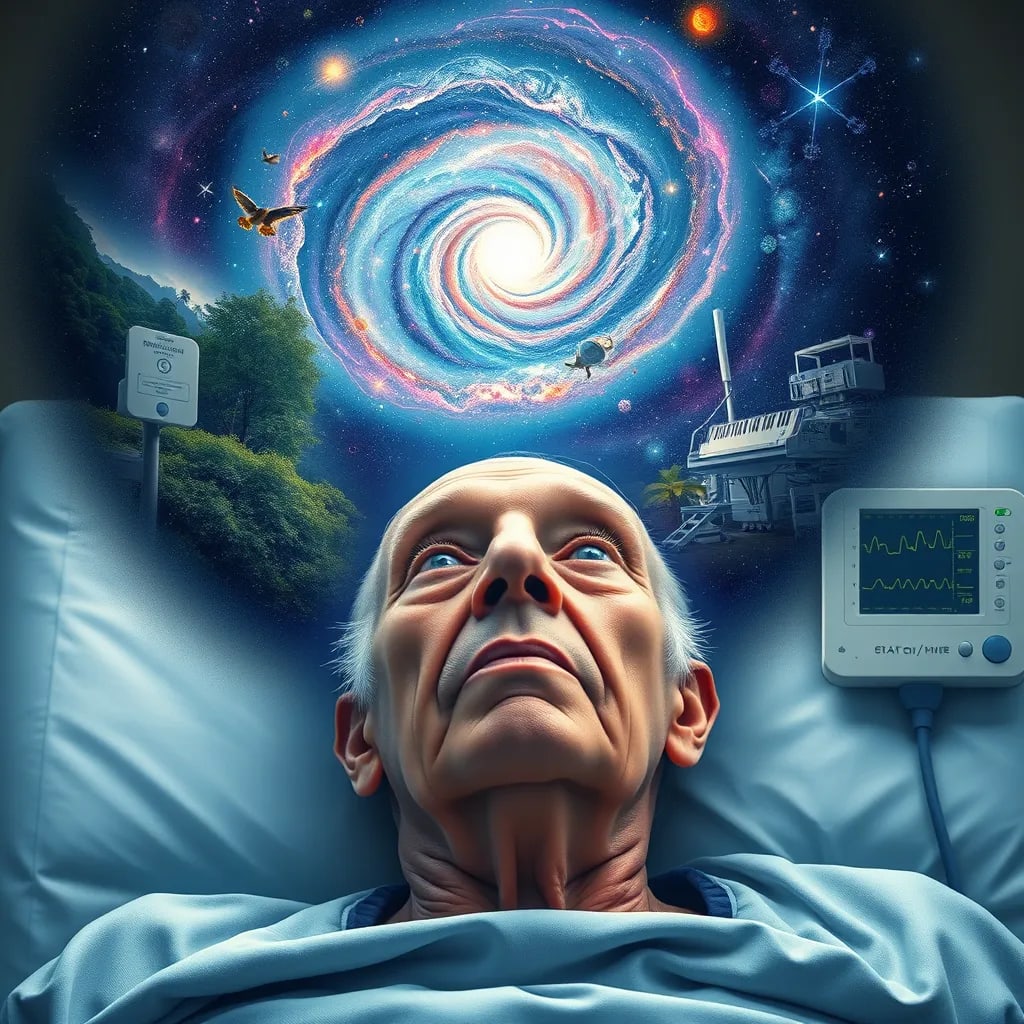
The heart monitor emitted a constant beep, a mechanical reminder that life still persisted in that time-worn body. A trembling hand, crisscrossed with prominent blue veins, rested on the white hospital sheets. The fingers twitched slightly, as if trying to grasp a fleeting memory.
Thomas opened his eyes for the first time on a sweltering August day in 1945. The world celebrated the end of a war, while he began his own battle with life. His mother used to say he was born with a smile on his lips and a spark of curiosity in his eyes.
By five, Thomas had already learned to play the piano by ear, surprising everyone in his small Ohio town. His tiny fingers danced across the keys, creating melodies that seemed to come from another world.
A nurse entered the hospital room, adjusting the IV drip. He looked compassionately at the old man lying motionless, connected to a tangle of tubes and wires. "How are we doing today?" he asked, knowing he wouldn't get a response.
At twelve, Thomas won his first science fair with a project on solar energy. "This boy will change the world," his teacher said. Little did he know those words would prove prophetic.
Adolescence arrived like a whirlwind. Thomas discovered his mind was like a kaleidoscope, full of brilliant ideas in constant motion. While his peers dreamed of prom nights, he dreamed of equations and distant galaxies.
A gray-haired doctor entered the room, reviewing the medical history. "He's had an incredible life," she murmured to herself, flipping through the pages. "Shame it all has to end like this."
At twenty, Thomas found himself in the middle of the Amazon rainforest, studying plants that could cure diseases yet unnamed. He fell in love there, not just with science, but with Maria, a local botanist with amber eyes and a laugh that echoed like music through the dense jungle.
He returned to the United States with a full heart and a notebook brimming with ideas. Universities fought over him, but Thomas chose a different path. He founded his own biotech company at twenty-five, with the promise of changing the world.
And he did.
At thirty, his company developed a method to purify contaminated water using nanoparticles. Millions of people in Africa and Asia suddenly had access to clean drinking water. The world started to take notice.
A young nurse entered the room, carrying a bouquet of fresh flowers. "They're from your granddaughter," she said softly, placing them by the window. "She says she's sorry she can't come today, but she'll be here tomorrow without fail."
At forty, Thomas became the face of global innovation. Debates on ethics in science, TED talks, magazine covers. His voice was heard in the corridors of power and in school classrooms alike. But at home, for Maria and their three children, he was still just Dad, the man who made the world's best pancakes on Sunday mornings.
Crisis hit at fifty. A failed experiment, accusations of negligence, the weight of fame becoming an unbearable burden. Thomas withdrew from public life, disappearing into a mountain cabin. The world speculated, headlines screamed, but he found peace in the silence.
It was there, in the midst of solitude, that he had his greatest epiphany.
The heart monitor emitted an irregular beep. The old man's eyes flew open, as if he'd been yanked from a deep dream. For a moment, it seemed he wanted to say something.
At sixty, Thomas returned to the world with a theory that unified quantum physics and relativity. Scientists called it "The Thomas Theory." He called it "The Last Blink." It spoke of how the universe, in its infinite complexity, could be a single expanded instant, a moment of consciousness stretched to infinity.
"Perhaps," he said in his Nobel acceptance speech, "our entire life is nothing more than the last blink before death. A cosmic flashback where we relive everything in an eternal instant."
The following years were a whirlwind of discoveries and accolades. Thomas traveled the world, gave lectures, inspired a new generation of dreamers and thinkers. But each night, as he closed his eyes, he wondered if it was all real or simply part of that last blink.
At seventy, he lost Maria. The world offered condolences, but nothing filled the void her departure left. Thomas immersed himself in his work with renewed fervor, as if wanting to challenge death itself with each new discovery.
Eighty years. A new global crisis. The world looked to Thomas for answers. And he had them, or at least he thought he did. A new method for generating clean energy, the promise of a sustainable future. But his body was beginning to betray him. His hands, once steady manipulating lab equipment, now trembled holding a cup of coffee.
The heart monitor emitted a series of erratic beeps. Nurses rushed into the room. "He's having another episode," one of them shouted.
Thomas, at ninety, lay in the hospital bed. His mind, still brilliant, was trapped in a body that refused to cooperate. Visitors came and went. Some cried, others recounted anecdotes from his glory days. He listened, or at least seemed to, with a faint smile on his lips.
In his lucid moments, Thomas reflected on his "last blink" theory. What if all this, his entire life, was nothing more than that expanded moment? What if he was actually dying somewhere else, at some other time, and everything he had lived was just a fleeting memory before the end?
The monitor emitted a long, continuous beep. Thomas's eyes opened wide, bright and clear as they hadn't been in years. For a moment, it seemed he saw something beyond the hospital room, beyond this world.
And then, in an instant that seemed eternal, Thomas saw his entire life flash before his eyes. Every moment, every achievement, every failure. The first kiss with Maria, the birth of his children, the taste of victory and the bitter aftertaste of defeat. All condensed into a single instant of crystal-clear clarity.
As the last breath left his lips, Thomas wasn't sure if he was ending a life or beginning another. Was this the end of the flashback or the start of a new one? Was he dying or waking up?
Somewhere, sometime, a child opened his eyes for the first time on a sweltering August day. The world celebrated the end of a war, while he began his own battle with life. His mother would later say he was born with a smile on his lips and a spark of curiosity in his eyes.
And so, the cycle began anew. Or perhaps, it had never ended.
For in the end, what is life but a blink in the eternity of the universe? An expanded instant, a relived memory, a story told over and over in the vast silence of the cosmos.
And in that blink, in that eternal instant, we live, love, dream, and wonder: Is this real? Or is it just the echo of a memory in the last gasp of a dying star?
The answer, like life itself, remains eternally elusive, inviting us to keep searching, to keep asking, to keep living each moment as if it were the last and the first, all at the same time.
About the Creator
Keep reading
More stories from Ulter Damin and writers in Fiction and other communities.
"The Choice"
Manuel Vega had always been a man plagued by suspicion. From childhood, the world seemed to him a labyrinth of deception and betrayal. He saw conspiracies lurking behind his parents' smiles, lies masked by his siblings' embraces, and falsehoods woven through politicians' promises. But nothing could have prepared him for the suspicion that now gnawed at his mind like a relentless parasite: his wife, Laura, was having an affair with his best friend, Javier.
By Ulter Daminabout a year ago in Fiction
Becca
"Everything is so... flat." Denille said stupidly as she looked around her new neighborhood. She looked around at the muted desert where even the smallest sign of life seemed to have given up. The plant life was shrubs that were half cooked by the heat and where there should have been a lawn, a mess of white rocks laid glistening in the sun. Even the sky looked stretched thin, like the sun had ironed it smooth. She’d moved from Riverside, where at least there were hills, but here in Barstow, everything felt baked and brittle.
By Sara Wilson2 days ago in Fiction
The Synaptic Scalpel
Metal moaned and splintered. The impact came without warning. The car slammed against the guardrail, then twisted, crumpled, and rolled. Tires screamed. Glass exploded like miniature stars. The final blow was internal—bone crushed, ribs punctured lungs, and a jagged fragment tore through his skull. Pain surged and vanished as consciousness faltered, leaving a hollow, fading awareness.
By Mark Stigers 2 days ago in Fiction
The Politics of Playing Dress-Up
Well, to start off I'd like to say a happy world book day to all who celebrate. I know I haven't really posted anything on my socials about it but I'm not a jubilant kind of person. I lay low most of the time. Let's start off with a popular anecdote from the vaults...
By Annie Kapur3 days ago in Geeks


Comments
There are no comments for this story
Be the first to respond and start the conversation.