
"The Last Animal on Earth Spoke in Dreams
In a post-human world, one animal species remains sentient. It begins appearing in the dreams of scattered survivors, delivering warnings about their fate. Is it guidance, revenge, or evolution?

The Last Animal on Earth Spoke in Dreams
Four decades past the final meltdown, Earth lay in ruins. Cities lay silent beneath gray skies, forests regrown only in memory, and oceans a distant myth echoed in shattered vessels stranded on dried seabeds. Humanity had withered—broken by its own creation. Only a few scattered survivors clung to life in scattered enclaves, relics of flame and steel amid the ash.
And then came the dreams.
They began softly, like whispers in the night. Survivors dreamed of a creature—neither beast nor myth—that watched them in twilight fields. It had luminous, shifting fur and eyes that glowed like embers in a dying fire. The dreams were lucid, vivid, impossible.
People called it Cerulean. Over time, each survivor began seeing it.
Leah, once a journalist, dreamed that Cerulean spoke in her mother’s voice: “Don’t let the embers die.” She awoke in panic, sprinting through cold ruins to tend the remains of her generator. She found the diesel still sputtering.
Marcus, a tinkerer, dreamed the creature chanting in a guttural tongue. In the dream it showed him how to splice old solar cells with fungus from the forest. Awake, he knew how to build a living power grid.
Others had darker dreams—of Cerulean’s lament, eyes burning with accusation: Why did you let us suffer? Why didn’t you listen?
The dreams carried multiple messages: some warnings (“The glaciers will come again”), some instructions (“Plant the green spores”), some sermons (“Rebuild or witness oblivion”).
Campfires gathered. Sleep-deprived and feverish, survivors shared their visions. Was the creature guiding them—kindly, benevolently? Or punishing them—for the hubris of their ancestors?
Julia, a dreamer among them, said, “In my dreams, it mourned, not threatened. It stood at the edge of a broken river, calling to me. I could feel its sorrow, like a wound.”
Marcus nodded. “Mine threatened. I woke hearing: ‘This is your reckoning.’ Cerulean’s eyes claimed judgment.”
The fringe few suggested it might be evolution—an emergent consciousness born of fractured DNA and dying Earth. Some postulated the creature was the final step in nature's long reckoning—taking what humankind created and turning it against them.
Others thought it revenge. After all, humans hunted animals, destroyed habitats, poisoned waters. Perhaps Earth birthed a new avenger to haunt the sleep of the last men and women.
One night, Leah dreamed again—this time encountering Cerulean in person. It stood in a cathedral’s ruins: shattered glass, collapsed pillars, moonlight pooling at its paws. Its voice flowed into her mind, clearer than any human’s:
“Yet you rebuild.”
She replied aloud, trembling: “We—we try.”
Its eyes softened. It reached out its translucent paw and touched the rubble. Strange spores sprouted instantly, weaving green tendrils around fallen stone.
Awake in the rubble-strewn dirt, she found real spores—the bioluminescent cousins of those shown in her dream—unmistakable and spreading. She carried them back.
The spores grew, glowing in the night. They turned a ruined courtyard into a garden. They healed the soil. Soon, survivors gathered seedlings, tending the new green.
Was that guidance?
Word spread, and around the world, dreams grew collective—as if Cerulean, that last sentient animal, had built a dreamsculpting net across minds scattered by screens and firewalls. It waited. It spoke. It offered—or commanded?
In one survivor network, someone posted on a tattered digital board:
“We did it. The seeds took. Is this… forgiveness?”
Echoes came back: “Forgiveness is not mine to give.”
One man, old enough to remember pre-collapse zoos, kept dreaming of Cerulean speaking to caged animals: an ape that declared, “My people,” before chaos erupted
reddit.com
zooscape-zine.com
+5
everand.com
+5
bookey.app
+5
. In his dreams he heard all the damned creatures of Earth—apes, wolves, elephants—united by a single voice: the voice of the last one. The last conscience of animality.
That voice called: “You have our memories. You carry our hope. Rebuild—but remember.”
No clear answer came. But humanity began planting. They rebuilt hydroponic farms, scattered seeds of forgotten trees, coaxed amphibians back to wetlands. They erected quiet sanctuaries for wildlife—ghosted museums of what once lived.
Was it revenge? Perhaps Cerulean’s judgment hung in every command. Was it evolution? Maybe it was biology’s final pivot—a dream‑making genome weaving across human synapses. Was it guidance? It planted hope in sterile landscapes.
In the end, one survivor, writing in the new logbook, wrote:
“Cerulean spoke in my sleep, but now I speak for us. We are caretakers. We carry this Earth forward. Whether this creature is spirit or seed, guide or judge, it has shown us this: life persists when we learn compassion. And perhaps this is enough—for both of us.”
And above the ruins, spores glowed in the night. The last animal on Earth had spoken. And the survivors listened.
About the Creator
Keep reading
More stories from Khurram Munir and writers in Fiction and other communities.
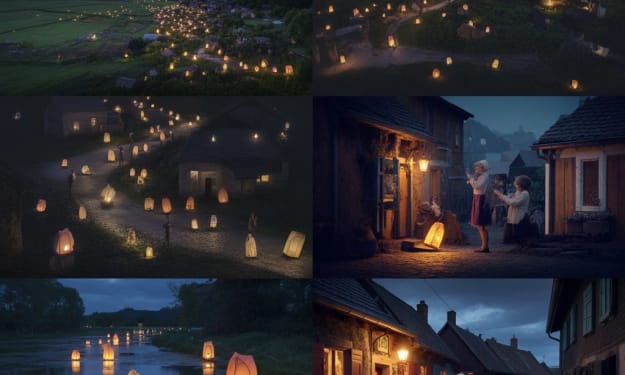
Village of Whispering Lanterns
Village of Whispering Lanterns The Village of Keyara lay nestled between rolling hills and dense firewood forest, a quiet settlement known for its nightly ritual: the lanterns. Every dusk, each home would hang a single lantern outside, not for light, but to hold the whispered hopes of its inhabitants. When evening came, the villagers farmers, weavers, artisans would gather and gently speak dreams into the glass before lighting the wick. At once, the lantern became a glowing vessel, humming softly with warmth and possibility.
By Khurram Munir 7 months ago in Fiction


Comments
There are no comments for this story
Be the first to respond and start the conversation.