
The Hundred-Year Awakening: A Monologue from an Old Umbrella
When the objects we use for a century grow a soul, what do they whisper in the quiet of the night? A tale of Tsukumogami.

Esteemed Reader,
Have you ever looked at an old, forgotten object in your home—perhaps a chipped teacup, a faded kimono, or a dusty old fan—and wondered about its story? In Japan, we have a belief that after a hundred years of loyal service, an inanimate object can gain a soul, transforming into a Tsukumogami (付喪神). They aren't malicious spirits, but rather gentle, often melancholic entities, imbued with the memories and experiences of their owners.
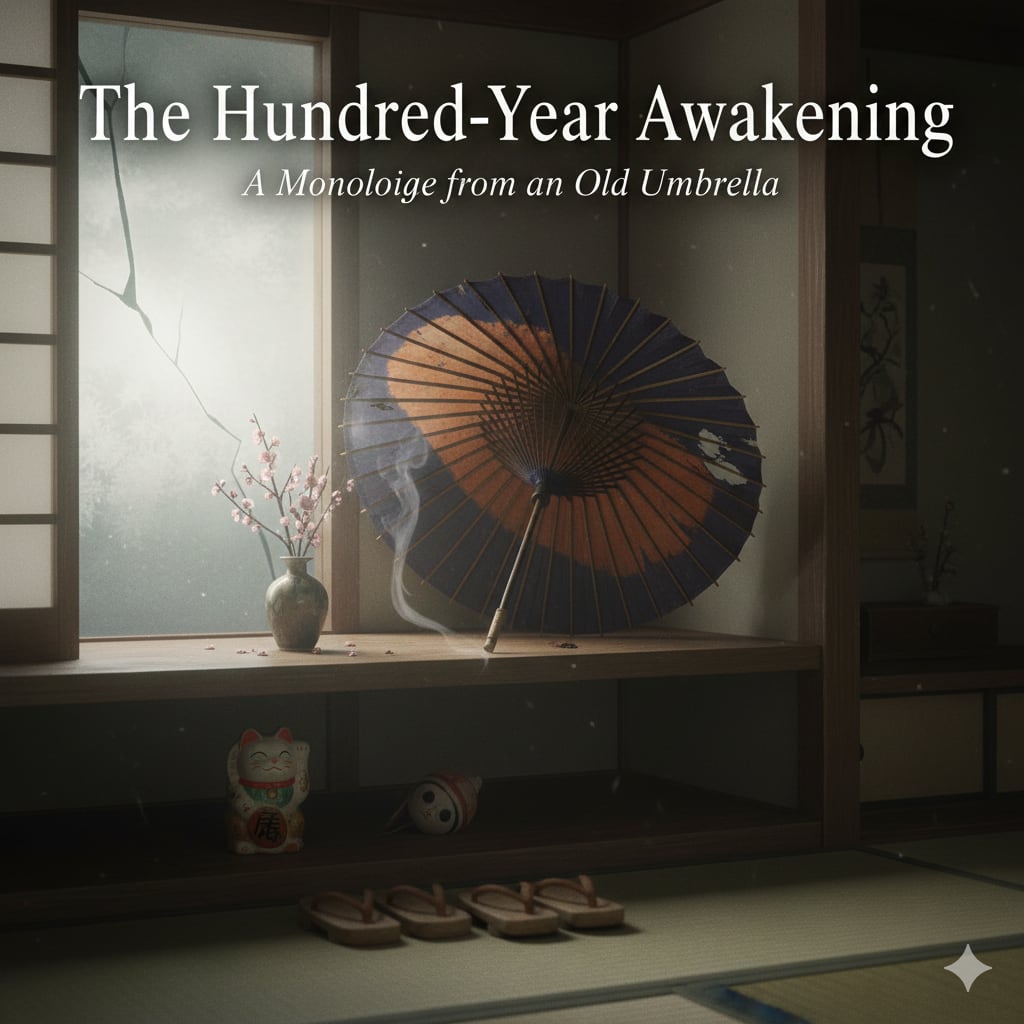
Today, let us lend an ear to one such ancient soul: an old bangasa (traditional Japanese oil-paper umbrella), who has served a single family through a century of rain and sun, laughter and tears. As the family prepares for a grand decluttering, the old umbrella finds himself facing an uncertain future. What thoughts stir within his weathered bamboo frame?
Chapter 1: The Weight of a Hundred Rains
It has been exactly one hundred and three years, three months, and seventeen days since my bamboo ribs were first stretched, and my oiled paper skin unfurled beneath the eager gaze of Master Hiroshi. A hundred years. Enough time, they say, for a soul to seep into the very fibers of one's being.
I remember my first rain. A gentle spring drizzle that shimmered like tiny jewels on my surface, protecting Hiroshi as he walked to his first day of school. I carried his hopes, his fears, and the scent of plum blossoms he tucked into my handle. And I have carried them all since.
Through seasons, through generations. Hiroshi grew old, and his daughter, Haru, inherited me. Then Haru's son, Kenji. Each new hand that gripped my polished wooden handle left a faint, almost invisible imprint, a warmth that settled deep within my core. I've shielded tears from falling onto wedding kimonos and stood guard over solemn faces at funerals. I've witnessed whispered secrets beneath the cherry trees and heard the boisterous laughter of children splashing through puddles.
My paper skin is faded now, patched in places where time and elements have taken their toll. My bamboo ribs creak a little more with each opening. I am a map of their lives, each stain a memory, each tear a story.
Chapter 2: The Whispers of "Decluttering"
Tonight, the air in the entryway feels different. Not the crisp coolness of approaching autumn, but a strange, unsettling draft. I heard the family speaking earlier, their voices hushed, their words heavy. "Decluttering," young Sakura had said. "We must make space for the new."
"Space for the new," she repeated, her voice bright and modern. I watched her through a crack in the shoji screen, her fingers tapping at a glowing rectangular device. Her world moves so fast. My world, the one I know, is slow and deliberate, measured by the cycle of seasons and the rhythm of footsteps.
Suddenly, a small, ceramic daruma doll, who usually sits silently on the top shelf, rolled precariously close to the edge. "Did you hear that, Old Umbrella?" the daruma whispered, its single painted eye wide with alarm. "They're talking about 'discarding'!"
The ancient wooden geta (clogs) by the door, who always seem to carry a perpetually grumpy expression, merely grumbled. "It's the way of things. New things come, old things go. We serve our purpose."
But what is my purpose, if not to serve? To protect from the rain, yes. But also to bear witness. To remember.
Chapter 3: A Parliament of Forgotten Things
As midnight deepened, the old house began to creak, not just from the wind, but from the restless stirring of its forgotten inhabitants. The daruma doll, now having successfully rolled to the floor, beckoned me closer. "We must discuss our fates! The human 'decluttering' ritual is a dangerous one!"
From a dusty corner, an old, chipped maneki-neko (beckoning cat figurine) slowly raised its paw. Its gold paint had long since faded. "Fear not, little daruma. I have seen many a 'decluttering.' Some of us go, some of us stay. It depends on our utility... or our sentimental value."
"Utility?" I creaked, my voice a rustle of old paper. "My utility is diminished. My paper skin can no longer withstand the heaviest downpour without tearing."
"But your sentimental value!" chirped a tiny, lacquered comb, barely visible on a forgotten chest of drawers. "Haru-san cherished you! You were always by the door for her!"
"Cherished," the geta snorted. "They cherish the idea of us, until something brighter, newer, comes along."
We were a parliament of forgotten things, a chorus of old souls facing an uncertain dawn. Each of us carried a century of memories, bound to this family, to this house. We had seen its joys, its sorrows, its secrets. And now, our very existence was in question.
Chapter 4: The Decision of the Tenth Dawn
Days turned into a week. The sorting began. Items were moved, boxes filled. My heart, a hollow space of bamboo and paper, felt heavy. I saw Master Hiroshi's old calligraphy brushes, dried and stiff, placed gently into a box marked "Sentimental." A glimmer of hope.
Then, Sakura approached. Her hand reached for me. My ribs stiffened, bracing for the inevitable. She lifted me, feeling my weight, tracing the faint patterns on my faded paper. I heard her sigh.
"This old thing," she murmured. "It's so beautiful, but so fragile. It can't really be used anymore, can it?"
My heart sank. The geta had been right. My utility was gone.
But then, a different voice. Haru-san, now an elder, entered the entryway. "Ah, the old umbrella," she said softly, her eyes distant with memory. "Your grandfather carried that to his first day of school. It protected me from so many storms. And Kenji used to play with it indoors when he was small."
Sakura looked at her grandmother, then back at me. A different kind of light dawned in her eyes. Not the bright, dismissive light of "new," but the soft glow of "remembered."
"Maybe," Sakura said, her voice gentler, "it doesn't need to protect from rain anymore. Maybe... it just needs to protect our memories."
And with that, she didn't place me in the "discard" pile. She placed me gently on a high shelf in the guest room, beside a small, dried bouquet of plum blossoms. A place of honor. A place of quiet contemplation. My new purpose.
Conclusion: The Quiet Hum of Continued Service
The "decluttering" ended. Some of our fellow Tsukumogami did indeed depart, carried away in bags to new, unknown fates. But many of us remained, now with a renewed sense of purpose. The daruma doll, still slightly lopsided, sat proudly on the mantelpiece, having been deemed "lucky." The maneki-neko continued its eternal beckoning from the window sill.
And I, the old bangasa, now rest in my quiet corner. I no longer feel the bite of the wind or the sting of the rain. Instead, I feel the gentle hum of continued service. My purpose has evolved. I am no longer just an umbrella; I am a guardian of stories, a vessel of time. And in the quiet of the night, when the family sleeps, I sometimes unfurl my weathered skin, not to catch the rain, but to unfurl the memories, one slow, loving drop at a time. My hundred-year awakening was not just about gaining a soul, but about understanding that true purpose, like true love, is never truly lost; it merely transforms.
About the Creator
Takashi Nagaya
I want everyone to know about Japanese culture, history, food, anime, manga, etc.
Keep reading
More stories from Takashi Nagaya and writers in Fiction and other communities.
The Night Weeping Inn: A Guest Protocol for Your Serene Stay
Esteemed Guest, Welcome to the Yonaki-kan (Night Weeping Inn), a sanctuary nestled deep within the forgotten valleys of Ishikawa Prefecture. For generations, our inn has offered weary travelers a timeless respite, a glimpse into an older Japan where nature and spirit intertwine. To ensure your stay is as tranquil and undisturbed as possible, we kindly ask you to observe the following traditional protocols. These guidelines are not mere suggestions; they are the bedrock of harmony between our cherished guests and the ancient spirits of this land. Your cooperation ensures not just your comfort, but your safety.
By Takashi Nagaya2 months ago in Fiction
The First Rainbow Baby
Pitter-patter, pitter-patter. The rain fell in rhythmic splatters, slowly slowing, but still constant. Mira rolled onto her side pulling the blanket tight against her ears, but still she could hear chitter-chatter and scurrying feet of the creatures that refused to sleep in the lower decks.
By A. J. Schoenfelda day ago in Fiction
Beginner's Luck: Liminal 4
Fluke's eyes widened at the new stat: Resonance: 1.9 He had no idea what it could mean but he felt excited to try it out. Sitting up on the bed, he began to try and focus his energy like he had done in his dreams. Letting out a long slow breath, he focused on the sensation in his right index finger. His mind instantly began to feel the slight buzzing energy that was normal for any part of his body. Slowly, he felt that energetic buzz building up and concentrate down in the pad of his finger. The energy began to go beyond just a vibration, now turning to heat, which made Fluke almost panic. Concentrating again, he began to spread his focus to the rest of his hand, the heat now expanding with the electrical energy. Letting the energy swirl in the palm of his hand, Fluke opened his eyes to see if he could visualize what was happening. But sadly, there was nothing to visualize at first. An icon appeared in his masks vision; it was just a simple eyeball symbol. Trying not to break his concentration, he focused for a moment on the symbol and suddenly it was as if he could see so much more of the world.
By Everett Scaifeabout 4 hours ago in Fiction


Comments
There are no comments for this story
Be the first to respond and start the conversation.