
The House That Waited
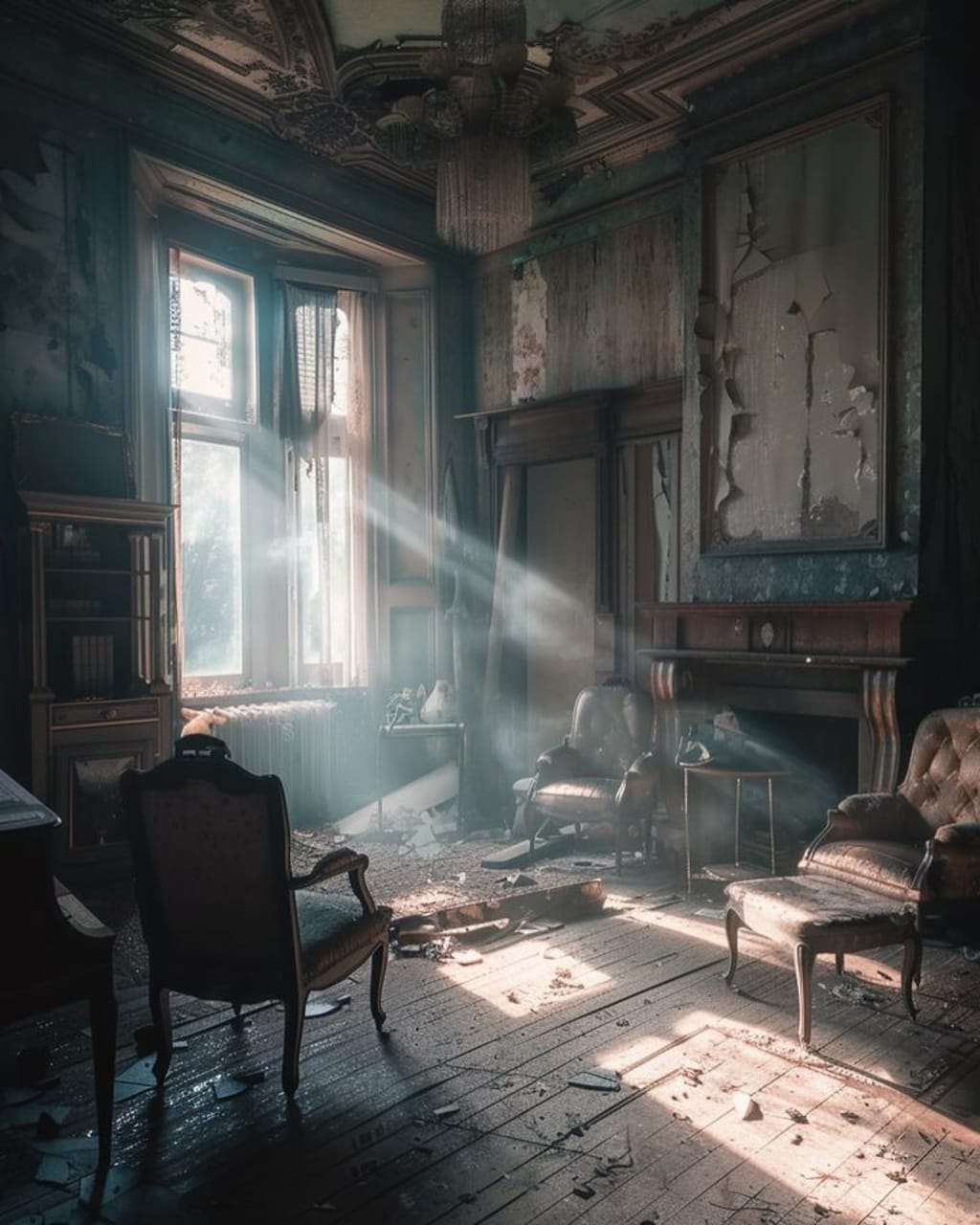
On the outskirts of town, beyond the crooked oak trees and the overgrown path, stood a house no one claimed
M Mehran
On the outskirts of town, beyond the crooked oak trees and the overgrown path, stood a house no one claimed. Its paint peeled, windows sagged, and yet every night, one upstairs light glowed as though someone were still waiting inside.
Children dared each other to approach it, whispering about ghosts and lost lovers, but few ever got closer than the rusted gate.
Clara, however, had never been afraid of the house. At twenty-seven, she returned to her hometown with a suitcase of failures—her business had collapsed, her relationship had ended, and the city that once promised so much now felt like a cruel trick.
On her first night back, she walked until the familiar silhouette rose in the moonlight. The house looked just as it had when she was a girl, when she’d sketch it in the margins of her notebooks, convinced it had secrets worth knowing.
The gate creaked open easily. No lock. No chain. As if the house had always been waiting for her.
Inside, dust blanketed the floor, but the air felt strangely warm. The wallpaper peeled in strips, revealing faded patterns of roses. A staircase curved upward, and at its top, yes—light spilled faintly from a room.
Clara should have turned back. Instead, she climbed, each step groaning under her weight. At the landing, she hesitated, then pushed open the glowing door.
The room was a library. Hundreds of books lined the walls, their spines gleaming though no hand had touched them in decades. A single lamp on a desk flickered gently.
And on that desk sat a book with her name embossed in gold.
Clara froze. Her throat went dry.
She opened it. The first page read:
The Story of Clara Whitmore
Below, in delicate handwriting, was the story of her childhood—the afternoons at the creek, the loneliness after her mother’s death, the way she always sat at the back of class, sketching that strange house.
The pages turned themselves, as though impatient. They showed her teenage years, her secret dreams of becoming an artist, her decision to chase practicality instead. Every choice, every misstep, every heartbreak.
And then, halfway through the book, the pages were blank.
The lamp flickered once, twice, and the silence thickened.
Clara touched the paper. “What is this?” she whispered.
A voice drifted from the shelves—soft, old, but clear.
“It is your unfinished story.”
She spun, but no one was there.
“Who’s speaking?”
The voice chuckled, though not unkindly. “The house. I keep the stories of those who wander too far from themselves. Yours has been waiting.”
Clara’s hands trembled on the desk. “So… what do I do?”
“Write,” the house said simply. “Fill the pages with what comes next. Not what you think you should do. Not what others told you to do. What you want.”
Her chest ached. “But I don’t know anymore.”
“Then start small. One choice. One word. A blank page is not a curse, Clara. It is an invitation.”
Her eyes blurred with tears. She sat, picked up the pen lying beside the book, and hesitated. The nib hovered over the page, her hand shaking.
Then she wrote:
Tomorrow, Clara paints again.
The lamp glowed brighter. Somewhere deep in the walls, gears clicked like locks being undone.
---
The next morning, Clara woke in her childhood bedroom, unsure if the house had been dream or memory. But the scent of ink clung to her fingertips, and on her desk sat a canvas she hadn’t touched in years.
She began to paint. Hesitant strokes at first, then bolder, until color spilled across the canvas. She painted the oak trees, the crooked path, the waiting house.
Day after day, she returned to the library, each time finding the book open to the next blank page. Whatever she wrote there seemed to shape her waking life. She painted, she applied for exhibitions, she reconnected with friends she’d long avoided.
But with each written word, the house grew quieter. The wallpaper faded further, the shelves thinned. The voice, when it spoke, sounded weaker.
On her final visit, the library was nearly bare. Only her book remained. Its last blank page trembled as though in a breeze.
The house’s voice whispered, faint as a sigh: “You have no need of me now. Your story is yours to carry.”
Clara placed her hand on the final page and wrote:
Clara chooses to keep writing, no matter how uncertain.
The lamp flickered once—and went dark.
---
Years later, Clara’s paintings hung in galleries across the country. Critics praised the haunting imagery, the way her canvases captured both loss and possibility. She never told them the truth: that each painting began in a library that no longer existed.
Sometimes, when she walked past the edge of town, she looked for the house. But the path had grown over, and no silhouette rose in the distance.
And yet, on nights when doubt clawed at her, Clara would hear it faintly in her dreams—the creak of a gate, the whisper of pages turning, and the soft voice reminding her:
“A blank page is not a curse. It is an invitation.”
About the Creator
Keep reading
More stories from Muhammad Mehran and writers in Fiction and other communities.
The Library of Forgotten Names
M Mehran It wasn’t on any map, nor marked by any sign. But if you ever lost something precious—so precious that the ache of it followed you like a shadow—you might find yourself wandering a narrow street one evening and stopping before a tall, ivy-covered building you had never noticed before.
By Muhammad Mehran6 months ago in Fiction
Silken Chains
Silhouettes of the female form were given flesh and bone. Silken skin glistened under the spotlight. Dry ice rose around our Icons as they danced atop their podiums in the Square. Heralded for their beauty, their movements were slight, powerful, and sensual.
By Paul Stewart5 days ago in Fiction
Top tipple tricks
Been thinking a lot about drinking, lately. Not least because of a recent episode of over-indulgence and the inevitable after effects. Some readers may recall the earlier articles I wrote about beating the booze. Here I set out an experiment in techniques for cutting down on my alcohol intake. The experiment was successful, the techniques worked, and I have armed myself with an arsenal of weapons in the war against the demon drink. I have yet to fire the first round however. It's all a question of timing (perhaps procrastination).
By Raymond G. Taylor2 days ago in Psyche



Comments
There are no comments for this story
Be the first to respond and start the conversation.