
The House That Waited
Some places never forget you. Even when you try to forget them.


For fifteen years, the house sat untouched, locked behind rusting gates and unspoken stories.
Everyone said it should’ve collapsed by now. But it didn’t.
The paint still peeled in the same places. The porch sagged like an old sigh. And yet… the windows remained whole. The roof still held. And the door never stopped creaking open, as if it were still waiting for someone.
As if it were waiting for her.
Lena didn’t mean to come back.
She was just driving. Past the town she swore she’d never see again. Past the turnoff with the old wooden sign, barely legible under ivy and dirt. But her hands turned the wheel before her mind could argue.
She told herself she only wanted to see it.
But some places pull harder than reason.
The driveway was cracked and uneven, wild with weeds. As she stepped out of the car, her breath caught.
It looked exactly the same.
The same as the day they found her mother’s note on the kitchen table.
The same day, Lena and her brother were sent to two different foster homes.
The same as the day everything good collapsed into silence.
She approached the front steps slowly. They creaked like they recognized her weight.
Her hand hesitated over the doorknob.
It turned without resistance.
The door opened.
And the house exhaled.
It smelled of old wood, dust, and faint lavender. The wallpaper was faded but intact. The floorboards, worn smooth from years of footsteps, felt familiar beneath her boots.
Everything was still there—the rocking chair by the fireplace, the cracked family portrait, the small dent in the hallway where she and Jacob used to race with their toy cars.
Time hadn’t touched this place.
Only memory had.
She wandered room to room, like walking through an old dream. Every wall whispered something.
In the kitchen, she saw her mother’s back as she hummed by the stove.
In the living room, Jacob’s laughter echoed—distant, but real enough to make her pause.
In the upstairs hallway, she saw a shadow move ahead of her.
She followed it.
The door to her childhood room was ajar.
Inside: her bed, still made. The blue curtains she once begged for. Her bookshelf — dusty, but intact.
On her desk sat a folded paper crane.
She hadn’t made that.
“Jacob?” She whispered before she could stop herself.
Silence.
But then, from behind her, a voice soft and small:
“I knew you’d come back.”
She turned fast—heart racing.
No one was there.
Just the quiet hum of the house, alive in a way she couldn’t explain.
She picked up the paper crane and found, written on its wing in Jacob’s handwriting:
“This place is waiting for you, too.”
Tears stung her eyes. She hadn't seen Jacob in over a decade. The system scattered them like leaves. No calls. No reunions. No answers.
She didn’t know if he was alive.
But she knew he had been here.
Maybe recently.
Maybe just long enough to remember.
The house didn’t ask her to stay.
But it didn’t ask her to leave either.
That night, she built a fire in the hearth. Ate canned soup she found in the cupboard. Slept in her old bed beneath moth-bitten sheets. And for the first time in years, her dreams were full of warmth.
She dreamt of Jacob.
Of laughter.
Of her mother humming at the window.
In the morning, she stood at the front door with her bag over her shoulder.
The house was quiet again. Still.
But not empty.
She turned back once more and whispered,
“Thank you.”
And the wind through the trees whispered back:
“Come home again when you’re ready.”
Because some houses don’t forget.
Some houses remember what the people inside them try to bury.
And some houses…
Wait.
About the Creator
Keep reading
More stories from Javid khan and writers in Fiction and other communities.
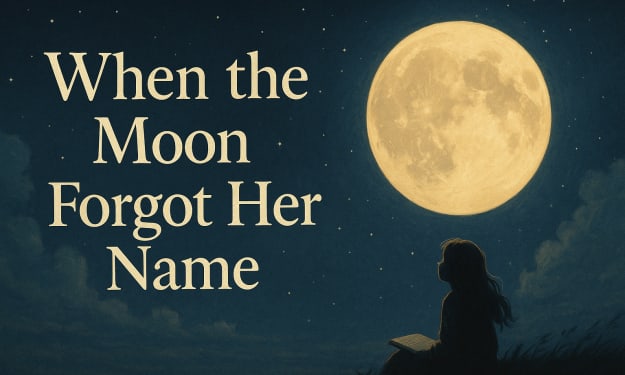
When the Moon Forgot Her Name
They say the Moon forgot her name the night the sky broke open. It was quiet—as all important things are. No thunder. No fire. Just a soft stillness that fell across the universe like sleep. The stars blinked slower. The planets held their breath. And the moon… the moon simply paused.
By Javid khan8 months ago in Fiction
Becca
"Everything is so... flat." Denille said stupidly as she looked around her new neighborhood. She looked around at the muted desert where even the smallest sign of life seemed to have given up. The plant life was shrubs that were half cooked by the heat and where there should have been a lawn, a mess of white rocks laid glistening in the sun. Even the sky looked stretched thin, like the sun had ironed it smooth. She’d moved from Riverside, where at least there were hills, but here in Barstow, everything felt baked and brittle.
By Sara Wilson4 days ago in Fiction
Man Buys a $20 Couch at a Thrift Store — Then Finds $100,000 Hidden Inside
Sometimes life-changing moments arrive when we least expect them. A simple decision, a random purchase, or an ordinary day can suddenly turn into a story that feels almost unbelievable. For one man, what started as a routine trip to a thrift store became a moment he would remember for the rest of his life. It all began with a couch that cost just twenty dollars. A Simple Purchase Jason Miller was a 28-year-old delivery driver who had recently moved into a small apartment in a quiet neighborhood. Like many young people starting out on their own, he was trying to save as much money as possible. His apartment was mostly empty except for a small table and a bed. One weekend, he decided it was finally time to buy a couch. But buying new furniture was expensive, and Jason didn’t have much to spare after paying rent and bills. So he did what many people do when money is tight—he visited a local thrift store. The store was filled with old furniture, secondhand decorations, and shelves of forgotten items waiting for someone to give them a new home. Jason slowly walked through the aisles, checking price tags and imagining what might fit in his apartment. Then he noticed it. In the corner of the store sat an old beige couch. It wasn’t perfect. The fabric looked slightly worn, and the cushions were a little soft. But the price tag caught his attention immediately. $20. Jason couldn’t believe it. For that price, it felt like a great deal. After thinking about it for a few minutes, he paid for the couch and arranged to bring it home that afternoon. At the time, he thought he had simply found a cheap piece of furniture. He had no idea the couch was hiding a secret.
By Shoaib Afridia day ago in Fiction


Comments
There are no comments for this story
Be the first to respond and start the conversation.