
The House That Remembers Me
Some homes shelter. Others haunt. This one does both

The house had been empty for six years.
Not vacant—empty.
There’s a difference.
Vacant is neutral. Empty carries weight.
I returned on a Thursday, suitcase in hand, bones already tired from the drive. My grandmother had died two weeks earlier, leaving behind a house full of dust and secrets, and a will that simply read: “Give it back to her. She’ll know what that means.”
I didn’t.
The front door creaked open before I touched it. I stepped inside, and the scent hit me—lemons, mothballs, and something less nameable. Time, maybe. Or memory.
Everything was exactly as I remembered, but not quite right. The yellow floral wallpaper was now the color of butter left out too long. The dining table stood as if expecting guests, though none had crossed this threshold since the funeral.
And the silence… it wasn’t passive. It was listening.
I slept that first night in the old guest room, the one with peeling lavender paint and a ceiling fan that trembled with every spin. Around 3 a.m., I woke to the sound of soft humming.
It was coming from the vents. The melody—familiar. I followed it barefoot down the stairs, the song growing clearer with each step. My grandmother’s lullaby. The one she used to sing when I cried after my mother left.
But it wasn’t a recording.
It was her voice.
I found the source in the living room vent. As I leaned closer, the voice cut out, replaced by a child's whisper: “Don’t leave me in the closet again.”
I didn’t sleep after that.
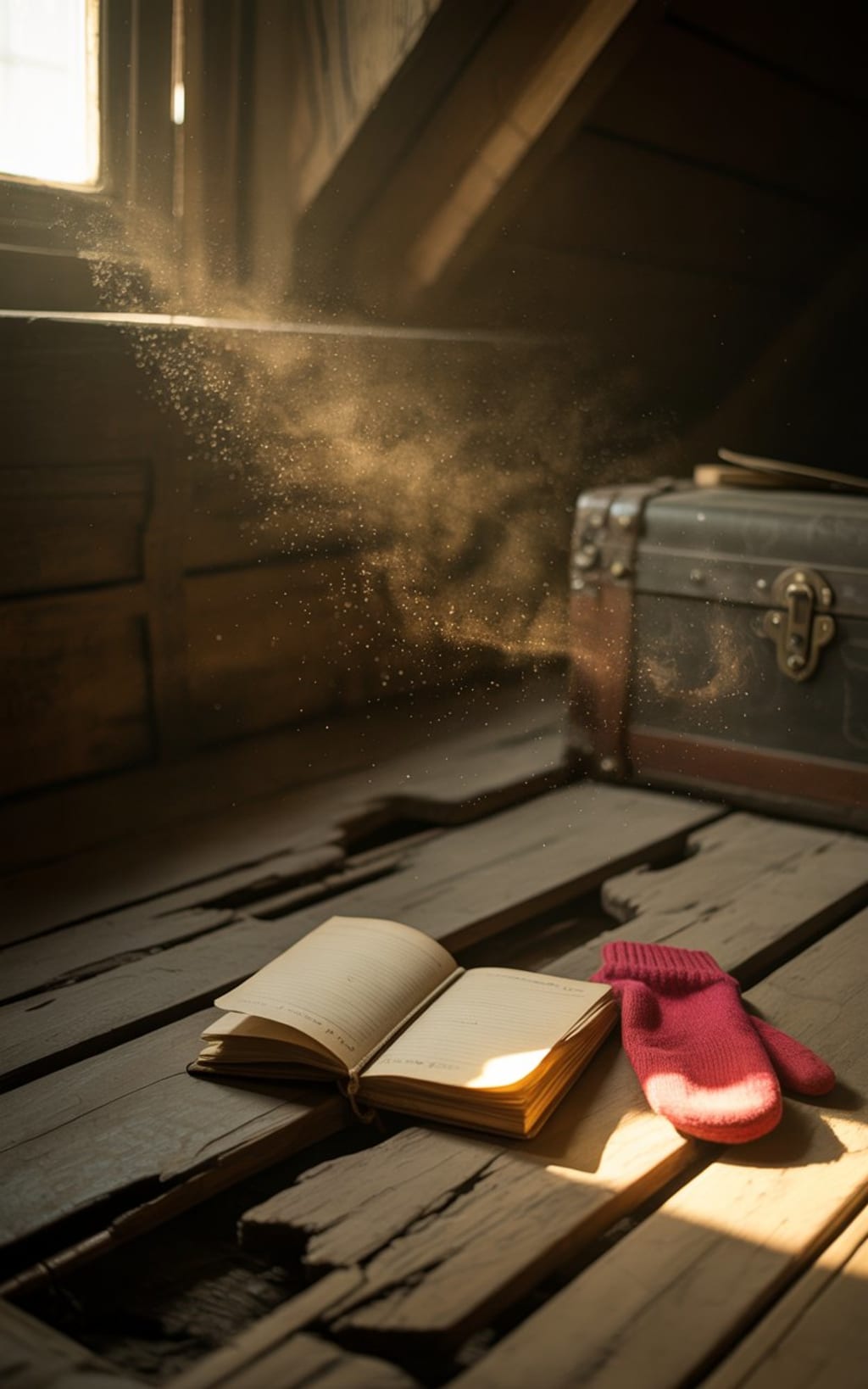
The next morning, I opened the kitchen pantry to find a single red mitten hanging from a nail inside. I hadn’t seen that mitten since I was seven. I had lost it in the woods behind the house—and cried for hours. My mother had slapped me for making a scene. My grandmother said nothing. Later, she made me hot cocoa and tucked me in with a story about wolves who wore mittens to hide their claws.
I stared at the mitten. It stared back.
Over the next week, the house grew bolder.
The hallway lights flickered in Morse code. A book fell off the shelf, open to a passage about inherited trauma. I walked past the bathroom mirror and saw, for a moment, my mother’s eyes instead of my own. I began talking aloud, just to hear something other than the house.
“Why now?” I asked the walls.
“Why me?”
The house responded by unlocking the attic.
It had been sealed shut since I was a teenager—after the night I found my mother sitting up there, cross-legged on the floor, humming to the dark. She didn’t look at me, just whispered, “You don’t want to remember. Not yet.”
She left the next morning.
Inside the attic, the air was thick with heat and old pain. Dust floated like ghosts in the sunlight. In the far corner sat a trunk I’d never seen before. I opened it slowly.
Inside:
A photograph of my mother as a child, bruises peeking out from her turtleneck.
A bundle of letters addressed to no one. They were all written by my grandmother. Some angry. Some tender. All unsigned.
And a cassette tape labeled “For Her.”
I brought it down to the living room and found an old tape deck. The static gave way to my grandmother’s voice.
“If you’re hearing this, then the house has decided it’s time. I’ve been keeping it all in—trying to protect you. But you deserve the truth. The house remembers what I tried to forget.”
She went on to tell stories I had only sensed, never known. About my mother’s abuse. About her own guilt. About how the house began “recording” long before I was born—imprinting memories, storing echoes. A living archive of everything we wouldn’t say.
“I don’t know if the house is cursed or kind,” she said. “Maybe both. Maybe that’s what love is when it’s broken. You’ll feel it. You’ll hear it. But don’t run. Make peace with what lingers.”
That night, I didn’t fight the house. I let it show me.
In the hallway, I watched a flickering vision of my mother as a girl, crying into a stuffed rabbit. In the kitchen, I heard laughter—the kind that hurt more than it healed. Upstairs, my own childhood sobs looped through the vents like a forgotten hymn.
And in my bedroom, I found something I hadn’t known I needed: a journal. My mother’s.
One entry read:
“I left because I was afraid I’d become like her. I stayed away because I was afraid I already had.”
Another:
“If she ever comes back, tell her I did love her. I just didn’t know how to stay.”
I’m still in the house.
It breathes a little easier now.
The lights don’t flicker as often, and the air smells more like lavender than lemons.
I talk to the walls every morning.
Sometimes, they talk back.
Not with words—but warmth.
Like the house is learning to remember differently.
So am I.
About the Creator
yasir zeb
best stories and best life


Comments
There are no comments for this story
Be the first to respond and start the conversation.