
The House That Only Appeared When I Was Sad
A magical realism + emotional horror concept

The House That Only Appeared When I Was Sad
By Hasnain Shah
The first time I saw the house, I thought I had simply taken the wrong path home.
I was twelve, soaked from the rain, and furious after a fight with my mother. I ran out of the house that evening swearing I’d never return, even though I had nowhere else to go. I wandered for what felt like hours before finally turning back toward our neighborhood, hugging myself against the cold.
That’s when I saw it.
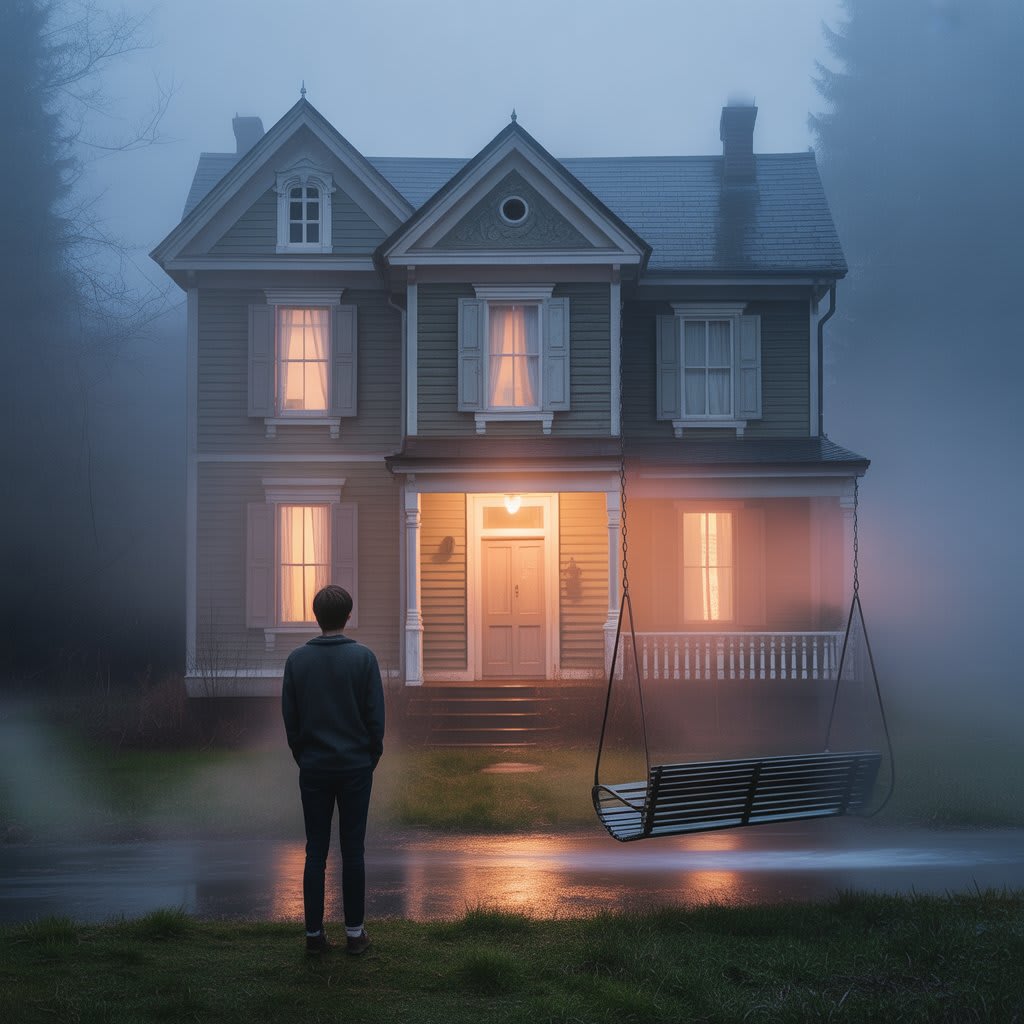
A narrow, two-story house sat quietly at the end of Briar Lane, where there had always been a vacant lot. Its windows glowed with a soft amber light, as though a fire crackled inside. The porch swing rocked despite the still air. Something about it made my chest ache with a strange mixture of fear and comfort.
I blinked, confused. I’d lived in the same neighborhood my entire life. This house wasn’t supposed to exist.
Yet it was impossible to look away.
As I stepped closer, I felt the warmth radiating through the open windows. The scent of cinnamon drifted out, familiar and inviting—like my grandmother’s kitchen, though she had been gone for years. My hand reached toward the doorknob before I consciously realized what I was doing.
Then headlights swept across the street behind me. My mother’s car screeched to a stop. She jumped out, shouting my name with a mix of anger and relief. I turned back, and in that split second the house vanished—like a chalk drawing washed off by rain.
Just the empty lot again.
I convinced myself it was my imagination.
Years passed.
But the house wasn’t done with me.
I saw it again when I was seventeen, standing behind the school gym after learning that my closest friend had moved away without telling me. I didn’t cry—not then, not ever, not if I could help it. But the world tilted strangely, and my throat tightened with a grief I didn’t want to admit.
And there it was.
The house leaned at the edge of the football field, as though it had always belonged there. The amber lights flickered through the windows, bright despite the midday sun. The porch swing moved again, slightly faster this time, as if urging me forward.
My insides twisted. This house wasn’t comforting anymore.
It was waiting.
I backed away, eyes locked on the silhouette of the roofline until I bumped into the chain-link fence. When I looked again, it was gone. Just a stretch of grass and the usual rusted bleachers.
I didn’t tell anyone.
How do you explain a building that only exists when your heart breaks?
I didn’t see the house for nearly a decade after that. Life stayed busy—college, work, a marriage that seemed stable until the day it wasn’t.
The week my ex-husband left, taking half our furniture and all of the warmth with him, I barely slept. The apartment felt like a hollow shell with my heartbeat echoing inside it. I tried holding myself together. I really did.
On the third night, when breathing felt like a chore and the loneliness gnawed at me like an animal, I found myself walking without purpose. Feet dragging along the dimly lit sidewalk, tears I refused to acknowledge blurring everything.
I rounded a corner near the edge of town.
The house stood right in front of me.
And this time it looked different.
The windows were darker, the amber glow pulsing unevenly like a failing heartbeat. The porch swing creaked sharply, back and forth, too quickly—like someone was pushing it from behind. The door was cracked open just enough for me to see a sliver of blackness inside.
The scent of cinnamon was gone. In its place was something metallic, cold, like wet iron.
My sadness deepened instantly, heavy as a stone. I felt it tugging at me, pulling me toward the porch. I took a step. Another.
Then I stopped.
Some part of me—small, buried, but still alive—whispered that if I entered, I wouldn’t come back.
The house wasn’t there to comfort me.
It was feeding on me.
Feeding on my sadness.
Every time it appeared, it had grown stronger. And every time, I had been more vulnerable.
My hand hovered inches from the doorknob when my phone buzzed. A message from my sister:
I know things are hard right now. Want to come over? I’ll make tea.
My breath hitched. Real warmth, real comfort. The kind that didn’t need darkness or magic.
I pulled my hand away.
The house groaned, as if displeased. The swinging stopped. The air grew still and cold.
“I’m not yours,” I whispered.
And before my eyes, the house folded in on itself like a dying shadow, collapsing silently until nothing remained but the cracked pavement and a few drifting leaves.
I still get sad. Everyone does.
But sadness feels different now. It doesn’t devour me. I don’t wander alone at night anymore, and the broken parts of me have soft edges instead of sharp ones.
And the house?
I haven’t seen it since.
I don’t know if it’s gone forever or just waiting somewhere in the dark, patient as grief itself.
But if it appears again, I think I’ll be ready.
Because now I know something I didn’t know before:
Houses built from sadness can only survive if you keep walking inside.
About the Creator
Hasnain Shah
"I write about the little things that shape our big moments—stories that inspire, spark curiosity, and sometimes just make you smile. If you’re here, you probably love words as much as I do—so welcome, and let’s explore together."
Keep reading
More stories from Hasnain Shah and writers in Fiction and other communities.
Dial 999 for Your Future Self
Dial 999 for Your Future Self By Hasnain Shah It started with a sticker on the inside of a bus shelter. The kind you usually ignore—cheap print, curled edges, probably someone’s attempt to advertise miracle weight-loss pills or forbidden streaming sites. But this one caught my eye because it said only four words:
By Hasnain Shah3 months ago in Fiction




Comments
There are no comments for this story
Be the first to respond and start the conversation.