
The House That Changed Its Doors
Every night, the doors in the old mansion rearranged—and the family inside couldn’t find their way out.
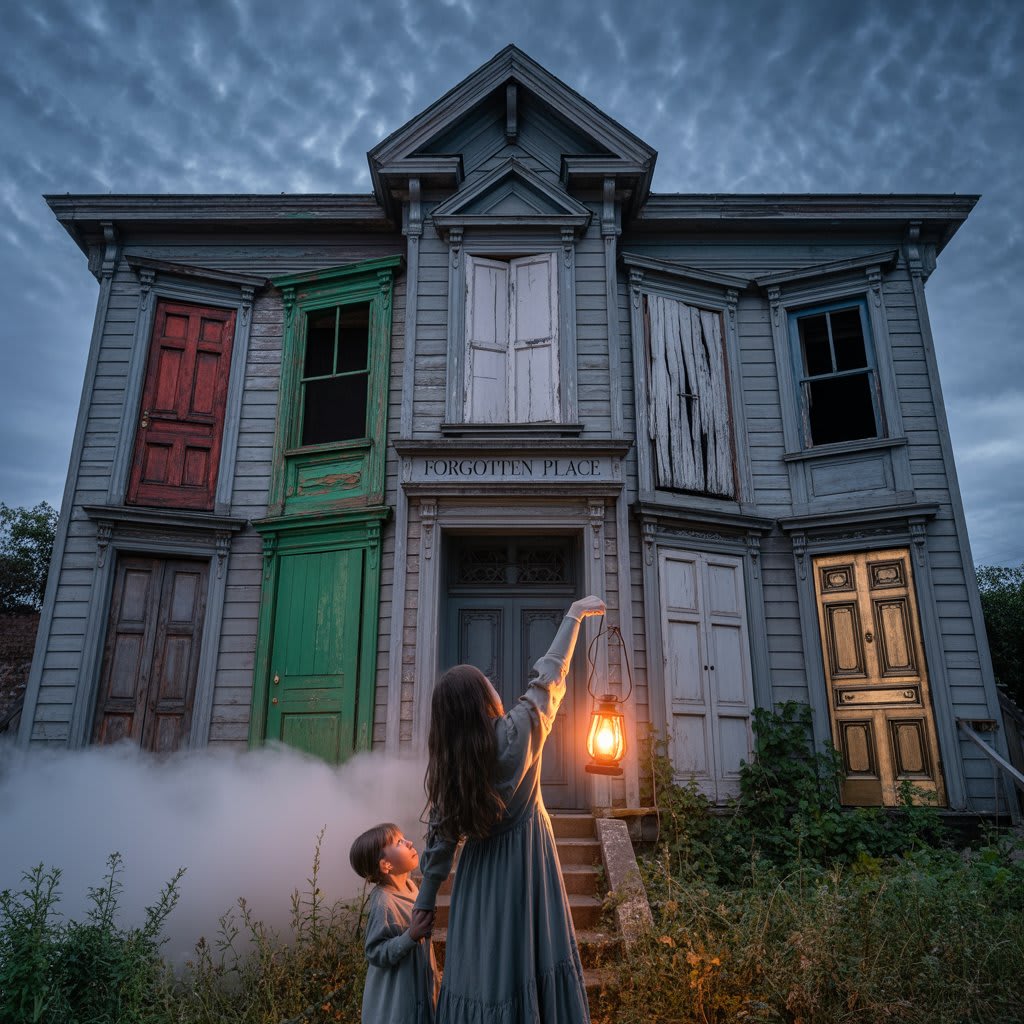
The house on Ash Fern Road had been empty for 47 years. Ivyith no history on record? That’s not a bargain, it’s a warning.”
Meredith laughed it off. Ghost stories didn’t pay the bills. This house, however, had four bedrooms, a library, a garden, and space for her son, Noah, to play.
It was perfect.
At least in the daylight.
The first door moved on the third night.
Meredith awoke at 2:43 a.m. to get a glass of water. She turned left from her bedroom, as always, toward the kitchen. Instead, she stepped into a narrow hallway filled with shelves.
Books.
Floor to ceiling.
She blinked, confused.
It was the library.
But that should’ve been two rooms over.
Shrugging it off, she figured she had turned the wrong way in her groggy state.
She didn’t mention it.
The next night, the bathroom wasn’t behind the blue door anymore.
It was a brick wall.
Noah woke her at 3:12 a.m., tugging at her sleeve. “Mommy, my door changed.”
“Go back to sleep,” she whispered.
“I saw a new one. It was red. I think it was watching me.”
By the end of the first week, Meredith wasn’t sure where anything was anymore.
The house seemed to breathe in its sleep, shifting its bones when no one was looking.
The kitchen swapped with the study. The front door disappeared one night and returned in the attic the next morning. Some doors vanished entirely, replaced by smooth walls or empty archways.
She tried to draw a floor plan.
It changed every night.
The only constant was Noah’s room—it never moved. The door was always green. Always at the top of the stairs. Always open, as if the house respected the boy more than the mother.
Or feared him.
Desperate, Meredith installed cameras. But each morning the footage was static between midnight and dawn. Her phone showed nothing. The electrical readings blinked and crackled like Morse code from another world.
Still, she stayed.
Because nowhere else would take them.
And because, deep down, some part of her was fascinated.
One night, she left sticky notes on every door.
“This was the kitchen.”
“This leads to laundry.”
“DO NOT OPEN AFTER MIDNIGHT.”
In the morning, the notes were rearranged, but one had something written beneath it.
Scrawled in tiny, perfect cursive:
“You are the stranger here. Not us.”
Noah became quieter.
He began talking to the house.
“Goodnight, East Wing,” he would say, placing a toy car by a new door. “You did good today.”
Once, Meredith found him whispering into the keyhole of a door with no knob.
“What are you doing?”
“I’m telling it my dream so it knows where not to take us.”
“Who told you that?”
He looked up, eyes wide. “The house.”
On the 23rd day, the mirror in the hallway showed a door that didn’t exist behind her.
When she turned around, it was there.
A tall, narrow wooden door with iron hinges and a black handle shaped like an open eye.
Something about it felt… final.
She didn’t open it.
That night, Noah disappeared.
She searched the whole house—every room, every door, even the attic with its damp beams and dusty rafters.
She screamed until her voice cracked.
The house stayed silent.
Then, around 4 a.m., she opened what used to be the coat closet.
Noah was inside.
Asleep.
Wrapped in blankets that weren’t theirs.
“They were kind,” he said. “They just wanted to meet me.”
“Who?”
“The doors.”
Meredith decided to leave the next day.
But there was no front door anymore.
Only 13 others.
All different colors.
All closed.
She tried them all.
Some opened into old rooms.
Some opened into nothing—just black space, like falling without end.
One opened into a copy of her childhood bedroom.
Another showed her standing on the other side, older, crying.
She closed that one quickly.
By the 40th day, she gave up.
They had food. The house made sure of that. It grew things in the garden overnight—fruits she couldn’t name, vegetables shaped like spirals. The water was always clean. The air smelled of books and earth.
She started to wonder: Was it really a house?
Or a being?
A creature of doors and choices and passageways?
Noah began drawing the doors.
Pages and pages of them.
Each had a name.
“The Listening Door.”
“The Door of Sighs.”
“The Door That Remembers.”
Meredith asked if he was afraid.
He said no.
“They’re just lonely,” he explained. “They used to go everywhere. But then the world forgot about them.”
She didn’t understand.
“Mom,” he said gently, “this isn’t a haunted house. It’s a house that got lost.”
On the 61st night, the iron-hinged door returned.
The one shaped like an eye.
It was in her bedroom now.
This time, it was open.
A note lay on her bed.
“You may leave. But not unchanged.”
She stepped forward.
Noah beside her.
The house didn’t creak or groan. It just... waited.
She held her son’s hand and stepped through.
The sunlight on the other side was warmer than she remembered.
They stood in front of the house.
But it was older now. Crumbling.
As if decades had passed.
The road was overgrown.
The world was… quieter.
She pulled Noah into her arms, heart pounding.
“Are we home?” she whispered.
He looked around.
“No,” he said. “But maybe they are.”
Author's Note:
Some houses are built to be lived in. Others are built to remember, to hide, or to wait. This one… waited for someone who would understand its doors.
About the Creator
Keep reading
More stories from Atta Ullah and writers in Fiction and other communities.
When the Sky Forgot the Stars
When the Sky Forgot the Stars It happened on a Thursday. Not the day of an apocalypse or a war—just a simple, quiet Thursday. The kind of day you forget before it’s even finished. That evening, people looked up and blinked in confusion.
By Atta Ullah7 months ago in Fiction
Mirror on the Wall
GillVille Drive was a quiet neighbourhood with recently paved roads, manicured lawns, a playground and soccer field, and houses much too large and extravagant for the average person to afford. Some houses had two garages, third floor balconies, backyard ponds, and one even had solar lights in the shape of owls and pinecones lining the walkway to its massive oak front door. This such house was the left half of a duplex. The other half was unoccupied, but balloons of yellow, white, and blue brushed against each other softly in the wind. On each balloon was written the words “open house” with too many exclamation marks. The balloons looked cheap and informal. They stood out for that reason. Two of the yellow ones had already popped. They dangled limply on their string.
By Gillian Corsiattoabout 12 hours ago in Fiction


Comments
There are no comments for this story
Be the first to respond and start the conversation.