

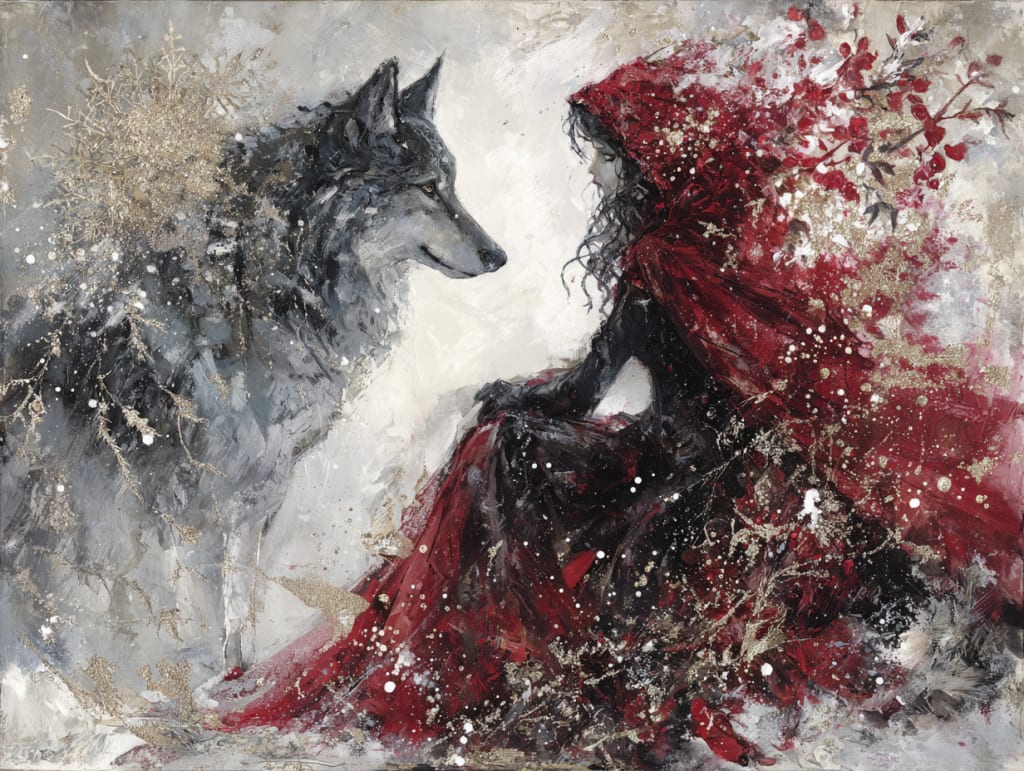
She had never liked the woods. Even as a child, when the stories were still just stories whispered by the hearth in the dead of winter, she felt something behind the trees watching her; some presence crouched in the shadows, too patient to ever be seen fully.
She told herself it was superstition, the same way you might tell yourself the wind at night is just the wind and not a voice calling your name in a tongue older than the trees themselves.
But standing at the edge of the path now, her red cloak hanging too heavily on her shoulders, as though it were trying to pin her to the earth, she knew that even if the Wolf was only an idea, it was an idea that could eat you alive, an idea that could slip between your ribs and nest there forever.
“Go straight there and come straight back,” her mother had said, the same way she always did, her face lined with worry that had nothing to do with the length of the walk. But this time, her mother hadn’t met her eye.
This time, her mother had tied the cloak around her throat with hands that trembled and then turned away too quickly, as though she suspected, no, expected, that the girl would fail. That the lure of the dark would prove too strong, as it always had for their kind.
She tightened her grip on the basket. Inside, the bread and herbs shifted softly, the linen folded over them as if to protect their fragile purpose. They were real enough, tangible, a weight she could feel pressing into her palm. She thought that should be reassuring, a simple anchor to ordinary things, but it wasn’t. It only reminded her how easily real things could be lost.
The first part of the path was familiar. She counted the pines in her head; fourteen on the right, seventeen on the left, the crooked one with a split trunk that looked like a mouth yawning wide enough to swallow a person.
That tree had always unsettled her, even when she was small, and she used to squeeze her eyes shut when she passed it. But today, she did not close her eyes.
Today, she stopped in front of it.
The split trunk gaped at her, dark and hollow. She felt as though if she leaned close enough, she would hear something breathing inside, and worse still, it would know her name.
Somewhere in the shadows beyond the tree, a branch cracked, a brittle sound that sliced through the hush like a blade through silk.
She told herself it was nothing, that the wind had done it, or some small creature rooting in the dead leaves.
She did not move.
The path ahead blurred at the edges, as though the forest were drawing a veil over her eyes. She lifted her chin, scanning the trees, waiting for a shape to step out, a grey flank, yellow eyes, teeth like knives.
But nothing came. No monster appeared to justify her dread. Only the silence pressed closer, thick and expectant, as though the whole wood was holding its breath.
Ten more steps, she told herself. Just ten steps and you’ll be past it.
She did not make it ten.
At the seventh step, something brushed her ankle, cold and delicate as a fingertip, and she recoiled as though it had burned her. Heart hammering in her throat, she looked down, expecting to see a vine or a root curling around her boot. But there was nothing.
Nothing.
Not real, she thought. Just a story, a suggestion.
She began to walk again, faster this time, her breath hitching with each step.
She knew the Wolf wasn’t real. Everyone knew that, and yet everyone acted as if he was, because it didn’t matter whether he had fur and teeth or whether he was just the shape you saw in the dark when you closed your eyes. The caution had teeth. The caution had claws.
And if you believed in him long enough, if you whispered about him enough, he began to believe in you, too.
She reached her grandmother’s house by noon, though it felt as though a year had passed while she walked. The roof sagged under the weight of moss and time, and the windows looked blind, two blank eyes that reflected nothing back at her.
She hated the house almost as much as she hated the forest.
She knocked once. No answer.
“Grandmother?” she called, her voice stretched thin, as though the walk had wrung all the substance out of it.
Nothing.
She tried the latch. It opened easily, almost as though someone had been waiting for her.
Inside, the air smelled stale; like earth and old cloth and something else she couldn’t name. A sweetness gone rotten.
She set her basket down on the warped table and crept to the bedroom door, pressing her palm against the rough wood before she dared open it.
“Grandmother?”
From the dark beyond the threshold came a voice, low and calm in a way that made her feel colder than any shout could have:
“Come in, child.”
She did.
The shape in the bed was covered to the chin, the blankets rising and falling in a steady rhythm that almost convinced her it was an ordinary sickness. Only the top of the head showed, white hair fanned across the pillow in a tangled halo.
Her fingers curled against her skirt.
“Are you unwell?” she asked.
“Only tired,” the voice answered.
Something in it was wrong. Too patient. Too sure.
“Why is it so dark?” she whispered.
The figure shifted, and the blanket slipped an inch. She thought she saw the glint of an eye, yellow as old bruises, watching her without blinking.
“Because the better to see you with,” it murmured, the words soft as a lullaby and twice as dangerous.
She took a step back, her heel catching on a loose board.
“Grandmother?”
The shape moved again, almost a sigh of amusement.
Then the covers slid away all at once, as though an invisible hand had yanked them down.
There was nothing there.
No body. No Wolf. No sign that anyone had ever lain in that bed except the hollow pressed into the mattress, still warm as she reached out her hand and recoiled again before she could touch it.
She backed into the doorframe, her breath coming in ragged gasps, the room tilting around her as if she had stepped onto a ship in a storm. She felt dizzy, unmoored, as though her bones had turned to dust inside her skin.
Not real, she thought again. But her legs refused to obey her.
Behind her, the air shifted, cold and restless, and she turned just in time to see a shadow slip across the far wall. A silhouette narrow at the muzzle, broad at the shoulders, its movements almost lazy.
Gone.
She stared at the blank wall until her eyes watered, waiting for it to come back.
Her grandmother was nowhere in the house. No note. No sign of struggle. Only the suggestion that something had been here and chosen to leave no evidence of itself except the dread clamped around her lungs.
She tried to call out again, but her voice cracked and fell apart in her throat.
Slowly, she left the bedroom. She made herself pick up the basket, its ordinary weight now grotesque in her hands, and walked back out into the wan daylight.
But she could not shake the feeling that the Wolf, whatever the Wolf was, had brushed against her when she passed, invisible but... there.
Not real, she thought. But it didn’t matter.
Because when she closed the door behind her, she felt the weight of the absence more keenly than she had ever felt the weight of any presence, as though the nothing itself had reached into her chest and stolen something she would never get back.
She did not go straight home.
She told herself she was looking for her grandmother, that she would find her somewhere along the path or in the clearing by the old stone well. She told herself she was being brave.
But in the hidden corners of her mind, she knew she was circling the thing she feared, hoping it would appear so she could prove she had not imagined it, so she could finally understand whether it was only an echo or something real enough to swallow her.
Halfway down the path, she saw tracks in the mud, each print nearly the length of her forearm, four-toed and deep enough to pool with water.
They vanished into the undergrowth as though whatever had left them had simply dissolved.
She followed them anyway.
The deeper she went, the less she recognized. The trees grew close together, their trunks crowding in until the last threads of daylight were strangled to nothing and the world turned a colourless grey. The hush thickened until her own heartbeat sounded foreign to her, like the drumming of something else hidden behind her ribs.
Somewhere far behind her, the path ended.
But she did not turn back.
It felt like hours before she came to the clearing.
A single stone stood in the centre, veined with cracks that glowed faintly in the gloom, as if some ember burned just beneath the surface. Symbols she could not read were carved into every side, twisting lines that seemed to move when she didn’t look directly at them.
At the base of the stone lay a scrap of red cloth.
She went to her knees without meaning to, her legs folding as if someone had cut the strings that held her up. Her hands shook as she picked up the fabric, recognizing the corner of her grandmother’s shawl by touch alone.
The air in the clearing shivered, as though the trees were exhaling.
She looked up.
The Wolf was there.
Grey as fog, its body flickering around the edges, as though it were stitched together from every shadow she’d ever fled. Its eyes glowed with a quiet intelligence that made her want to weep.
She tried to speak, but no sound emerged.
For a long moment, neither of them moved. She thought that if she could only reach out, only touch it, she would understand whether it was real.
But she could not.
Because some part of her believed that if she touched it, she would never be able to let go.
Instead, she did the only thing she could. She laid the scrap of cloth on the stone and bowed her head.
“I know you,” she whispered, and the words tasted like surrender.
The Wolf blinked, slow and solemn, and then stepped backward into the darkness.
It dissolved like smoke.
She waited there until night fell, but it did not return.
When she finally found her way back to the path, she felt as though she had been scooped hollow, emptied of everything but the echo of that shape, that almost-presence that was real enough to mark her forever.
When she reached her mother’s house, she did not speak of what she had seen. She did not say that her grandmother was gone.
Because she did not know which was worse: to believe that something monstrous had taken her, or to believe that there was nothing there at all.
That a shadow could unmake a person simply by being almost real.
About the Creator
Diane Foster
I’m a professional writer, proofreader, and all-round online entrepreneur, UK. I’m married to a rock star who had his long-awaited liver transplant in August 2025.
When not working, you’ll find me with a glass of wine, immersed in poetry.
Keep reading
More stories from Diane Foster and writers in Fiction and other communities.
Voyage to Isla de Muertos
Captain Jack Sparrow never thought he’d lay eyes on Isla de Muertos again. The black silhouette of the island rose from the sea like a nightmare made of stone, unchanged by time or tempest. The jagged cliffs caught the dawn light, throwing long, uncanny shadows across the waves, as if the island itself were a living thing, waiting patiently for him to come crawling back. Which, admittedly, was rather rude of it.
By Diane Foster8 months ago in Fiction
Door of Secrets
I knew the moment I touched the handle that I wasn’t supposed to open that door. The hallway was silent. Too silent. The old house had many rooms, but this door was different from the others. It stood at the very end of the corridor, hidden behind a faded curtain like something the house itself was trying to forget.
By imtiazalam8 days ago in Fiction


Comments
There are no comments for this story
Be the first to respond and start the conversation.