
"The Hen, the Cave, Remorse"
"The Hen Who Was Bitten, Forgotten, and Finally Remembered"

To Be Remorseful
One warm afternoon, beneath the rustle of dry leaves and the fading hum of the sun, a poor hen wandered too close to the forest edge. There, hidden in the cool shadow of a rock, a snake struck. The bite came fast, a blur of fang and pain. The venom spread like cold fire through her veins. Dizzy, trembling, she limped toward the coop where she had grown up, where she'd laughed, laid eggs, and clucked in the comfort of sisterhood.
When she reached the door of the chicken room—her safe place—she collapsed. Her breathing was shallow, her eyes pleading.
“I’ve been bitten,” she gasped. “I need to rest.”
But the other hens looked at her, alarmed. Their feathers puffed with fear, not compassion. One stepped forward. “If you stay here, we’ll get poisoned too! Go, go before it spreads!”
“I’m not contagious,” she whispered, barely able to lift her head. “It’s a snakebite. Please. I only need to rest.”
But fear is a cold god. Another hen clucked sharply, “It’s not our fault you went too far. You should’ve been more careful.”
She begged. “Please. My leg is broken. I can’t walk far.”
No one moved to help her. They turned their backs and preened their feathers, pretending they didn’t hear the sob in her voice.
And so, with the last of her strength, the hen rose. The pain made her vision blur. Her broken leg dragged behind her, her body trembling with fever. Step by step, she left, and with each step, a tear dropped to the earth, soaking into the soil like tiny seeds of sorrow.
The other chickens watched until she disappeared over the hill.
“Leave it,” one muttered. “She’ll die out there.”
“She brought this on herself,” said another.
Time passed, as it always does.
The sun and moon danced over the hills many times, and the memory of the wounded hen faded like dust in the wind.
Then, one morning, a bird arrived—a little brown sparrow, trembling with excitement.
“I’ve seen her!” the bird cried. “She’s alive! Far away, in a cave under the mountains. She lives alone, eating roots and insects. She has only one leg now, and life is hard for her. She needs your help.”
The chickens looked up. A silence fell, like a sheet of snow.
“She’s your sister,” the bird pleaded. “She needs food. Warmth. Company.”
But one hen shook her head. “I just laid eggs—I can’t leave them now.”
Another clucked, “I finally got a good spot by the window. I can’t be without my blanket.”
“I’m collecting wheat,” said a third, puffing up proudly. “I’m not lazy like her.”
One by one, they found reasons not to go. Not one volunteered.
So the little bird returned to the cave, her wings heavy with disappointment.
More time passed.
The wind turned colder, and the leaves began to fall.
One day, the same bird returned to the chicken room—but this time, her wings did not tremble with hope. Her eyes were dim.
“She’s gone,” she whispered. “Your sister is dead. She died alone in the cave. No one was with her when her breath faded. No one laid flowers. No one sang a mourning song.”
A stillness fell like fog.
No clucking. No shifting. No excuses.
A heaviness settled in their hearts—one heavier than fear, heavier than the snake’s poison. Regret.
Egg-laying stopped. The daily chase for food became hollow. The warm grain lost its flavor.
Each hen, in her own corner, whispered the same question: “Why didn’t I go?”
No one could answer. Guilt turned them quiet.
The next morning, without speaking, the hens gathered at the edge of the chicken room. There was no plan. No leader. They simply began to walk, as if pulled by a force larger than themselves. Over the hills, through the cold wind, past the whispering trees.
Their feet grew tired. Their feathers soaked in rain. But none of them turned back.
When they reached the cave beneath the mountain, their breath caught in their throats.
There was no hen. No body. Just a small stone mound and a single letter, weighted with a feather.
One of the hens stepped forward and read it aloud.
> “To be remorseful,
is to know love too late.
I forgive you.
Not because you earned it,
but because I once called you my sisters.”
Tears fell freely then. One by one, the hens lay down beside the stone. Not to sleep, not to stay—but to weep.
They wept for the hen they had cast out. They wept for their cowardice. For the comfort they chose over compassion.
“We should’ve gone,” one whispered.
“I was scared,” said another. “But I wish I had been brave.”
And in that moment, their silence became a vow.
Back at the chicken room, they no longer mocked the weak. They shared warmth and food. When one hen stumbled, the others helped her rise.
The memory of the one-legged hen, who walked away with tears falling from every step, stayed with them like a sacred song.
Some say the cave still stands. And sometimes, late at night, when the wind is just right, it carries a soft voice that says:
> “To be remorseful
is not enough.
To love,
you must act before the silence.”
About the Creator
Keep reading
More stories from Muhammad Yar and writers in Fiction and other communities.
Hedgehog and snake encounter peacefully.
--- In the quiet heart of a forest, where the canopy filtered sunlight into soft green-gold beams and the scent of damp earth lingered in the air, a peculiar moment was unfolding. Among the fallen leaves and roots, nestled between the undergrowth of ferns and moss, a hedgehog and a snake had found themselves face to face. It was not a dramatic confrontation, nor a violent ambush—at least, not yet. It was a stillness before something, or perhaps a stillness that would pass without incident. It was a frozen point in time that might resolve into movement or dissolve into memory.
By Muhammad Yar9 months ago in Fiction
Lightning Never Strikes Twice
The distant rumble, the sudden deluge, the crescendo of sound, the flash of light, the explosive energy — it never gets old. I became an amateur storm chaser about two years ago. My wife, Cindy suggested it. Sort of. She said, "Alex, you know this cancer is killing me. I've come to terms with that, but you're smothering me. Go join a band, write a book, or become a storm chaser, for all I care. I love you, but you need a hobby."
By Julie Lacksonen6 days ago in Fiction
The Forgetting Room
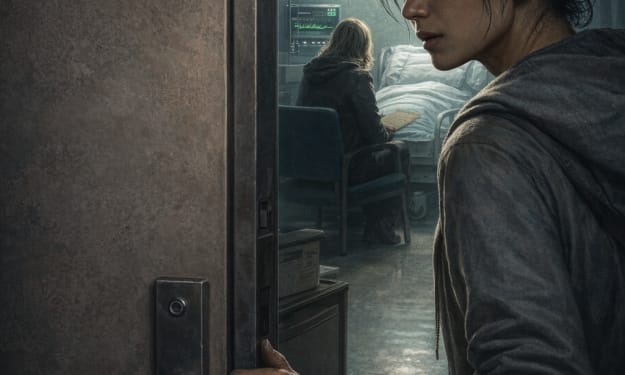
Dr. Sarah Chen stood in the doorway of Room 447, her hand trembling on the cold metal handle. The hospital corridor stretched behind her, fluorescent lights humming their eternal song. She'd been avoiding this room for three weeks, ever since the accident that had stolen eighteen months of her memory.
By Alpha Cortex4 days ago in Fiction



Comments
There are no comments for this story
Be the first to respond and start the conversation.