
The Heart of the Kingdom.
The Day the World Held Its Breath.
July 2029 had arrived over London like a gray flame. The city felt smaller, heavier, as if the air itself had thickened. Streets once crowded with tourists and chatter now echoed only with the footsteps of the few who remained. Airports operated at half capacity, a ghostly hum of machines and departing flights. Foreign nationals, anxious and wary, had returned to their countries in waves. Embassies posted terse bulletins, urging their citizens to leave while they still could. The United Kingdom had become a solitary island in a world that had once regarded it as central, now watching it with suspicion.
Prime Minister Nike Badejo walked through the corridors of Westminster with the precision of someone who measured every word, every gesture, every glance. Her black suit was simple but commanding, her hair pulled back so tightly it seemed to hold her thoughts in place. People either feared her or admired her. There was no in-between. Some whispered that she had hardened after the early months of the war, that the weight of global isolation had carved away any softness in her demeanor. Others said she was exactly what the country needed: unflinching, sharp, and brilliant.
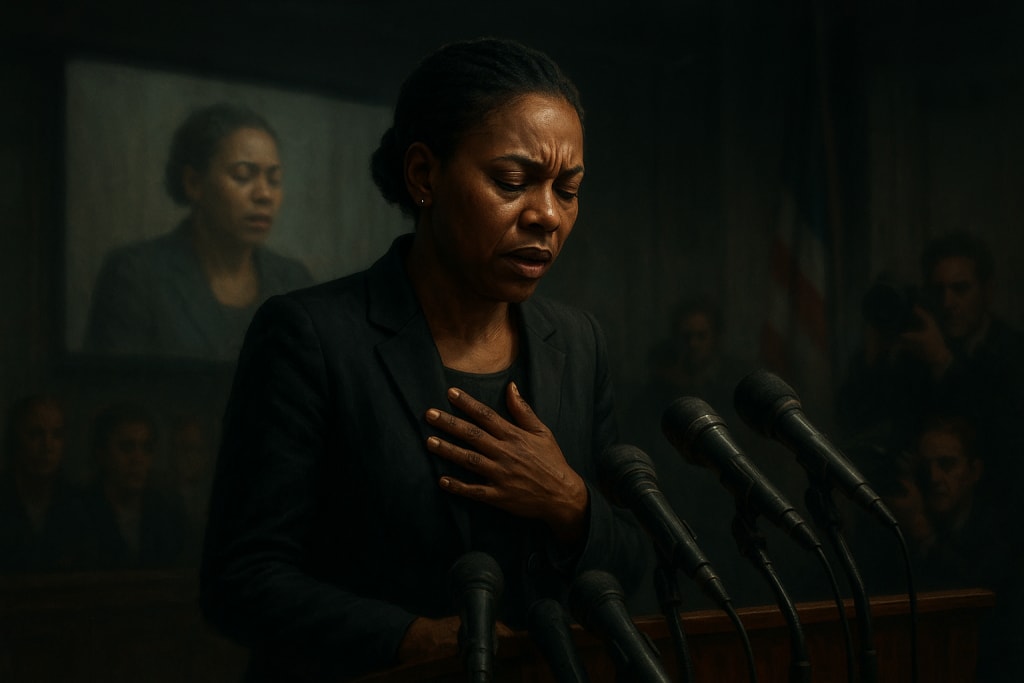
She arrived at the press conference room, the cameras already trained on her. Journalists fidgeted behind microphones, knowing they were on the edge of history. The war had begun six months earlier, a conflict that had grown from political tensions into an international nightmare. Nations that had once been allies now eyed Britain with hostility. Reports of border skirmishes and cyber attacks arrived daily. The threat of escalation was constant. And now here she was, addressing the country with her usual clarity, her voice steady.
Halfway through her speech, she faltered. One hand went to her chest, the other gripping the podium as if it could anchor her to the world. Gasps rippled through the room. Cameras whirred. In a single heartbeat, the news cycle fractured.
Within minutes, the official announcement was released: sudden heart attack. The statement was terse and clinical. Officials moved quickly to control the narrative, to prevent panic. Social media, however, ignored the official line. Cryptic posts hinted at something darker. Whispers of assassination spread through encrypted channels and private forums. Ordinary citizens felt a strange combination of grief and fear, unable to separate truth from speculation.
Across the globe, leaders issued their statements. In Washington, the president spoke with solemn formality, expressing condolences and reaffirming the enduring alliance between the United States and Britain. Paris offered words of respect while subtly noting the necessity of stability in Europe. Moscow remained silent, a quiet presence more threatening than words could convey. Beijing expressed measured sympathy, careful not to betray the tensions beneath the diplomacy.
Inside Britain, the government quaked. Cabinet ministers scrambled to maintain appearances, jockeying for position while projecting unity. The King appeared on television, his tone steady, his expression a mask of control, though a tremor of emotion betrayed the gravity of the moment. Citizens stared at screens in disbelief, their minds struggling to absorb the shock of sudden loss. Panic simmered beneath the surface. Riots threatened in some neighborhoods, while in others, an eerie stillness prevailed.
Then the war ended. Without warning, without explanation, ceasefires were declared. Countries that had been ready to escalate pulled back. Britain, isolated and beleaguered, suddenly regained influence. Analysts scrambled to make sense of the events. Was Nike Badejo’s death the catalyst for peace? Had it been orchestrated as a sacrifice for advantage? The questions multiplied faster than answers could emerge.
A young aide named Amelia stood near the podium the day Nike collapsed. She had spent months observing the prime minister, learning the cadence of her voice, the flicker of emotion in her eyes. Amelia had seen the cracks in the armor no one else noticed, the small moments where exhaustion threatened to overwhelm resolve. Now she watched the chaos unfold, feeling both powerless and keenly aware of the hidden currents shaping history.
Amelia followed the developments closely, piecing together reports, leaks, and fragments of conversation. She understood the machinery of secrecy, the delicate balance of fear and power that guided the nation’s response. She also understood something deeper: Nike Badejo’s presence would linger far longer than her absence. The woman had shifted the trajectory of Britain with intellect, courage, and determination, and her death would not erase the imprint she left on history.
In the days following the announcement, ordinary citizens began to reconcile with the new reality. Streets filled with quiet murmurs as people attempted to make sense of the sudden peace. Markets stabilized, borders reopened, and diplomats engaged with Britain anew. Behind closed doors, ministers toasted in muted celebration, aware that the nation’s regained leverage had come at a staggering cost. Publicly, the narrative remained controlled, the heart attack repeated in headlines, the story of assassination never acknowledged.
Amelia walked past the empty podium each morning, lingering for a moment as if Nike’s spirit might still inhabit the room. She thought about the choices made in silence, about the weight of leadership and the fragile balance between truth and necessity. The city outside moved forward, bustling again with commerce and conversation, yet beneath the surface, the tension of that July lingered like an unspoken memory.
Nike Badejo had been gone only days, but the world had already begun to rearrange itself around her absence. The war that had seemed unstoppable collapsed, alliances shifted, and Britain, though scarred, had regained prominence. People speculated endlessly, historians would debate for decades, and the truth of what had transpired behind closed doors remained locked away in the minds of those who had witnessed it firsthand.
Amelia understood that some stories never ended neatly, that some truths existed only in the spaces between words. She carried the memory of Nike Badejo as both inspiration and warning: the cost of power, the price of vision, and the mystery that often accompanies greatness. The city breathed around her, alive yet fragile, a kingdom poised between chaos and order, shaped forever by a single life cut short and a nation forced to navigate the consequences.
Even as Britain rebuilt its influence on the global stage, the shadow of that July hung in every corner of Westminster, every television broadcast, every whispered conversation. Nike Badejo had vanished, yet she remained present in the hearts of those who had served her and in the currents of history that would never forget her impact. The world had been altered by her presence, and the echo of her absence would reverberate long after the heart attack became an unquestioned fact in official records.
About the Creator
Hottest in the Office
Dear Rafi, You’re very distracting to work around. For the first second I saw you the other day, I thought you were some type of executive. It took a moment to realize no, you were just the new guy, dressed up for the job he wants. Be still, my heart.
By Gabriel Shames6 days ago in Pride



Comments (2)