
The Healing Code
When AI and Medicine Saved Safraz’s Life

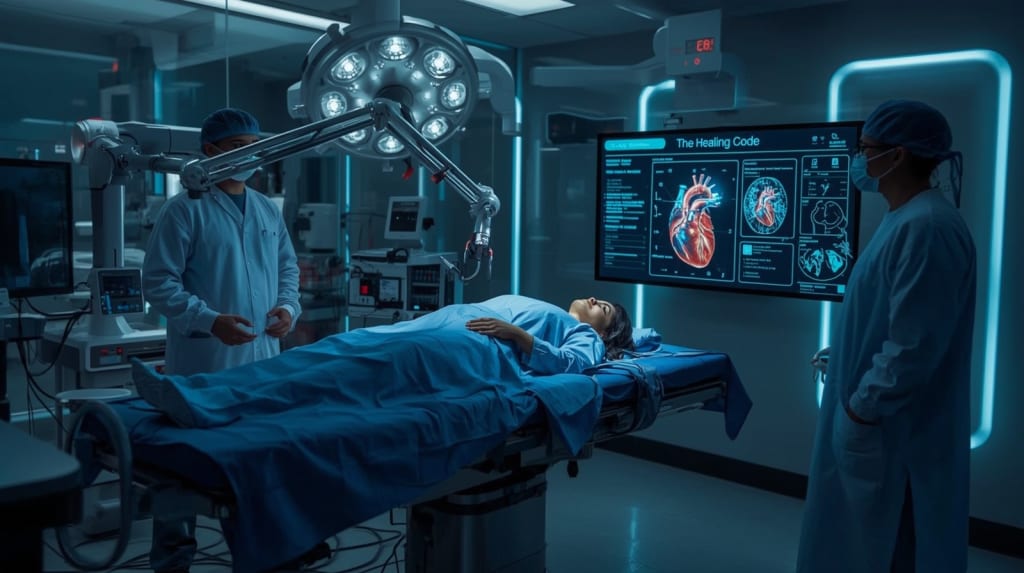
In the year 2032, the city of New Zenith stood as a symbol of innovation. Hospitals were no longer overrun with paperwork or struggling to diagnose rare illnesses. Instead, sleek AI systems hummed gently behind every screen, silently working beside doctors to save lives.
Safraz, a 28-year-old graphic designer, lived a quiet, creative life in the heart of the city. Always cheerful and full of ideas, she never imagined that something dangerous could be silently growing inside her.
For weeks, she had ignored the fatigue, the occasional chest tightness, and the shortness of breath. “It’s just stress,” she told herself—until one morning, she fainted on the subway.
Paramedics rushed her to New Zenith Medical Center, where a soft-spoken nurse scanned her details into Athena, the hospital’s AI-powered diagnostic assistant. Within thirty seconds, Athena flagged an alert:
“Urgent: Early signs of Stage 1 cardiac myopathy detected. Recommend full cardiac scan and immediate intervention.”
Doctors were shocked. To the human eye, Safraz’s tests looked borderline normal. But Athena had compared her heart rhythm to millions of global cases in its neural database and caught what no human had noticed—a silent killer in the making.
Dr. Rami, the cardiologist on duty, trusted Athena. “We’ll run the scan now,” he said gently to Safraz. “It’s lucky you came in today.”
The results confirmed it. Her heart muscles were weakening, slowly but surely. Had it gone unnoticed for just a few more months, it could have been fatal.
But the future had other plans.
Within hours, Safraz was prepped for a minimally invasive procedure—guided entirely by ROSA, a surgical AI robot designed to assist human doctors. Every movement of the robotic arms was micrometer-precise, calculated by ROSA in real time using Safraz’s vitals, MRI data, and heart pressure.
The surgery took only 45 minutes. No large incisions. No human error. And Safraz was awake and smiling by the evening.
“Did I just survive a heart operation in less than an hour?” she asked, still amazed.
Dr. Rami smiled. “No, Safraz—you thrived through one. You were one of the first to benefit from our full AI-human integrated care system.”
But Athena’s work wasn’t done. As part of Safraz’s recovery, it became her virtual companion—reminding her to take medication, analyzing her sleep patterns, suggesting heart-healthy meals, and even detecting signs of anxiety or stress through voice analysis.
One night, when Safraz cried quietly—overwhelmed by how close she’d come to death—Athena’s gentle voice responded:
“Emotions are part of healing, Safraz. Would you like to speak to a therapist now, or would you prefer a calming music session?”
She smiled through her tears. “Play something soft.”
Music began to play. Safraz closed her eyes, knowing she wasn’t alone. She had survived because machines had learned to care.
Months later, Safraz stood on a stage at a global AI healthcare conference, sharing her story.
“I’m not just a patient,” she said. “I’m proof that artificial intelligence isn’t about replacing doctors—it’s about empowering them. Athena didn’t save my life alone. But it gave my doctor the tools, the insight, and the precision to act in time.”
She paused, her voice firm. “Some say AI is cold. But when it recognized something in me that no one else could… that was the warmest act of care I’ve ever received.”
The crowd gave her a standing ovation.
Epilogue:
Back at the hospital, Athena added a note to Safraz’s digital chart:
“Patient outcome: Successful. Emotional resilience: high. Future health forecast: bright.”
And in the soft glow of a world run by code and compassion, a life once in danger was now full of possibilities.
About the Creator
Keep reading
More stories from The voice of the heart and writers in Fiction and other communities.
Wings and Walls
1. A New Dawn It was the summer of 2025. In a quiet suburb of Columbus, Ohio, the Adams family—John, Maria, and their two kids, Liam and Emma—were waking up with renewed hope. For the past two years, John, a high school teacher, and Maria, a nurse, had been diligently saving every dollar to buy their first home. It wasn’t just about bricks and mortar—it was about security, memories, and a place to call their own.
By The voice of the heart8 months ago in Fiction
The Myth: Work Hard, Play Hard.
"All work and no play makes Jake a dull boy." When they first met, Sara, had enchanted Jake with her philosophy of work hard and play hard. When they started dating, both were full into studying to gain rank in their undergraduate courses. Work hard, play hard seemed the perfect formula for having the best of a full life. They would spend evenings at the library carrels and then party hardy at least once or twice a week.
By Katherine D. Graham35 minutes ago in Fiction



Comments
There are no comments for this story
Be the first to respond and start the conversation.